

280
Appendix A: Some More Background
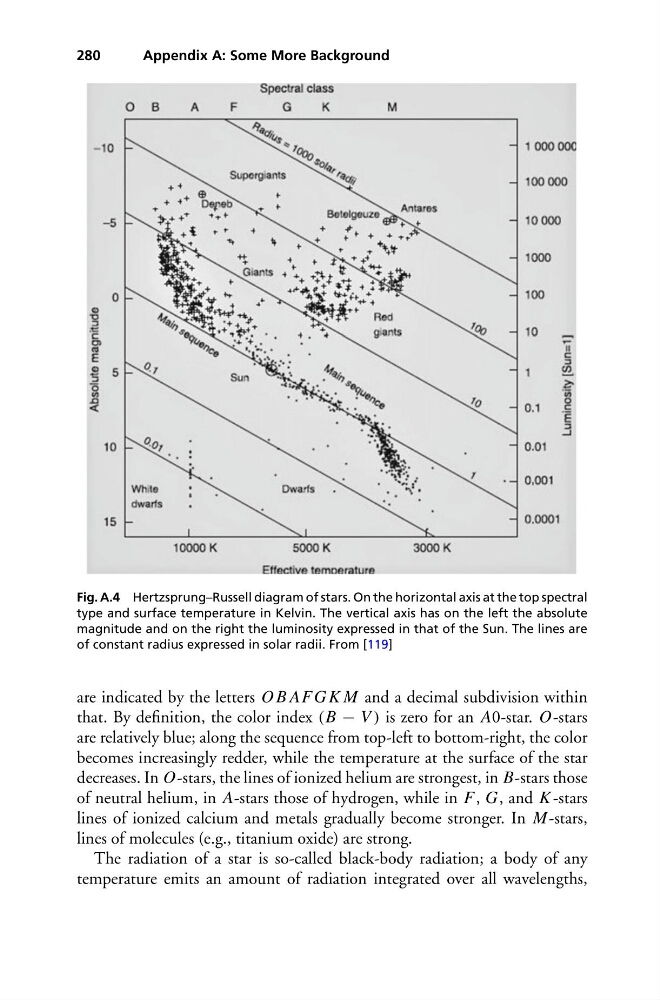
Fig. A.4 Hertzsprung–Russell diagram of stars. On the horizontal axis at the top spectral
type and surface temperature in Kelvin. The vertical axis has on the left the absolute
magnitude and on the right the luminosity expressed in that of the Sun. The lines are
of constant radius expressed in solar radii. From [119]
are indicated by the letters O B AFG K M and a decimal subdivision within
that. By definition, the color index (B − V ) is zero for an A0-star. O-stars
are relatively blue; along the sequence from top-left to bottom-right, the color
becomes increasingly redder, while the temperature at the surface of the star
decreases. In O-stars, the lines of ionized helium are strongest, in B-stars those
of neutral helium, in A-stars those of hydrogen, while in F, G, and K -stars
lines of ionized calcium and metals gradually become stronger. In M-stars,
lines of molecules (e.g., titanium oxide) are strong.
The radiation of a star is so-called black-body radiation; a body of any
temperature emits an amount of radiation integrated over all wavelengths,
Appendix A: Some More Background
Fig. A.4 Hertzsprung–Russell diagram of stars. On the horizontal axis at the top spectral
type and surface temperature in Kelvin. The vertical axis has on the left the absolute
magnitude and on the right the luminosity expressed in that of the Sun. The lines are
of constant radius expressed in solar radii. From [119]
are indicated by the letters O B AFG K M and a decimal subdivision within
that. By definition, the color index (B − V ) is zero for an A0-star. O-stars
are relatively blue; along the sequence from top-left to bottom-right, the color
becomes increasingly redder, while the temperature at the surface of the star
decreases. In O-stars, the lines of ionized helium are strongest, in B-stars those
of neutral helium, in A-stars those of hydrogen, while in F, G, and K -stars
lines of ionized calcium and metals gradually become stronger. In M-stars,
lines of molecules (e.g., titanium oxide) are strong.
The radiation of a star is so-called black-body radiation; a body of any
temperature emits an amount of radiation integrated over all wavelengths,