

12.4 Kapteyn and Shapley
263
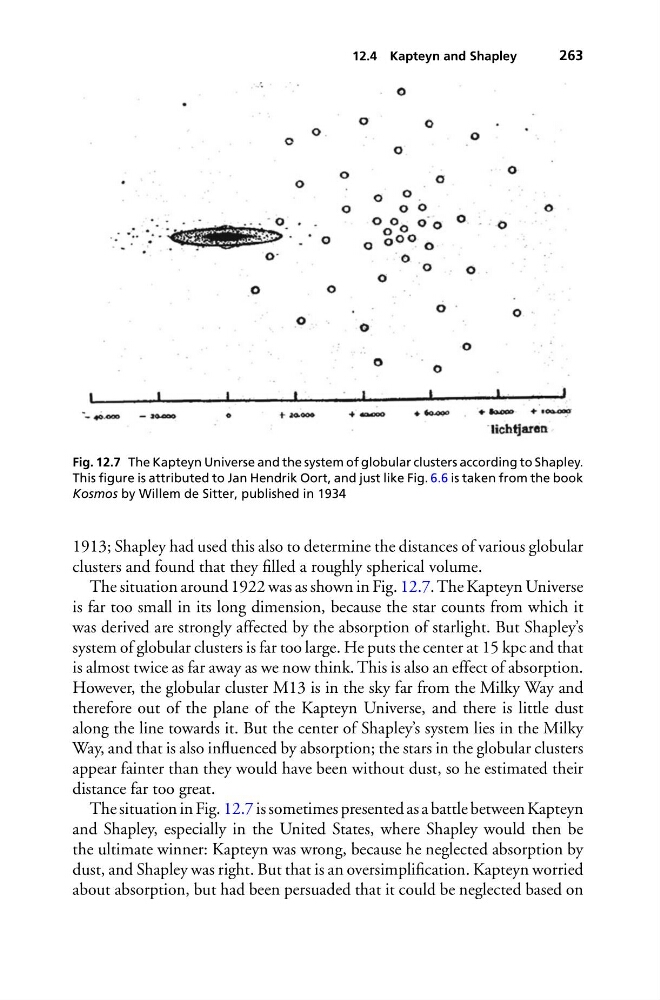
Fig. 12.7 The Kapteyn Universe and the system of globular clusters according to Shapley.
This figure is attributed to Jan Hendrik Oort, and just like Fig. 6.6 is taken from the book
Kosmos by Willem de Sitter, published in 1934
1913; Shapley had used this also to determine the distances of various globular
clusters and found that they filled a roughly spherical volume.
The situation around 1922 was as shown in Fig. 12.7. The Kapteyn Universe
is far too small in its long dimension, because the star counts from which it
was derived are strongly affected by the absorption of starlight. But Shapley’s
system of globular clusters is far too large. He puts the center at 15 kpc and that
is almost twice as far away as we now think. This is also an effect of absorption.
However, the globular cluster M13 is in the sky far from the Milky Way and
therefore out of the plane of the Kapteyn Universe, and there is little dust
along the line towards it. But the center of Shapley’s system lies in the Milky
Way, and that is also influenced by absorption; the stars in the globular clusters
appear fainter than they would have been without dust, so he estimated their
distance far too great.
The situation in Fig. 12.7 is sometimes presented as a battle between Kapteyn
and Shapley, especially in the United States, where Shapley would then be
the ultimate winner: Kapteyn was wrong, because he neglected absorption by
dust, and Shapley was right. But that is an oversimplification. Kapteyn worried
about absorption, but had been persuaded that it could be neglected based on
263
Fig. 12.7 The Kapteyn Universe and the system of globular clusters according to Shapley.
This figure is attributed to Jan Hendrik Oort, and just like Fig. 6.6 is taken from the book
Kosmos by Willem de Sitter, published in 1934
1913; Shapley had used this also to determine the distances of various globular
clusters and found that they filled a roughly spherical volume.
The situation around 1922 was as shown in Fig. 12.7. The Kapteyn Universe
is far too small in its long dimension, because the star counts from which it
was derived are strongly affected by the absorption of starlight. But Shapley’s
system of globular clusters is far too large. He puts the center at 15 kpc and that
is almost twice as far away as we now think. This is also an effect of absorption.
However, the globular cluster M13 is in the sky far from the Milky Way and
therefore out of the plane of the Kapteyn Universe, and there is little dust
along the line towards it. But the center of Shapley’s system lies in the Milky
Way, and that is also influenced by absorption; the stars in the globular clusters
appear fainter than they would have been without dust, so he estimated their
distance far too great.
The situation in Fig. 12.7 is sometimes presented as a battle between Kapteyn
and Shapley, especially in the United States, where Shapley would then be
the ultimate winner: Kapteyn was wrong, because he neglected absorption by
dust, and Shapley was right. But that is an oversimplification. Kapteyn worried
about absorption, but had been persuaded that it could be neglected based on