

12.2 Reorganization of the Sterrewacht Leiden
257
its research program and organizing the interface with Dutch astronomy. De
Sitter argued that the Minister’s attempts at specialization and concentration
could lead to a division of tasks among Dutch universities. He repeated (so
he said) his opinion regarding astronomy, which he summarized as: ‘Leiden
specializes in everything except the specializations of Groningen and Utrecht’.
12.3 Forty Years Professor and Seventieth
Birthday
In 1918 Kapteyn had been a professor for forty years and several friends and
colleagues wanted to celebrate that. Willem de Sitter and Pieter van Rhijn must
have taken the initiative. Funding was raised and the famous painter Jan Pieter
Veth (1864–1925) was commissioned to paint a portrait of Kapteyn. In the
Kapteyn Room at the Kapteyn Astronomical Institute in Groningen—which
contains much of Kapteyn’s books, research materials, his ‘celestial spheres’ and
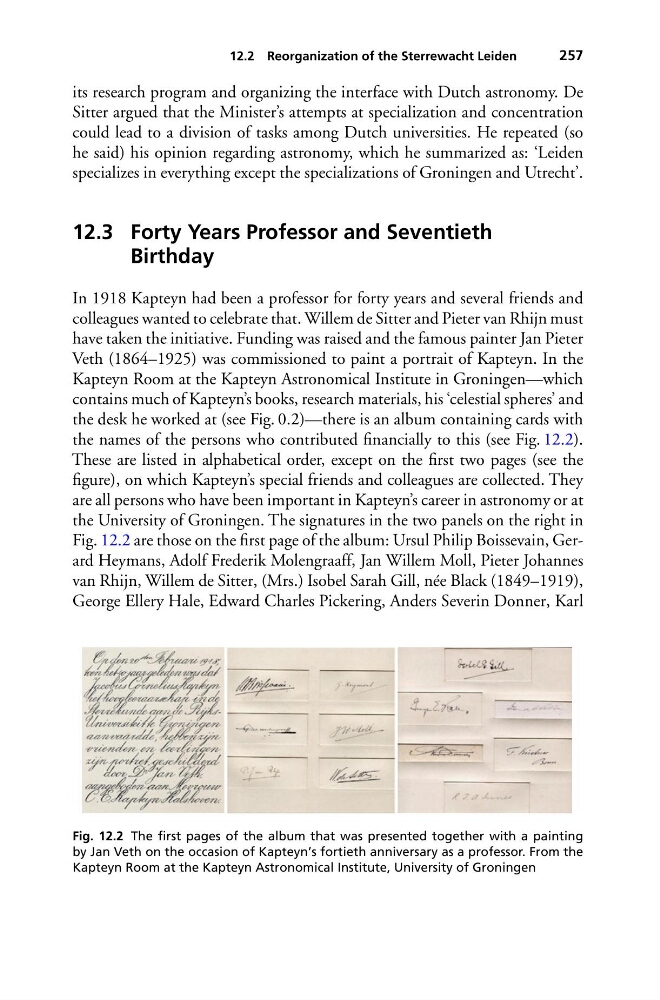
the desk he worked at (see Fig. 0.2)—there is an album containing cards with
the names of the persons who contributed financially to this (see Fig. 12.2).
These are listed in alphabetical order, except on the first two pages (see the
figure), on which Kapteyn’s special friends and colleagues are collected. They
are all persons who have been important in Kapteyn’s career in astronomy or at
the University of Groningen. The signatures in the two panels on the right in
Fig. 12.2 are those on the first page of the album: Ursul Philip Boissevain, Gerard Heymans, Adolf Frederik Molengraaff, Jan Willem Moll, Pieter Johannes
van Rhijn, Willem de Sitter, (Mrs.) Isobel Sarah Gill, née Black (1849–1919),
George Ellery Hale, Edward Charles Pickering, Anders Severin Donner, Karl
Fig. 12.2 The first pages of the album that was presented together with a painting
by Jan Veth on the occasion of Kapteyn’s fortieth anniversary as a professor. From the
Kapteyn Room at the Kapteyn Astronomical Institute, University of Groningen
257
its research program and organizing the interface with Dutch astronomy. De
Sitter argued that the Minister’s attempts at specialization and concentration
could lead to a division of tasks among Dutch universities. He repeated (so
he said) his opinion regarding astronomy, which he summarized as: ‘Leiden
specializes in everything except the specializations of Groningen and Utrecht’.
12.3 Forty Years Professor and Seventieth
Birthday
In 1918 Kapteyn had been a professor for forty years and several friends and
colleagues wanted to celebrate that. Willem de Sitter and Pieter van Rhijn must
have taken the initiative. Funding was raised and the famous painter Jan Pieter
Veth (1864–1925) was commissioned to paint a portrait of Kapteyn. In the
Kapteyn Room at the Kapteyn Astronomical Institute in Groningen—which
contains much of Kapteyn’s books, research materials, his ‘celestial spheres’ and
the desk he worked at (see Fig. 0.2)—there is an album containing cards with
the names of the persons who contributed financially to this (see Fig. 12.2).
These are listed in alphabetical order, except on the first two pages (see the
figure), on which Kapteyn’s special friends and colleagues are collected. They
are all persons who have been important in Kapteyn’s career in astronomy or at
the University of Groningen. The signatures in the two panels on the right in
Fig. 12.2 are those on the first page of the album: Ursul Philip Boissevain, Gerard Heymans, Adolf Frederik Molengraaff, Jan Willem Moll, Pieter Johannes
van Rhijn, Willem de Sitter, (Mrs.) Isobel Sarah Gill, née Black (1849–1919),
George Ellery Hale, Edward Charles Pickering, Anders Severin Donner, Karl
Fig. 12.2 The first pages of the album that was presented together with a painting
by Jan Veth on the occasion of Kapteyn’s fortieth anniversary as a professor. From the
Kapteyn Room at the Kapteyn Astronomical Institute, University of Groningen