

10.2 Statistics
209
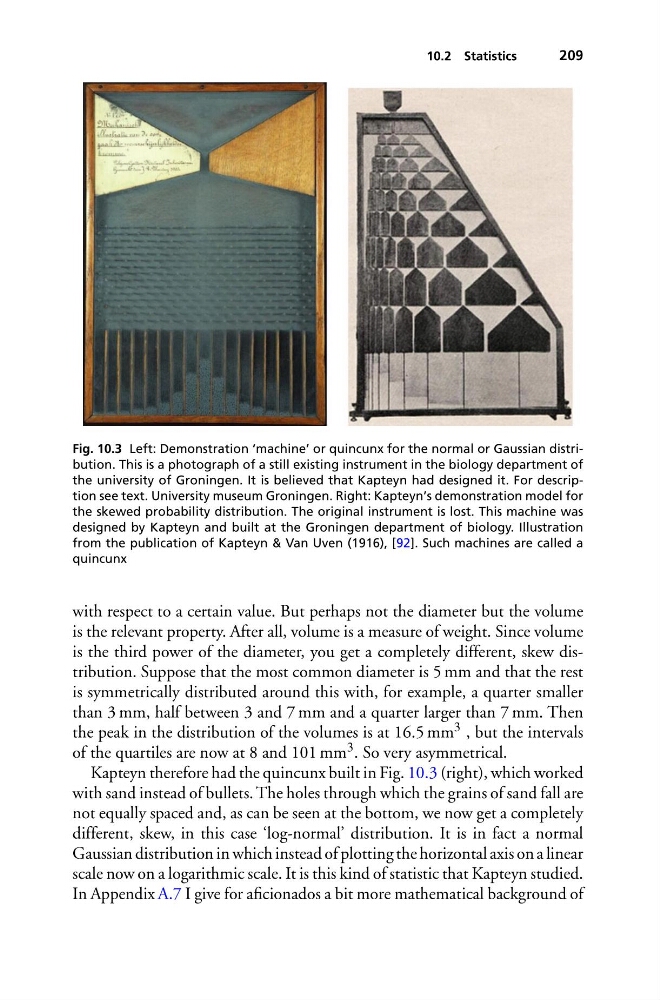
Fig. 10.3 Left: Demonstration ‘machine’ or quincunx for the normal or Gaussian distribution. This is a photograph of a still existing instrument in the biology department of
the university of Groningen. It is believed that Kapteyn had designed it. For description see text. University museum Groningen. Right: Kapteyn’s demonstration model for
the skewed probability distribution. The original instrument is lost. This machine was
designed by Kapteyn and built at the Groningen department of biology. Illustration
from the publication of Kapteyn & Van Uven (1916), [92]. Such machines are called a
quincunx
with respect to a certain value. But perhaps not the diameter but the volume
is the relevant property. After all, volume is a measure of weight. Since volume
is the third power of the diameter, you get a completely different, skew distribution. Suppose that the most common diameter is 5 mm and that the rest
is symmetrically distributed around this with, for example, a quarter smaller
than 3 mm, half between 3 and 7 mm and a quarter larger than 7 mm. Then
the peak in the distribution of the volumes is at 16.5 mm 3 , but the intervals
of the quartiles are now at 8 and 101 mm 3 . So very asymmetrical.
Kapteyn therefore had the quincunx built in Fig. 10.3 (right), which worked
with sand instead of bullets. The holes through which the grains of sand fall are
not equally spaced and, as can be seen at the bottom, we now get a completely
different, skew, in this case ‘log-normal’ distribution. It is in fact a normal
Gaussian distribution in which instead of plotting the horizontal axis on a linear
scale now on a logarithmic scale. It is this kind of statistic that Kapteyn studied.
In Appendix A.7 I give for aficionados a bit more mathematical background of
209
Fig. 10.3 Left: Demonstration ‘machine’ or quincunx for the normal or Gaussian distribution. This is a photograph of a still existing instrument in the biology department of
the university of Groningen. It is believed that Kapteyn had designed it. For description see text. University museum Groningen. Right: Kapteyn’s demonstration model for
the skewed probability distribution. The original instrument is lost. This machine was
designed by Kapteyn and built at the Groningen department of biology. Illustration
from the publication of Kapteyn & Van Uven (1916), [92]. Such machines are called a
quincunx
with respect to a certain value. But perhaps not the diameter but the volume
is the relevant property. After all, volume is a measure of weight. Since volume
is the third power of the diameter, you get a completely different, skew distribution. Suppose that the most common diameter is 5 mm and that the rest
is symmetrically distributed around this with, for example, a quarter smaller
than 3 mm, half between 3 and 7 mm and a quarter larger than 7 mm. Then
the peak in the distribution of the volumes is at 16.5 mm 3 , but the intervals
of the quartiles are now at 8 and 101 mm 3 . So very asymmetrical.
Kapteyn therefore had the quincunx built in Fig. 10.3 (right), which worked
with sand instead of bullets. The holes through which the grains of sand fall are
not equally spaced and, as can be seen at the bottom, we now get a completely
different, skew, in this case ‘log-normal’ distribution. It is in fact a normal
Gaussian distribution in which instead of plotting the horizontal axis on a linear
scale now on a logarithmic scale. It is this kind of statistic that Kapteyn studied.
In Appendix A.7 I give for aficionados a bit more mathematical background of