

9.5 Interstellar Extinction
189
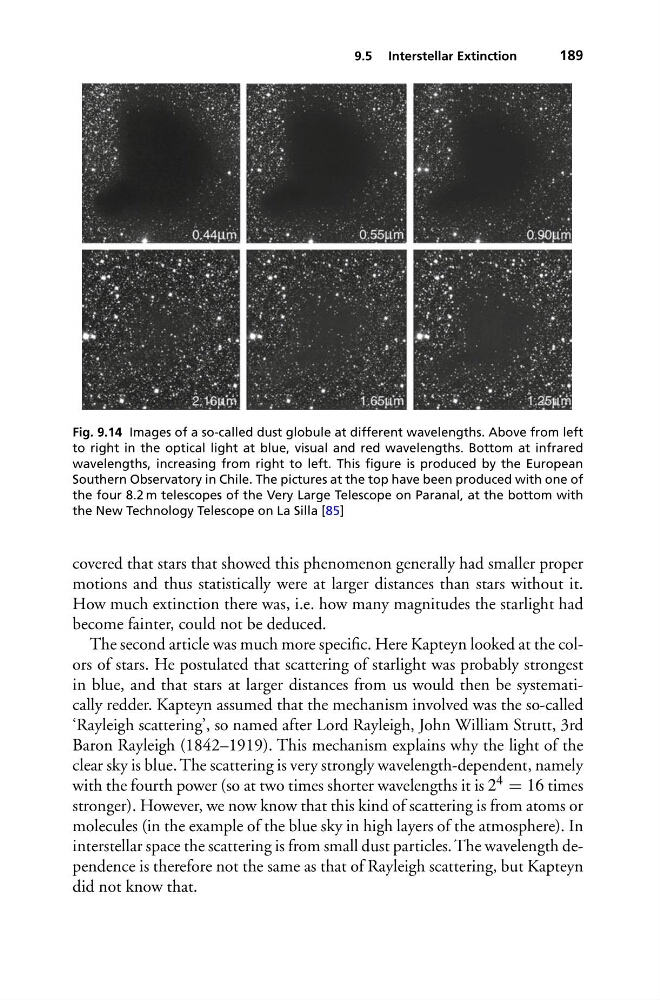
Fig. 9.14 Images of a so-called dust globule at different wavelengths. Above from left
to right in the optical light at blue, visual and red wavelengths. Bottom at infrared
wavelengths, increasing from right to left. This figure is produced by the European
Southern Observatory in Chile. The pictures at the top have been produced with one of
the four 8.2 m telescopes of the Very Large Telescope on Paranal, at the bottom with
the New Technology Telescope on La Silla [85]
covered that stars that showed this phenomenon generally had smaller proper
motions and thus statistically were at larger distances than stars without it.
How much extinction there was, i.e. how many magnitudes the starlight had
become fainter, could not be deduced.
The second article was much more specific. Here Kapteyn looked at the colors of stars. He postulated that scattering of starlight was probably strongest
in blue, and that stars at larger distances from us would then be systematically redder. Kapteyn assumed that the mechanism involved was the so-called
‘Rayleigh scattering’, so named after Lord Rayleigh, John William Strutt, 3rd
Baron Rayleigh (1842–1919). This mechanism explains why the light of the
clear sky is blue. The scattering is very strongly wavelength-dependent, namely
with the fourth power (so at two times shorter wavelengths it is 2 4 = 16 times
stronger). However, we now know that this kind of scattering is from atoms or
molecules (in the example of the blue sky in high layers of the atmosphere). In
interstellar space the scattering is from small dust particles. The wavelength dependence is therefore not the same as that of Rayleigh scattering, but Kapteyn
did not know that.
189
Fig. 9.14 Images of a so-called dust globule at different wavelengths. Above from left
to right in the optical light at blue, visual and red wavelengths. Bottom at infrared
wavelengths, increasing from right to left. This figure is produced by the European
Southern Observatory in Chile. The pictures at the top have been produced with one of
the four 8.2 m telescopes of the Very Large Telescope on Paranal, at the bottom with
the New Technology Telescope on La Silla [85]
covered that stars that showed this phenomenon generally had smaller proper
motions and thus statistically were at larger distances than stars without it.
How much extinction there was, i.e. how many magnitudes the starlight had
become fainter, could not be deduced.
The second article was much more specific. Here Kapteyn looked at the colors of stars. He postulated that scattering of starlight was probably strongest
in blue, and that stars at larger distances from us would then be systematically redder. Kapteyn assumed that the mechanism involved was the so-called
‘Rayleigh scattering’, so named after Lord Rayleigh, John William Strutt, 3rd
Baron Rayleigh (1842–1919). This mechanism explains why the light of the
clear sky is blue. The scattering is very strongly wavelength-dependent, namely
with the fourth power (so at two times shorter wavelengths it is 2 4 = 16 times
stronger). However, we now know that this kind of scattering is from atoms or
molecules (in the example of the blue sky in high layers of the atmosphere). In
interstellar space the scattering is from small dust particles. The wavelength dependence is therefore not the same as that of Rayleigh scattering, but Kapteyn
did not know that.