

144
7 Star Streams
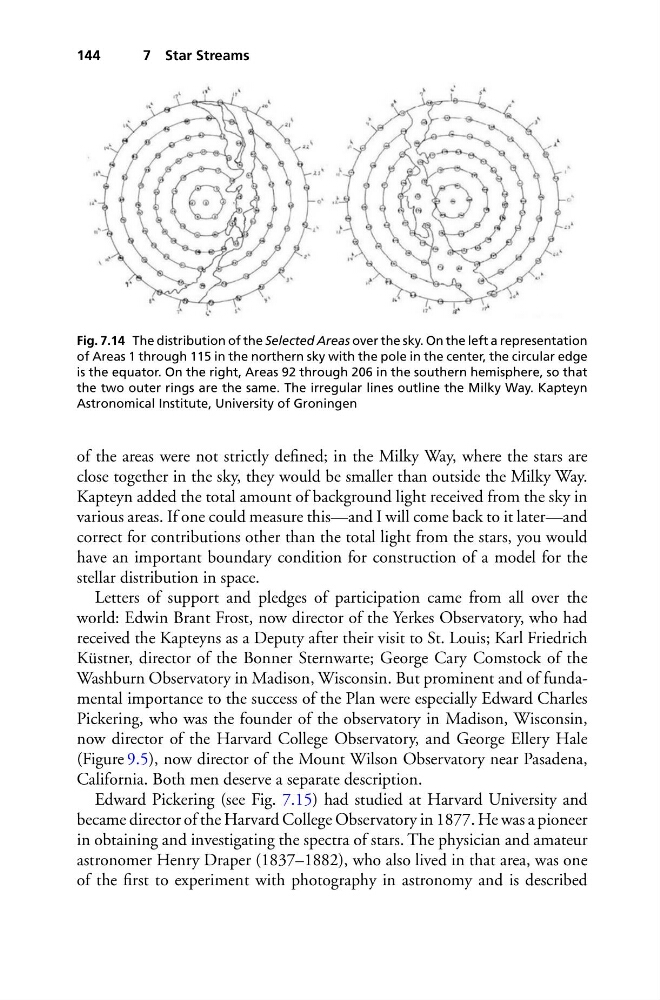
Fig. 7.14 The distribution of the Selected Areas over the sky. On the left a representation
of Areas 1 through 115 in the northern sky with the pole in the center, the circular edge
is the equator. On the right, Areas 92 through 206 in the southern hemisphere, so that
the two outer rings are the same. The irregular lines outline the Milky Way. Kapteyn
Astronomical Institute, University of Groningen
of the areas were not strictly defined; in the Milky Way, where the stars are
close together in the sky, they would be smaller than outside the Milky Way.
Kapteyn added the total amount of background light received from the sky in
various areas. If one could measure this—and I will come back to it later—and
correct for contributions other than the total light from the stars, you would
have an important boundary condition for construction of a model for the
stellar distribution in space.
Letters of support and pledges of participation came from all over the
world: Edwin Brant Frost, now director of the Yerkes Observatory, who had
received the Kapteyns as a Deputy after their visit to St. Louis; Karl Friedrich
Küstner, director of the Bonner Sternwarte; George Cary Comstock of the
Washburn Observatory in Madison, Wisconsin. But prominent and of fundamental importance to the success of the Plan were especially Edward Charles
Pickering, who was the founder of the observatory in Madison, Wisconsin,
now director of the Harvard College Observatory, and George Ellery Hale
(Figure 9.5), now director of the Mount Wilson Observatory near Pasadena,
California. Both men deserve a separate description.
Edward Pickering (see Fig. 7.15) had studied at Harvard University and
became director of the Harvard College Observatory in 1877. He was a pioneer
in obtaining and investigating the spectra of stars. The physician and amateur
astronomer Henry Draper (1837–1882), who also lived in that area, was one
of the first to experiment with photography in astronomy and is described
7 Star Streams
Fig. 7.14 The distribution of the Selected Areas over the sky. On the left a representation
of Areas 1 through 115 in the northern sky with the pole in the center, the circular edge
is the equator. On the right, Areas 92 through 206 in the southern hemisphere, so that
the two outer rings are the same. The irregular lines outline the Milky Way. Kapteyn
Astronomical Institute, University of Groningen
of the areas were not strictly defined; in the Milky Way, where the stars are
close together in the sky, they would be smaller than outside the Milky Way.
Kapteyn added the total amount of background light received from the sky in
various areas. If one could measure this—and I will come back to it later—and
correct for contributions other than the total light from the stars, you would
have an important boundary condition for construction of a model for the
stellar distribution in space.
Letters of support and pledges of participation came from all over the
world: Edwin Brant Frost, now director of the Yerkes Observatory, who had
received the Kapteyns as a Deputy after their visit to St. Louis; Karl Friedrich
Küstner, director of the Bonner Sternwarte; George Cary Comstock of the
Washburn Observatory in Madison, Wisconsin. But prominent and of fundamental importance to the success of the Plan were especially Edward Charles
Pickering, who was the founder of the observatory in Madison, Wisconsin,
now director of the Harvard College Observatory, and George Ellery Hale
(Figure 9.5), now director of the Mount Wilson Observatory near Pasadena,
California. Both men deserve a separate description.
Edward Pickering (see Fig. 7.15) had studied at Harvard University and
became director of the Harvard College Observatory in 1877. He was a pioneer
in obtaining and investigating the spectra of stars. The physician and amateur
astronomer Henry Draper (1837–1882), who also lived in that area, was one
of the first to experiment with photography in astronomy and is described