

6.5 Secular Parallax
113
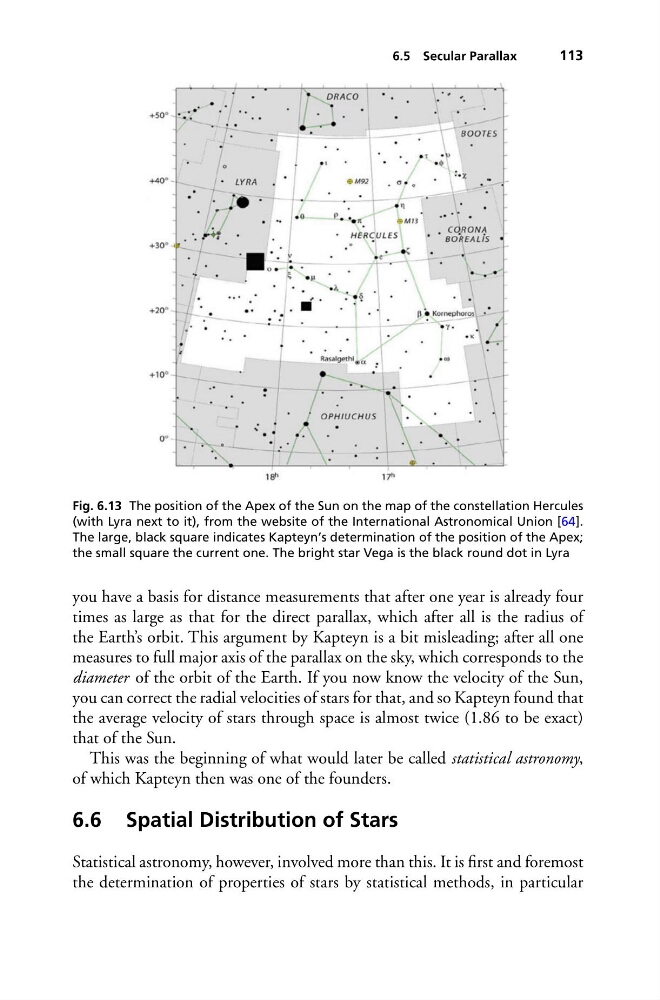
Fig. 6.13 The position of the Apex of the Sun on the map of the constellation Hercules
(with Lyra next to it), from the website of the International Astronomical Union [64].
The large, black square indicates Kapteyn’s determination of the position of the Apex;
the small square the current one. The bright star Vega is the black round dot in Lyra
you have a basis for distance measurements that after one year is already four
times as large as that for the direct parallax, which after all is the radius of
the Earth’s orbit. This argument by Kapteyn is a bit misleading; after all one
measures to full major axis of the parallax on the sky, which corresponds to the
diameter of the orbit of the Earth. If you now know the velocity of the Sun,
you can correct the radial velocities of stars for that, and so Kapteyn found that
the average velocity of stars through space is almost twice (1.86 to be exact)
that of the Sun.
This was the beginning of what would later be called statistical astronomy,
of which Kapteyn then was one of the founders.
6.6 Spatial Distribution of Stars
Statistical astronomy, however, involved more than this. It is first and foremost
the determination of properties of stars by statistical methods, in particular
113
Fig. 6.13 The position of the Apex of the Sun on the map of the constellation Hercules
(with Lyra next to it), from the website of the International Astronomical Union [64].
The large, black square indicates Kapteyn’s determination of the position of the Apex;
the small square the current one. The bright star Vega is the black round dot in Lyra
you have a basis for distance measurements that after one year is already four
times as large as that for the direct parallax, which after all is the radius of
the Earth’s orbit. This argument by Kapteyn is a bit misleading; after all one
measures to full major axis of the parallax on the sky, which corresponds to the
diameter of the orbit of the Earth. If you now know the velocity of the Sun,
you can correct the radial velocities of stars for that, and so Kapteyn found that
the average velocity of stars through space is almost twice (1.86 to be exact)
that of the Sun.
This was the beginning of what would later be called statistical astronomy,
of which Kapteyn then was one of the founders.
6.6 Spatial Distribution of Stars
Statistical astronomy, however, involved more than this. It is first and foremost
the determination of properties of stars by statistical methods, in particular