

6.5 Secular Parallax
111
write an overview of his work. Gill had taken early retirement when he was 63
and had moved back to the United Kingdom, where he had settled in London.
In 1907 he was chairman of the ‘British Association’, a society of scholars; he
wanted to use his presidential address later that year in Leicester to present a
discussion of Kapteyn’s work. The manuscript of the document that Kapteyn
wrote for Gill is in the Groningen archives [63]. It is a very nice, systematic
summary of how Kapteyn had developed his work, and well worth reading. In
the rest of this section I follow Kapteyn’s own description of his work.
Kapteyn had already realized that the direct measurement of parallaxes for
this program was not only time-consuming, but that this way only the distances
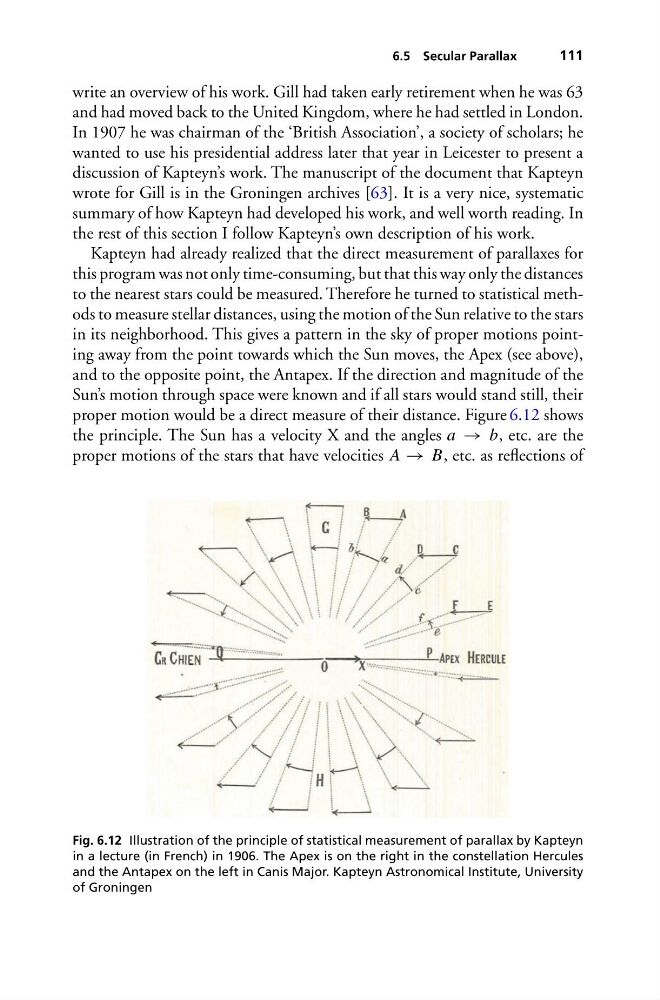
to the nearest stars could be measured. Therefore he turned to statistical methods to measure stellar distances, using the motion of the Sun relative to the stars
in its neighborhood. This gives a pattern in the sky of proper motions pointing away from the point towards which the Sun moves, the Apex (see above),
and to the opposite point, the Antapex. If the direction and magnitude of the
Sun’s motion through space were known and if all stars would stand still, their
proper motion would be a direct measure of their distance. Figure 6.12 shows
the principle. The Sun has a velocity X and the angles a → b, etc. are the
proper motions of the stars that have velocities A → B, etc. as reflections of
Fig. 6.12 Illustration of the principle of statistical measurement of parallax by Kapteyn
in a lecture (in French) in 1906. The Apex is on the right in the constellation Hercules
and the Antapex on the left in Canis Major. Kapteyn Astronomical Institute, University
of Groningen
111
write an overview of his work. Gill had taken early retirement when he was 63
and had moved back to the United Kingdom, where he had settled in London.
In 1907 he was chairman of the ‘British Association’, a society of scholars; he
wanted to use his presidential address later that year in Leicester to present a
discussion of Kapteyn’s work. The manuscript of the document that Kapteyn
wrote for Gill is in the Groningen archives [63]. It is a very nice, systematic
summary of how Kapteyn had developed his work, and well worth reading. In
the rest of this section I follow Kapteyn’s own description of his work.
Kapteyn had already realized that the direct measurement of parallaxes for
this program was not only time-consuming, but that this way only the distances
to the nearest stars could be measured. Therefore he turned to statistical methods to measure stellar distances, using the motion of the Sun relative to the stars
in its neighborhood. This gives a pattern in the sky of proper motions pointing away from the point towards which the Sun moves, the Apex (see above),
and to the opposite point, the Antapex. If the direction and magnitude of the
Sun’s motion through space were known and if all stars would stand still, their
proper motion would be a direct measure of their distance. Figure 6.12 shows
the principle. The Sun has a velocity X and the angles a → b, etc. are the
proper motions of the stars that have velocities A → B, etc. as reflections of
Fig. 6.12 Illustration of the principle of statistical measurement of parallax by Kapteyn
in a lecture (in French) in 1906. The Apex is on the right in the constellation Hercules
and the Antapex on the left in Canis Major. Kapteyn Astronomical Institute, University
of Groningen