

2
1 Introduction
a structure of sustained contacts when particles consolidate, leading to a solid-like
response, resulting in elastic deformation or a proportional strain.
Understanding the fundamentals of granular systems is essential to multiphase
chemical reactors. Fluid catalytic cracking (FCC), drying or gasification are examples
of granular processes that are particularly relevant to the process industry and the
energy sectors. In gas-solid chemical reactors, a stream of gas or liquid is delivered
evenly through a bottom plate, passing through the granular media. At a small flow
rate, particles interact with gas smoothly and remain static and packed. The system
operated under such a situation represents a fixed bed reactor. On the other hand,
when the gas velocity exceeds a certain threshold, forces between gas and solids are
sufficiently large to support the net gravitational weight of the entire particle hold-up,
a transition occurs, and the system exhibits many dynamic fluid-like features. Such a
phenomenon is named fluidisation, while this particular superficial velocity is called
the minimum fluidisation velocity U mf . Unlike a fixed bed reactor, where temperature
gradients, gas channelling and hot spots frequently occur as consequences of flow
maldistribution, bubbles in fluidised beds impose vigorous agitation in the gas-solid
suspension, and hereby lead to a fast transport rate and homogenous mixing [61].
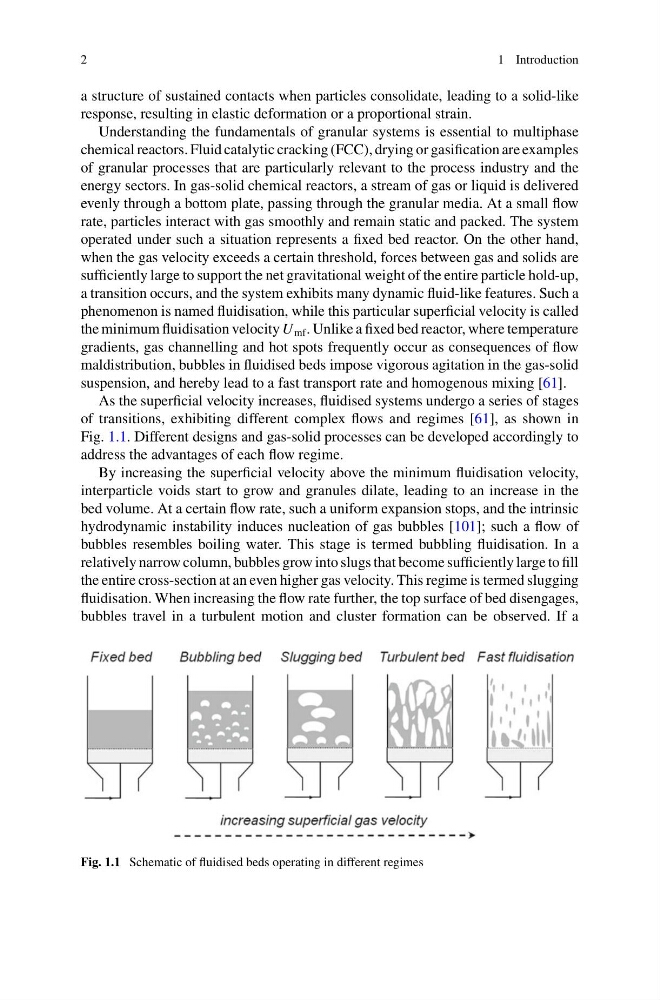
As the superficial velocity increases, fluidised systems undergo a series of stages
of transitions, exhibiting different complex flows and regimes [61], as shown in
Fig. 1.1. Different designs and gas-solid processes can be developed accordingly to
address the advantages of each flow regime.
By increasing the superficial velocity above the minimum fluidisation velocity,
interparticle voids start to grow and granules dilate, leading to an increase in the
bed volume. At a certain flow rate, such a uniform expansion stops, and the intrinsic
hydrodynamic instability induces nucleation of gas bubbles [101]; such a flow of
bubbles resembles boiling water. This stage is termed bubbling fluidisation. In a
relatively narrow column, bubbles grow into slugs that become sufficiently large to fill
the entire cross-section at an even higher gas velocity. This regime is termed slugging
fluidisation. When increasing the flow rate further, the top surface of bed disengages,
bubbles travel in a turbulent motion and cluster formation can be observed. If a
Fig. 1.1 Schematic of fluidised beds operating in different regimes
1 Introduction
a structure of sustained contacts when particles consolidate, leading to a solid-like
response, resulting in elastic deformation or a proportional strain.
Understanding the fundamentals of granular systems is essential to multiphase
chemical reactors. Fluid catalytic cracking (FCC), drying or gasification are examples
of granular processes that are particularly relevant to the process industry and the
energy sectors. In gas-solid chemical reactors, a stream of gas or liquid is delivered
evenly through a bottom plate, passing through the granular media. At a small flow
rate, particles interact with gas smoothly and remain static and packed. The system
operated under such a situation represents a fixed bed reactor. On the other hand,
when the gas velocity exceeds a certain threshold, forces between gas and solids are
sufficiently large to support the net gravitational weight of the entire particle hold-up,
a transition occurs, and the system exhibits many dynamic fluid-like features. Such a
phenomenon is named fluidisation, while this particular superficial velocity is called
the minimum fluidisation velocity U mf . Unlike a fixed bed reactor, where temperature
gradients, gas channelling and hot spots frequently occur as consequences of flow
maldistribution, bubbles in fluidised beds impose vigorous agitation in the gas-solid
suspension, and hereby lead to a fast transport rate and homogenous mixing [61].
As the superficial velocity increases, fluidised systems undergo a series of stages
of transitions, exhibiting different complex flows and regimes [61], as shown in
Fig. 1.1. Different designs and gas-solid processes can be developed accordingly to
address the advantages of each flow regime.
By increasing the superficial velocity above the minimum fluidisation velocity,
interparticle voids start to grow and granules dilate, leading to an increase in the
bed volume. At a certain flow rate, such a uniform expansion stops, and the intrinsic
hydrodynamic instability induces nucleation of gas bubbles [101]; such a flow of
bubbles resembles boiling water. This stage is termed bubbling fluidisation. In a
relatively narrow column, bubbles grow into slugs that become sufficiently large to fill
the entire cross-section at an even higher gas velocity. This regime is termed slugging
fluidisation. When increasing the flow rate further, the top surface of bed disengages,
bubbles travel in a turbulent motion and cluster formation can be observed. If a
Fig. 1.1 Schematic of fluidised beds operating in different regimes