

154
Appendix C
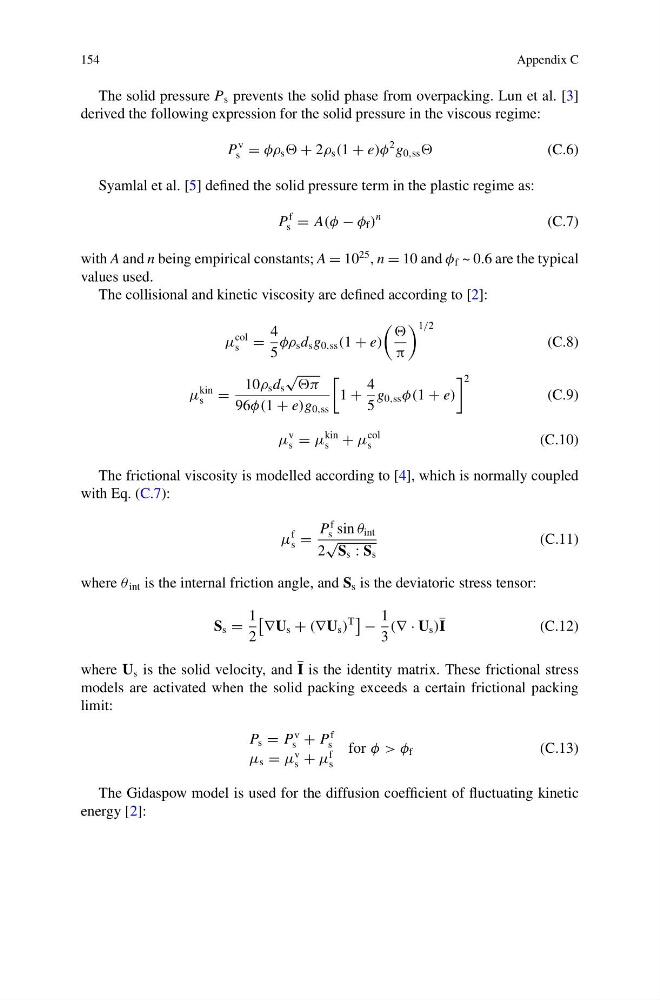
The solid pressure P s prevents the solid phase from overpacking. Lun et al. [3]
derived the following expression for the solid pressure in the viscous regime:
P
v
s = φρ s + 2ρ s (1 + e)φ
2 g 0,ss
(C.6)
Syamlal et al. [5] defined the solid pressure term in the plastic regime as:
P
f
s = A(φ − φ f )
n
(C.7)
with A and n being empirical constants; A = 10
25 , n = 10 and φ f ~ 0.6 are the typical
values used.
The collisional and kinetic viscosity are defined according to [2]:
μ
col
s =
4
5
φρ s d s g 0,ss (1 + e)
π
1/2
(C.8)
μ
kin
s =
10ρ s d s
√
π
96φ(1 + e)g 0,ss
1 +
4
5
g 0,ss φ(1 + e)
2
(C.9)
μ
v
s = μ
kin
s + μ
col
s
(C.10)
The frictional viscosity is modelled according to [4], which is normally coupled
with Eq. (C.7):
μ
f
s =
P
f
s sin θ int
2
√
S s : S s
(C.11)
where θ int is the internal friction angle, and S s is the deviatoric stress tensor:
S s =
1
2
∇U s + (∇U s )
T
−
1
3
(∇ · U s )I
(C.12)
where U s is the solid velocity, and I is the identity matrix. These frictional stress
models are activated when the solid packing exceeds a certain frictional packing
limit:
P s = P
v
s + P
f
s
μ s = μ
v
s + μ
f
s
for φ > φ f
(C.13)
The Gidaspow model is used for the diffusion coefficient of fluctuating kinetic
energy [2]:
Appendix C
The solid pressure P s prevents the solid phase from overpacking. Lun et al. [3]
derived the following expression for the solid pressure in the viscous regime:
P
v
s = φρ s + 2ρ s (1 + e)φ
2 g 0,ss
(C.6)
Syamlal et al. [5] defined the solid pressure term in the plastic regime as:
P
f
s = A(φ − φ f )
n
(C.7)
with A and n being empirical constants; A = 10
25 , n = 10 and φ f ~ 0.6 are the typical
values used.
The collisional and kinetic viscosity are defined according to [2]:
μ
col
s =
4
5
φρ s d s g 0,ss (1 + e)
π
1/2
(C.8)
μ
kin
s =
10ρ s d s
√
π
96φ(1 + e)g 0,ss
1 +
4
5
g 0,ss φ(1 + e)
2
(C.9)
μ
v
s = μ
kin
s + μ
col
s
(C.10)
The frictional viscosity is modelled according to [4], which is normally coupled
with Eq. (C.7):
μ
f
s =
P
f
s sin θ int
2
√
S s : S s
(C.11)
where θ int is the internal friction angle, and S s is the deviatoric stress tensor:
S s =
1
2
∇U s + (∇U s )
T
−
1
3
(∇ · U s )I
(C.12)
where U s is the solid velocity, and I is the identity matrix. These frictional stress
models are activated when the solid packing exceeds a certain frictional packing
limit:
P s = P
v
s + P
f
s
μ s = μ
v
s + μ
f
s
for φ > φ f
(C.13)
The Gidaspow model is used for the diffusion coefficient of fluctuating kinetic
energy [2]: