

5.5 Results and Discussion
139
contacts cease to be valid when persistent particle contacts become paramount, typically observed in dense bubbling fluidised beds. Over the last few years, increasing
efforts have been devoted to improving how to account for friction in dense granular
flows. Advance frictional stress models, based on rheological principles have tackled
the transition between the viscous and the plastic regime in dense granular flows [8,
16]. However, their formulations are still in a too early stage for wide applications in
fluidised beds. According to the simulations reported, a correct description of friction
effect appears as a necessary factor in creating such regular bubble patterns, which
indicates that not only the emulsion phase must be densely packed, but it also needs
to be able to approach correct critical packing. In CFD-DEM simulations, increasing
the friction coefficient leads to greater energy dissipation within the solid phase, and
the structured bubble patterns become stable.
When friction is eliminated, the solids become mobile in the wake of the bubbles,
and pulsed beds remain unstructured. By omitting frictional stresses in the locked
region, the model fails to identify the correct jamming point and energy dissipation;
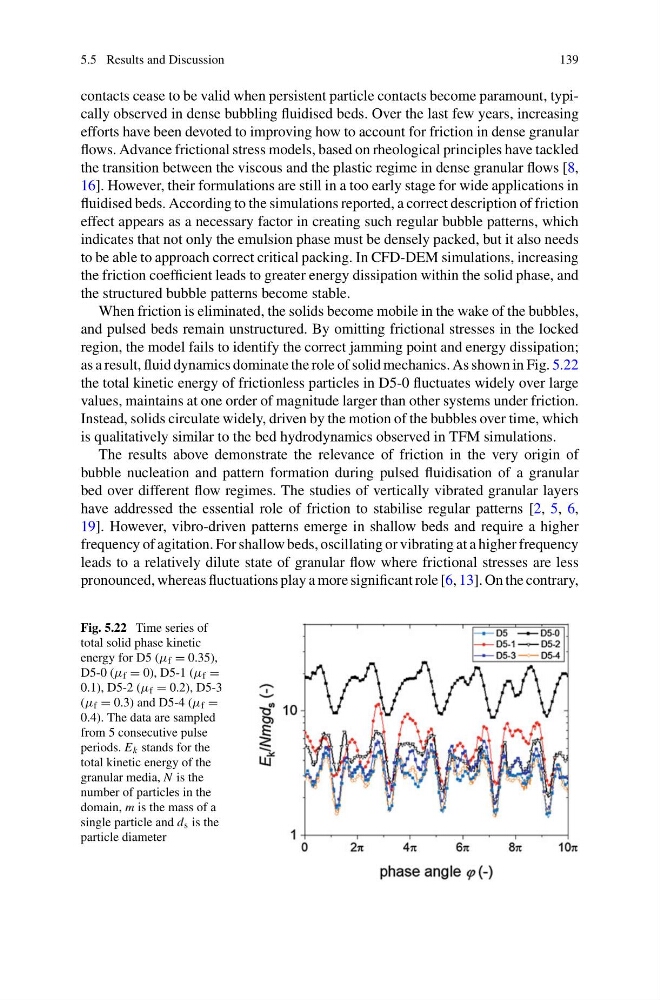
as a result, fluid dynamics dominate the role of solid mechanics. As shown in Fig. 5.22
the total kinetic energy of frictionless particles in D5-0 fluctuates widely over large
values, maintains at one order of magnitude larger than other systems under friction.
Instead, solids circulate widely, driven by the motion of the bubbles over time, which
is qualitatively similar to the bed hydrodynamics observed in TFM simulations.
The results above demonstrate the relevance of friction in the very origin of
bubble nucleation and pattern formation during pulsed fluidisation of a granular
bed over different flow regimes. The studies of vertically vibrated granular layers
have addressed the essential role of friction to stabilise regular patterns [2, 5, 6,
19]. However, vibro-driven patterns emerge in shallow beds and require a higher
frequency of agitation. For shallow beds, oscillating or vibrating at a higher frequency
leads to a relatively dilute state of granular flow where frictional stresses are less
pronounced, whereas fluctuations play a more significant role [6, 13]. On the contrary,
Fig. 5.22 Time series of
total solid phase kinetic
energy for D5 (μ f = 0.35),
D5-0 (μ f = 0), D5-1 (μ f =
0.1), D5-2 (μ f = 0.2), D5-3
(μ f = 0.3) and D5-4 (μ f =
0.4). The data are sampled
from 5 consecutive pulse
periods. E k stands for the
total kinetic energy of the
granular media, N is the
number of particles in the
domain, m is the mass of a
single particle and d s is the
particle diameter
139
contacts cease to be valid when persistent particle contacts become paramount, typically observed in dense bubbling fluidised beds. Over the last few years, increasing
efforts have been devoted to improving how to account for friction in dense granular
flows. Advance frictional stress models, based on rheological principles have tackled
the transition between the viscous and the plastic regime in dense granular flows [8,
16]. However, their formulations are still in a too early stage for wide applications in
fluidised beds. According to the simulations reported, a correct description of friction
effect appears as a necessary factor in creating such regular bubble patterns, which
indicates that not only the emulsion phase must be densely packed, but it also needs
to be able to approach correct critical packing. In CFD-DEM simulations, increasing
the friction coefficient leads to greater energy dissipation within the solid phase, and
the structured bubble patterns become stable.
When friction is eliminated, the solids become mobile in the wake of the bubbles,
and pulsed beds remain unstructured. By omitting frictional stresses in the locked
region, the model fails to identify the correct jamming point and energy dissipation;
as a result, fluid dynamics dominate the role of solid mechanics. As shown in Fig. 5.22
the total kinetic energy of frictionless particles in D5-0 fluctuates widely over large
values, maintains at one order of magnitude larger than other systems under friction.
Instead, solids circulate widely, driven by the motion of the bubbles over time, which
is qualitatively similar to the bed hydrodynamics observed in TFM simulations.
The results above demonstrate the relevance of friction in the very origin of
bubble nucleation and pattern formation during pulsed fluidisation of a granular
bed over different flow regimes. The studies of vertically vibrated granular layers
have addressed the essential role of friction to stabilise regular patterns [2, 5, 6,
19]. However, vibro-driven patterns emerge in shallow beds and require a higher
frequency of agitation. For shallow beds, oscillating or vibrating at a higher frequency
leads to a relatively dilute state of granular flow where frictional stresses are less
pronounced, whereas fluctuations play a more significant role [6, 13]. On the contrary,
Fig. 5.22 Time series of
total solid phase kinetic
energy for D5 (μ f = 0.35),
D5-0 (μ f = 0), D5-1 (μ f =
0.1), D5-2 (μ f = 0.2), D5-3
(μ f = 0.3) and D5-4 (μ f =
0.4). The data are sampled
from 5 consecutive pulse
periods. E k stands for the
total kinetic energy of the
granular media, N is the
number of particles in the
domain, m is the mass of a
single particle and d s is the
particle diameter