

4.1 Introduction
91
In common implementations of TFM, the granular phase is also treated mathematically as a continuum using a generalised form of the Navier-Stokes equation,
penetrating the gas phase reciprocally [2]. The presumption substantially reduces
its computational demand, and allows one to model macroscopic dynamics of the
particulate phase at reasonable computational cost, which excels Eulerian treatment
as the preferred approach for applications on large scales [6, 38]. Nevertheless,
unknowns, such as solids viscosity and pressure, arise from the cost of omitting local
solids dynamics, and need to be modelled constitutively. In analogy to the dynamics
of thermal gases, kinetic theory of granular flow (KTGF) has been developed and
applied broadly in conjunction with a Eulerian framework. It assumes that particles behave in a “chaotic” fashion, following the Maxwellian velocity distribution
and uncorrelated in collisions. Besides, particles only undergo binary, instantaneous
and frictionless collisions, and these assumptions feature for a rapid, dilute flow in
the viscous regime [18]. The KTGF tracks energy transport and dissipation via a
so-called granular temperature, a type of pseudo-energy that quantifies the kinetic
energy of solids fluctuation.
In its classic form, TFM incorporates the models derived from the critical state
theory of soil mechanics to address dense granular flow rheology [24, 44]. These
models assume a sharp transition of solid effective stresses once the solids are above
a critical packing. Predicted solid circulation and flow of bubbles were reported
significantly reliant on the implementation of frictional stress correlations and the
selected critical volume [16, 23, 39]. Nevertheless, the frictional solid pressure
is modelled with highly empirical correlations. In this context, the prediction of
different correlations varies by orders of magnitude [55].
In terms of fluidised granular matters, nonlinear phase coupling of solid-gas and
solid-solid occurring at different levels contributes to the complex rheology across
different flow regimes, which complicates macroscopic behaviour of bubbling beds
remarkably. Modelling a periodically pulsed bed becomes more challenging, as
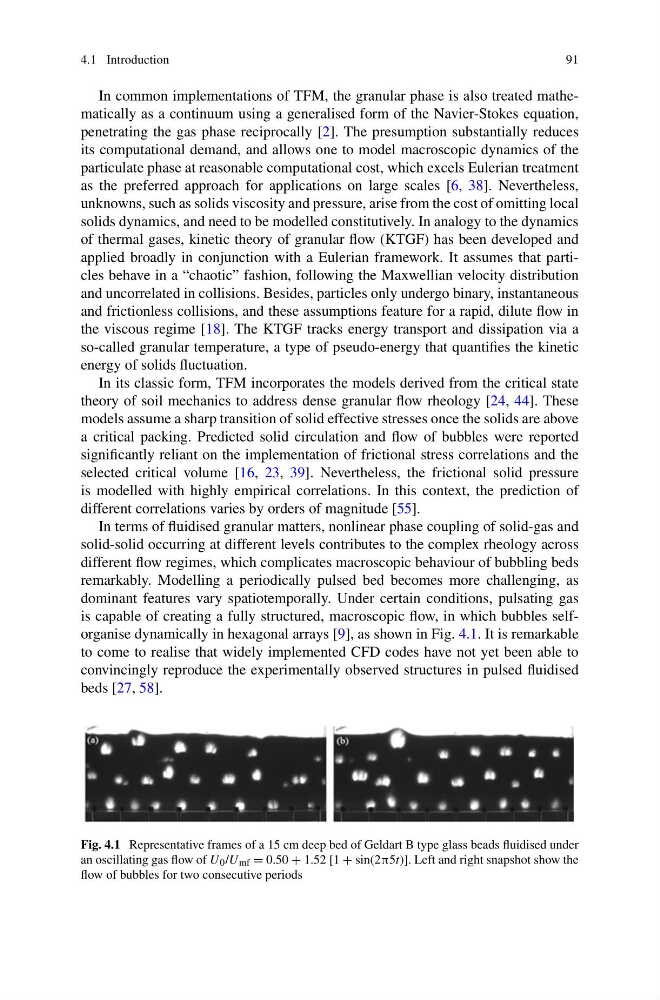
dominant features vary spatiotemporally. Under certain conditions, pulsating gas
is capable of creating a fully structured, macroscopic flow, in which bubbles selforganise dynamically in hexagonal arrays [9], as shown in Fig. 4.1. It is remarkable
to come to realise that widely implemented CFD codes have not yet been able to
convincingly reproduce the experimentally observed structures in pulsed fluidised
beds [27, 58].
Fig. 4.1 Representative frames of a 15 cm deep bed of Geldart B type glass beads fluidised under
an oscillating gas flow of U 0 /U mf = 0.50 + 1.52 [1 + sin(2π5t)]. Left and right snapshot show the
flow of bubbles for two consecutive periods
91
In common implementations of TFM, the granular phase is also treated mathematically as a continuum using a generalised form of the Navier-Stokes equation,
penetrating the gas phase reciprocally [2]. The presumption substantially reduces
its computational demand, and allows one to model macroscopic dynamics of the
particulate phase at reasonable computational cost, which excels Eulerian treatment
as the preferred approach for applications on large scales [6, 38]. Nevertheless,
unknowns, such as solids viscosity and pressure, arise from the cost of omitting local
solids dynamics, and need to be modelled constitutively. In analogy to the dynamics
of thermal gases, kinetic theory of granular flow (KTGF) has been developed and
applied broadly in conjunction with a Eulerian framework. It assumes that particles behave in a “chaotic” fashion, following the Maxwellian velocity distribution
and uncorrelated in collisions. Besides, particles only undergo binary, instantaneous
and frictionless collisions, and these assumptions feature for a rapid, dilute flow in
the viscous regime [18]. The KTGF tracks energy transport and dissipation via a
so-called granular temperature, a type of pseudo-energy that quantifies the kinetic
energy of solids fluctuation.
In its classic form, TFM incorporates the models derived from the critical state
theory of soil mechanics to address dense granular flow rheology [24, 44]. These
models assume a sharp transition of solid effective stresses once the solids are above
a critical packing. Predicted solid circulation and flow of bubbles were reported
significantly reliant on the implementation of frictional stress correlations and the
selected critical volume [16, 23, 39]. Nevertheless, the frictional solid pressure
is modelled with highly empirical correlations. In this context, the prediction of
different correlations varies by orders of magnitude [55].
In terms of fluidised granular matters, nonlinear phase coupling of solid-gas and
solid-solid occurring at different levels contributes to the complex rheology across
different flow regimes, which complicates macroscopic behaviour of bubbling beds
remarkably. Modelling a periodically pulsed bed becomes more challenging, as
dominant features vary spatiotemporally. Under certain conditions, pulsating gas
is capable of creating a fully structured, macroscopic flow, in which bubbles selforganise dynamically in hexagonal arrays [9], as shown in Fig. 4.1. It is remarkable
to come to realise that widely implemented CFD codes have not yet been able to
convincingly reproduce the experimentally observed structures in pulsed fluidised
beds [27, 58].
Fig. 4.1 Representative frames of a 15 cm deep bed of Geldart B type glass beads fluidised under
an oscillating gas flow of U 0 /U mf = 0.50 + 1.52 [1 + sin(2π5t)]. Left and right snapshot show the
flow of bubbles for two consecutive periods