

the time. In addition, the average biosolids consistency was 3.2% solids, which
negates the need for a biosolids thickener.
9 Treatment of Lagoons Effluent
Arpin Wastewater Treatment Plant in Arpin, WI, USA is a system of aerated lagoons
[41] treating a combination of dairy processing wastewater and domestic sewage
with a high proportion (over 75%) of the flow coming from the dairy. The lagoons
effluent contained a lot of colloidal substances and had high color (green) and algae
count [18].
A sump pump was used to feed the pilot plant from the third lagoon. Alum and
polymer were added to the feed line at dosages of 6–40 mg/L of alum and 0.5–1 mg/
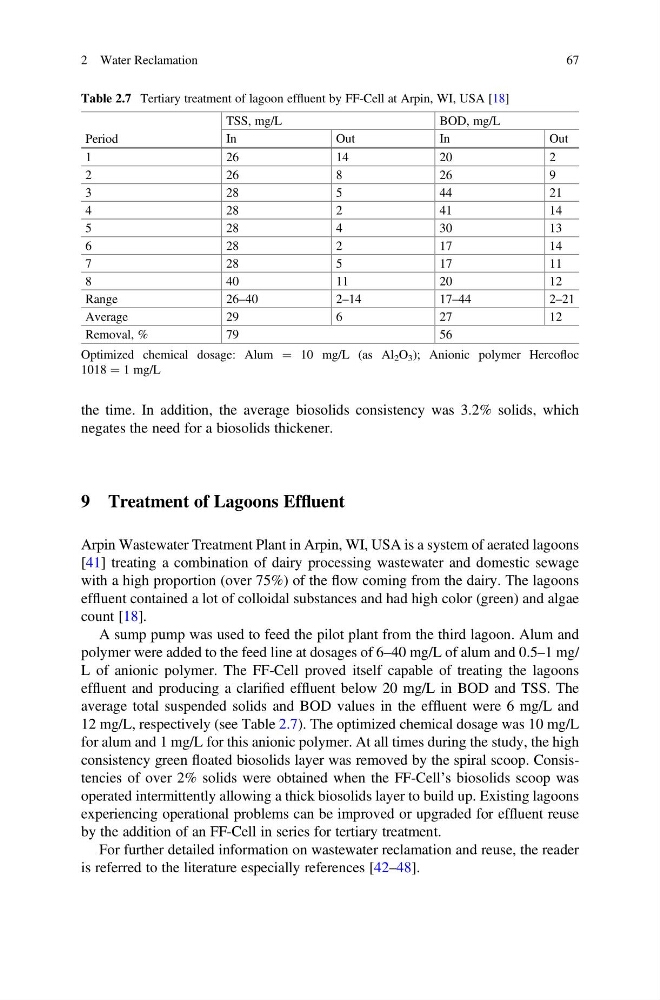
L of anionic polymer. The FF-Cell proved itself capable of treating the lagoons
effluent and producing a clarified effluent below 20 mg/L in BOD and TSS. The
average total suspended solids and BOD values in the effluent were 6 mg/L and
12 mg/L, respectively (see Table 2.7). The optimized chemical dosage was 10 mg/L
for alum and 1 mg/L for this anionic polymer. At all times during the study, the high
consistency green floated biosolids layer was removed by the spiral scoop. Consistencies of over 2% solids were obtained when the FF-Cell’s biosolids scoop was
operated intermittently allowing a thick biosolids layer to build up. Existing lagoons
experiencing operational problems can be improved or upgraded for effluent reuse
by the addition of an FF-Cell in series for tertiary treatment.
For further detailed information on wastewater reclamation and reuse, the reader
is referred to the literature especially references [42–48].
Table 2.7 Tertiary treatment of lagoon effluent by FF-Cell at Arpin, WI, USA [18]
Period
TSS, mg/L
BOD, mg/L
In
Out
In
Out
1
2 6
1 4
2 0
2
2
26
8
26
9
3
28
5
44
21
4
28
2
41
14
5
28
4
30
13
6
28
2
17
14
7
28
5
17
11
8
4 0
1 1
2 0
1 2
Range
26–40
2–14
17–44
2–21
Average
29
6
27
12
Removal, %
79
56
Optimized chemical dosage: Alum ¼ 10 mg/L (as Al 2 O 3 ); Anionic polymer Hercofloc
1018 ¼ 1 mg/L
2 Water Reclamation
67
negates the need for a biosolids thickener.
9 Treatment of Lagoons Effluent
Arpin Wastewater Treatment Plant in Arpin, WI, USA is a system of aerated lagoons
[41] treating a combination of dairy processing wastewater and domestic sewage
with a high proportion (over 75%) of the flow coming from the dairy. The lagoons
effluent contained a lot of colloidal substances and had high color (green) and algae
count [18].
A sump pump was used to feed the pilot plant from the third lagoon. Alum and
polymer were added to the feed line at dosages of 6–40 mg/L of alum and 0.5–1 mg/
L of anionic polymer. The FF-Cell proved itself capable of treating the lagoons
effluent and producing a clarified effluent below 20 mg/L in BOD and TSS. The
average total suspended solids and BOD values in the effluent were 6 mg/L and
12 mg/L, respectively (see Table 2.7). The optimized chemical dosage was 10 mg/L
for alum and 1 mg/L for this anionic polymer. At all times during the study, the high
consistency green floated biosolids layer was removed by the spiral scoop. Consistencies of over 2% solids were obtained when the FF-Cell’s biosolids scoop was
operated intermittently allowing a thick biosolids layer to build up. Existing lagoons
experiencing operational problems can be improved or upgraded for effluent reuse
by the addition of an FF-Cell in series for tertiary treatment.
For further detailed information on wastewater reclamation and reuse, the reader
is referred to the literature especially references [42–48].
Table 2.7 Tertiary treatment of lagoon effluent by FF-Cell at Arpin, WI, USA [18]
Period
TSS, mg/L
BOD, mg/L
In
Out
In
Out
1
2 6
1 4
2 0
2
2
26
8
26
9
3
28
5
44
21
4
28
2
41
14
5
28
4
30
13
6
28
2
17
14
7
28
5
17
11
8
4 0
1 1
2 0
1 2
Range
26–40
2–14
17–44
2–21
Average
29
6
27
12
Removal, %
79
56
Optimized chemical dosage: Alum ¼ 10 mg/L (as Al 2 O 3 ); Anionic polymer Hercofloc
1018 ¼ 1 mg/L
2 Water Reclamation
67