

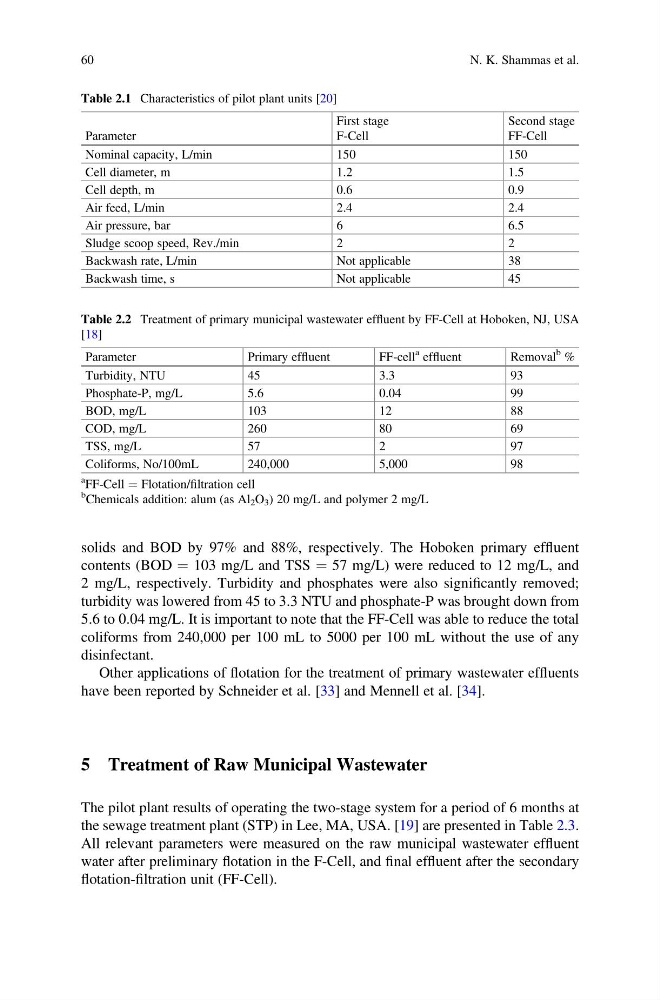
solids and BOD by 97% and 88%, respectively. The Hoboken primary effluent
contents (BOD ¼ 103 mg/L and TSS ¼ 57 mg/L) were reduced to 12 mg/L, and
2 mg/L, respectively. Turbidity and phosphates were also significantly removed;
turbidity was lowered from 45 to 3.3 NTU and phosphate-P was brought down from
5.6 to 0.04 mg/L. It is important to note that the FF-Cell was able to reduce the total
coliforms from 240,000 per 100 mL to 5000 per 100 mL without the use of any
disinfectant.
Other applications of flotation for the treatment of primary wastewater effluents
have been reported by Schneider et al. [33] and Mennell et al. [34].
5 Treatment of Raw Municipal Wastewater
The pilot plant results of operating the two-stage system for a period of 6 months at
the sewage treatment plant (STP) in Lee, MA, USA. [19] are presented in Table 2.3.
All relevant parameters were measured on the raw municipal wastewater effluent
water after preliminary flotation in the F-Cell, and final effluent after the secondary
flotation-filtration unit (FF-Cell).
Table 2.1 Characteristics of pilot plant units [20]
Parameter
First stage
F-Cell
Second stage
FF-Cell
Nominal capacity, L/min
150
150
Cell diameter, m
1.2
1.5
Cell depth, m
0.6
0.9
Air feed, L/min
2.4
2.4
Air pressure, bar
6
6.5
Sludge scoop speed, Rev./min
2
2
Backwash rate, L/min
Not applicable
38
Backwash time, s
Not applicable
45
Table 2.2 Treatment of primary municipal wastewater effluent by FF-Cell at Hoboken, NJ, USA
[18]
Parameter
Primary effluent
FF-cell
a effluent
Removal
b %
Turbidity, NTU
45
3.3
93
Phosphate-P, mg/L
5.6
0.04
99
BOD, mg/L
103
12
88
COD, mg/L
260
80
69
TSS, mg/L
57
2
97
Coliforms, No/100mL
240,000
5,000
98
a FF-Cell ¼ Flotation/filtration cell
b
Chemicals addition: alum (as Al 2 O 3 ) 20 mg/L and polymer 2 mg/L
60
N. K. Shammas et al.
contents (BOD ¼ 103 mg/L and TSS ¼ 57 mg/L) were reduced to 12 mg/L, and
2 mg/L, respectively. Turbidity and phosphates were also significantly removed;
turbidity was lowered from 45 to 3.3 NTU and phosphate-P was brought down from
5.6 to 0.04 mg/L. It is important to note that the FF-Cell was able to reduce the total
coliforms from 240,000 per 100 mL to 5000 per 100 mL without the use of any
disinfectant.
Other applications of flotation for the treatment of primary wastewater effluents
have been reported by Schneider et al. [33] and Mennell et al. [34].
5 Treatment of Raw Municipal Wastewater
The pilot plant results of operating the two-stage system for a period of 6 months at
the sewage treatment plant (STP) in Lee, MA, USA. [19] are presented in Table 2.3.
All relevant parameters were measured on the raw municipal wastewater effluent
water after preliminary flotation in the F-Cell, and final effluent after the secondary
flotation-filtration unit (FF-Cell).
Table 2.1 Characteristics of pilot plant units [20]
Parameter
First stage
F-Cell
Second stage
FF-Cell
Nominal capacity, L/min
150
150
Cell diameter, m
1.2
1.5
Cell depth, m
0.6
0.9
Air feed, L/min
2.4
2.4
Air pressure, bar
6
6.5
Sludge scoop speed, Rev./min
2
2
Backwash rate, L/min
Not applicable
38
Backwash time, s
Not applicable
45
Table 2.2 Treatment of primary municipal wastewater effluent by FF-Cell at Hoboken, NJ, USA
[18]
Parameter
Primary effluent
FF-cell
a effluent
Removal
b %
Turbidity, NTU
45
3.3
93
Phosphate-P, mg/L
5.6
0.04
99
BOD, mg/L
103
12
88
COD, mg/L
260
80
69
TSS, mg/L
57
2
97
Coliforms, No/100mL
240,000
5,000
98
a FF-Cell ¼ Flotation/filtration cell
b
Chemicals addition: alum (as Al 2 O 3 ) 20 mg/L and polymer 2 mg/L
60
N. K. Shammas et al.