

among others of less importance. A summary of mosquito-borne diseases, along
with etiologic agent, reservoir, mode of transmission, incubation period, and control,
is found in Salvato [9]. A listing of illustrative human diseases transmitted by
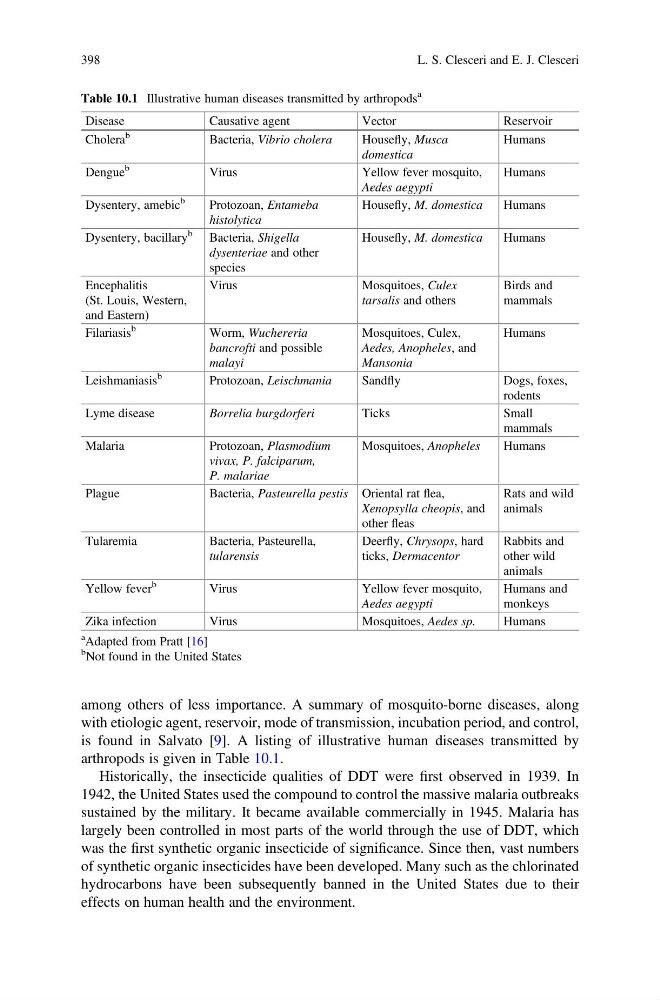
arthropods is given in Table 10.1.
Historically, the insecticide qualities of DDT were first observed in 1939. In
1942, the United States used the compound to control the massive malaria outbreaks
sustained by the military. It became available commercially in 1945. Malaria has
largely been controlled in most parts of the world through the use of DDT, which
was the first synthetic organic insecticide of significance. Since then, vast numbers
of synthetic organic insecticides have been developed. Many such as the chlorinated
hydrocarbons have been subsequently banned in the United States due to their
effects on human health and the environment.
Table 10.1 Illustrative human diseases transmitted by arthropods
a
Disease
Causative agent
Vector
Reservoir
Cholera
b
Bacteria, Vibrio cholera
Housefly, Musca
domestica
Humans
Dengue
b
Virus
Yellow fever mosquito,
Aedes aegypti
Humans
Dysentery, amebic
b
Protozoan, Entameba
histolytica
Housefly, M. domestica
Humans
Dysentery, bacillary
b
Bacteria, Shigella
dysenteriae and other
species
Housefly, M. domestica
Humans
Encephalitis
(St. Louis, Western,
and Eastern)
Virus
Mosquitoes, Culex
tarsalis and others
Birds and
mammals
Filariasis
b
Worm, Wuchereria
bancrofti and possible
malayi
Mosquitoes, Culex,
Aedes, Anopheles, and
Mansonia
Humans
Leishmaniasis
b
Protozoan, Leischmania
Sandfly
Dogs, foxes,
rodents
Lyme disease
Borrelia burgdorferi
Ticks
Small
mammals
Malaria
Protozoan, Plasmodium
vivax, P. falciparum,
P. malariae
Mosquitoes, Anopheles
Humans
Plague
Bacteria, Pasteurella pestis Oriental rat flea,
Xenopsylla cheopis, and
other fleas
Rats and wild
animals
Tularemia
Bacteria, Pasteurella,
tularensis
Deerfly, Chrysops, hard
ticks, Dermacentor
Rabbits and
other wild
animals
Yellow fever
b
Virus
Yellow fever mosquito,
Aedes aegypti
Humans and
monkeys
Zika infection
Virus
Mosquitoes, Aedes sp.
Humans
a Adapted from Pratt [16]
b
Not found in the United States
398
L. S. Clesceri and E. J. Clesceri
with etiologic agent, reservoir, mode of transmission, incubation period, and control,
is found in Salvato [9]. A listing of illustrative human diseases transmitted by
arthropods is given in Table 10.1.
Historically, the insecticide qualities of DDT were first observed in 1939. In
1942, the United States used the compound to control the massive malaria outbreaks
sustained by the military. It became available commercially in 1945. Malaria has
largely been controlled in most parts of the world through the use of DDT, which
was the first synthetic organic insecticide of significance. Since then, vast numbers
of synthetic organic insecticides have been developed. Many such as the chlorinated
hydrocarbons have been subsequently banned in the United States due to their
effects on human health and the environment.
Table 10.1 Illustrative human diseases transmitted by arthropods
a
Disease
Causative agent
Vector
Reservoir
Cholera
b
Bacteria, Vibrio cholera
Housefly, Musca
domestica
Humans
Dengue
b
Virus
Yellow fever mosquito,
Aedes aegypti
Humans
Dysentery, amebic
b
Protozoan, Entameba
histolytica
Housefly, M. domestica
Humans
Dysentery, bacillary
b
Bacteria, Shigella
dysenteriae and other
species
Housefly, M. domestica
Humans
Encephalitis
(St. Louis, Western,
and Eastern)
Virus
Mosquitoes, Culex
tarsalis and others
Birds and
mammals
Filariasis
b
Worm, Wuchereria
bancrofti and possible
malayi
Mosquitoes, Culex,
Aedes, Anopheles, and
Mansonia
Humans
Leishmaniasis
b
Protozoan, Leischmania
Sandfly
Dogs, foxes,
rodents
Lyme disease
Borrelia burgdorferi
Ticks
Small
mammals
Malaria
Protozoan, Plasmodium
vivax, P. falciparum,
P. malariae
Mosquitoes, Anopheles
Humans
Plague
Bacteria, Pasteurella pestis Oriental rat flea,
Xenopsylla cheopis, and
other fleas
Rats and wild
animals
Tularemia
Bacteria, Pasteurella,
tularensis
Deerfly, Chrysops, hard
ticks, Dermacentor
Rabbits and
other wild
animals
Yellow fever
b
Virus
Yellow fever mosquito,
Aedes aegypti
Humans and
monkeys
Zika infection
Virus
Mosquitoes, Aedes sp.
Humans
a Adapted from Pratt [16]
b
Not found in the United States
398
L. S. Clesceri and E. J. Clesceri