

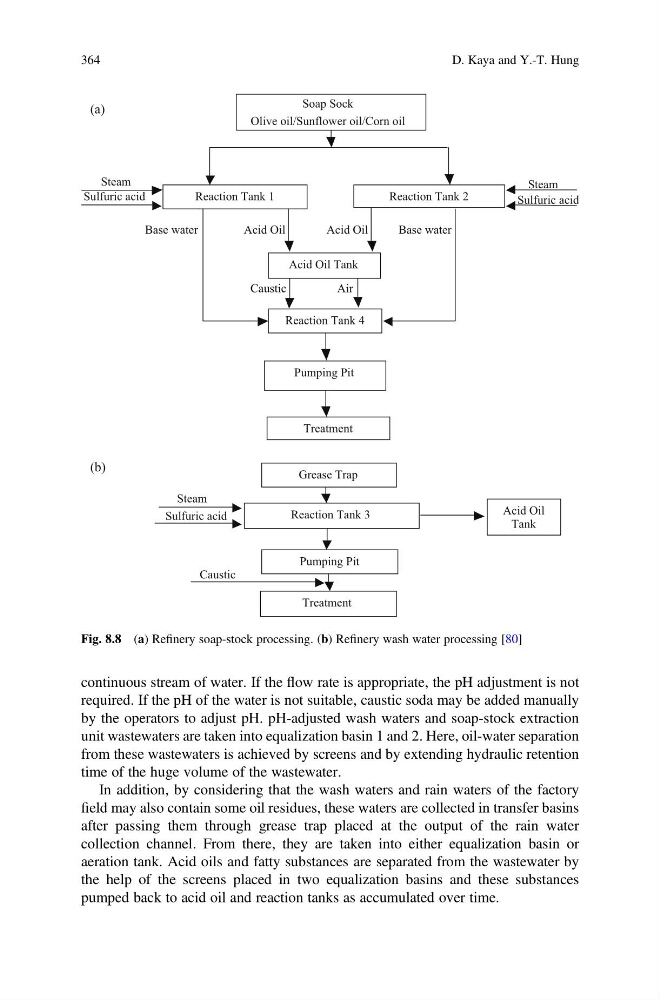
continuous stream of water. If the flow rate is appropriate, the pH adjustment is not
required. If the pH of the water is not suitable, caustic soda may be added manually
by the operators to adjust pH. pH-adjusted wash waters and soap-stock extraction
unit wastewaters are taken into equalization basin 1 and 2. Here, oil-water separation
from these wastewaters is achieved by screens and by extending hydraulic retention
time of the huge volume of the wastewater.
In addition, by considering that the wash waters and rain waters of the factory
field may also contain some oil residues, these waters are collected in transfer basins
after passing them through grease trap placed at the output of the rain water
collection channel. From there, they are taken into either equalization basin or
aeration tank. Acid oils and fatty substances are separated from the wastewater by
the help of the screens placed in two equalization basins and these substances
pumped back to acid oil and reaction tanks as accumulated over time.
Steam
Sulfuric acid
Acid Oil Tank
Treatment
Reaction Tank 1
Reaction Tank 2
Soap Sock
Olive oil/Sunflower oil/Corn oil
Reaction Tank 4
Pumping Pit
Steam
Sulfuric acid
Acid Oil
Acid Oil
Base water
Base water
Caustic
Air
(a)
Grease Trap
Reaction Tank 3
Pumping Pit
Treatment
Acid Oil
Tank
Steam
Sulfuric acid
Caustic
(b)
Fig. 8.8 (a) Refinery soap-stock processing. (b) Refinery wash water processing [80]
364
D. Kaya and Y.-T. Hung
required. If the pH of the water is not suitable, caustic soda may be added manually
by the operators to adjust pH. pH-adjusted wash waters and soap-stock extraction
unit wastewaters are taken into equalization basin 1 and 2. Here, oil-water separation
from these wastewaters is achieved by screens and by extending hydraulic retention
time of the huge volume of the wastewater.
In addition, by considering that the wash waters and rain waters of the factory
field may also contain some oil residues, these waters are collected in transfer basins
after passing them through grease trap placed at the output of the rain water
collection channel. From there, they are taken into either equalization basin or
aeration tank. Acid oils and fatty substances are separated from the wastewater by
the help of the screens placed in two equalization basins and these substances
pumped back to acid oil and reaction tanks as accumulated over time.
Steam
Sulfuric acid
Acid Oil Tank
Treatment
Reaction Tank 1
Reaction Tank 2
Soap Sock
Olive oil/Sunflower oil/Corn oil
Reaction Tank 4
Pumping Pit
Steam
Sulfuric acid
Acid Oil
Acid Oil
Base water
Base water
Caustic
Air
(a)
Grease Trap
Reaction Tank 3
Pumping Pit
Treatment
Acid Oil
Tank
Steam
Sulfuric acid
Caustic
(b)
Fig. 8.8 (a) Refinery soap-stock processing. (b) Refinery wash water processing [80]
364
D. Kaya and Y.-T. Hung