

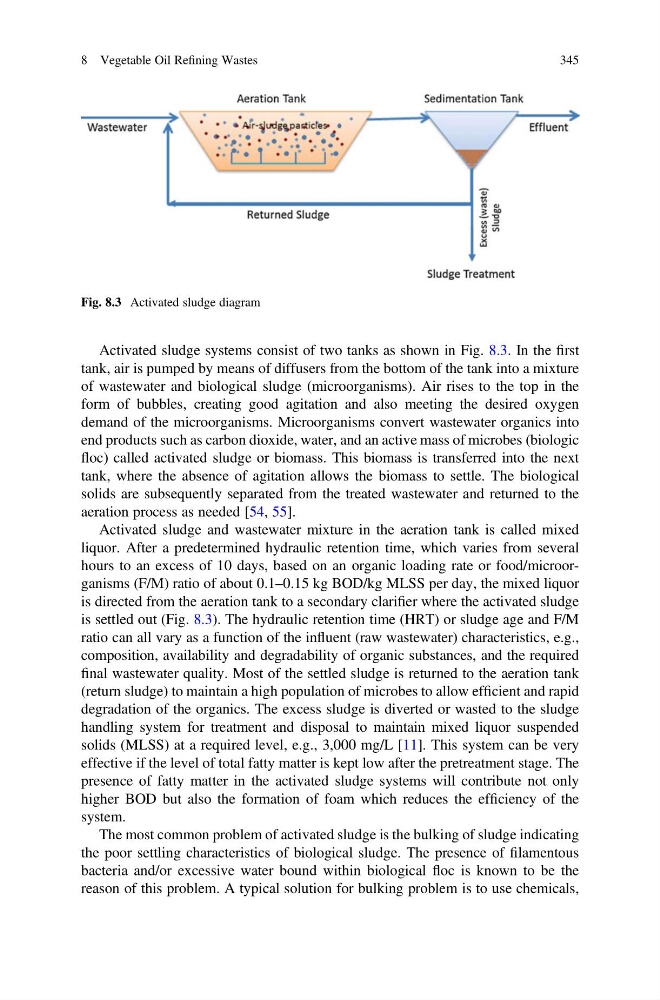
Activated sludge systems consist of two tanks as shown in Fig. 8.3. In the first
tank, air is pumped by means of diffusers from the bottom of the tank into a mixture
of wastewater and biological sludge (microorganisms). Air rises to the top in the
form of bubbles, creating good agitation and also meeting the desired oxygen
demand of the microorganisms. Microorganisms convert wastewater organics into
end products such as carbon dioxide, water, and an active mass of microbes (biologic
floc) called activated sludge or biomass. This biomass is transferred into the next
tank, where the absence of agitation allows the biomass to settle. The biological
solids are subsequently separated from the treated wastewater and returned to the
aeration process as needed [54, 55].
Activated sludge and wastewater mixture in the aeration tank is called mixed
liquor. After a predetermined hydraulic retention time, which varies from several
hours to an excess of 10 days, based on an organic loading rate or food/microorganisms (F/M) ratio of about 0.1–0.15 kg BOD/kg MLSS per day, the mixed liquor
is directed from the aeration tank to a secondary clarifier where the activated sludge
is settled out (Fig. 8.3). The hydraulic retention time (HRT) or sludge age and F/M
ratio can all vary as a function of the influent (raw wastewater) characteristics, e.g.,
composition, availability and degradability of organic substances, and the required
final wastewater quality. Most of the settled sludge is returned to the aeration tank
(return sludge) to maintain a high population of microbes to allow efficient and rapid
degradation of the organics. The excess sludge is diverted or wasted to the sludge
handling system for treatment and disposal to maintain mixed liquor suspended
solids (MLSS) at a required level, e.g., 3,000 mg/L [11]. This system can be very
effective if the level of total fatty matter is kept low after the pretreatment stage. The
presence of fatty matter in the activated sludge systems will contribute not only
higher BOD but also the formation of foam which reduces the efficiency of the
system.
The most common problem of activated sludge is the bulking of sludge indicating
the poor settling characteristics of biological sludge. The presence of filamentous
bacteria and/or excessive water bound within biological floc is known to be the
reason of this problem. A typical solution for bulking problem is to use chemicals,
Fig. 8.3 Activated sludge diagram
8 Vegetable Oil Refining Wastes
345
tank, air is pumped by means of diffusers from the bottom of the tank into a mixture
of wastewater and biological sludge (microorganisms). Air rises to the top in the
form of bubbles, creating good agitation and also meeting the desired oxygen
demand of the microorganisms. Microorganisms convert wastewater organics into
end products such as carbon dioxide, water, and an active mass of microbes (biologic
floc) called activated sludge or biomass. This biomass is transferred into the next
tank, where the absence of agitation allows the biomass to settle. The biological
solids are subsequently separated from the treated wastewater and returned to the
aeration process as needed [54, 55].
Activated sludge and wastewater mixture in the aeration tank is called mixed
liquor. After a predetermined hydraulic retention time, which varies from several
hours to an excess of 10 days, based on an organic loading rate or food/microorganisms (F/M) ratio of about 0.1–0.15 kg BOD/kg MLSS per day, the mixed liquor
is directed from the aeration tank to a secondary clarifier where the activated sludge
is settled out (Fig. 8.3). The hydraulic retention time (HRT) or sludge age and F/M
ratio can all vary as a function of the influent (raw wastewater) characteristics, e.g.,
composition, availability and degradability of organic substances, and the required
final wastewater quality. Most of the settled sludge is returned to the aeration tank
(return sludge) to maintain a high population of microbes to allow efficient and rapid
degradation of the organics. The excess sludge is diverted or wasted to the sludge
handling system for treatment and disposal to maintain mixed liquor suspended
solids (MLSS) at a required level, e.g., 3,000 mg/L [11]. This system can be very
effective if the level of total fatty matter is kept low after the pretreatment stage. The
presence of fatty matter in the activated sludge systems will contribute not only
higher BOD but also the formation of foam which reduces the efficiency of the
system.
The most common problem of activated sludge is the bulking of sludge indicating
the poor settling characteristics of biological sludge. The presence of filamentous
bacteria and/or excessive water bound within biological floc is known to be the
reason of this problem. A typical solution for bulking problem is to use chemicals,
Fig. 8.3 Activated sludge diagram
8 Vegetable Oil Refining Wastes
345