

Electroflotation
Electrochemical processes are investigated in several studies to treat oily wastewater
[34–37]. Briefly, in this process, bubbles are generated to carry the pollutants such as
sludge and fine particles to the top of the solution where they can be more easily
concentrated, collected, and removed. An electrochemical reactor consists of two
sets of iron electrodes, anodes and cathodes, in which treatment is done in 2–20 min
with intense iron dissolution. The electrodes are placed a few millimeters apart from
each other and submerged in the wastewater that is to be treated for oil contamination. The cathode and anode are connected to the negative and positive outlets of a
DC power supply, respectively. When direct current is applied to water through the
electrodes, the energy barrier is overcome, and water molecules are broken down
into hydrogen and oxygen gases. The reaction is observed through the hydrogen
bubbles that evolve from the cathode and oxygen bubbles that originate from the
anode. On the other hand, when the anode is made of metals having lower oxidation
potentials than water, the anode is dissolved to produce metal ions instead of
generating oxygen. These ions then react with hydroxyl ions, the by-products of
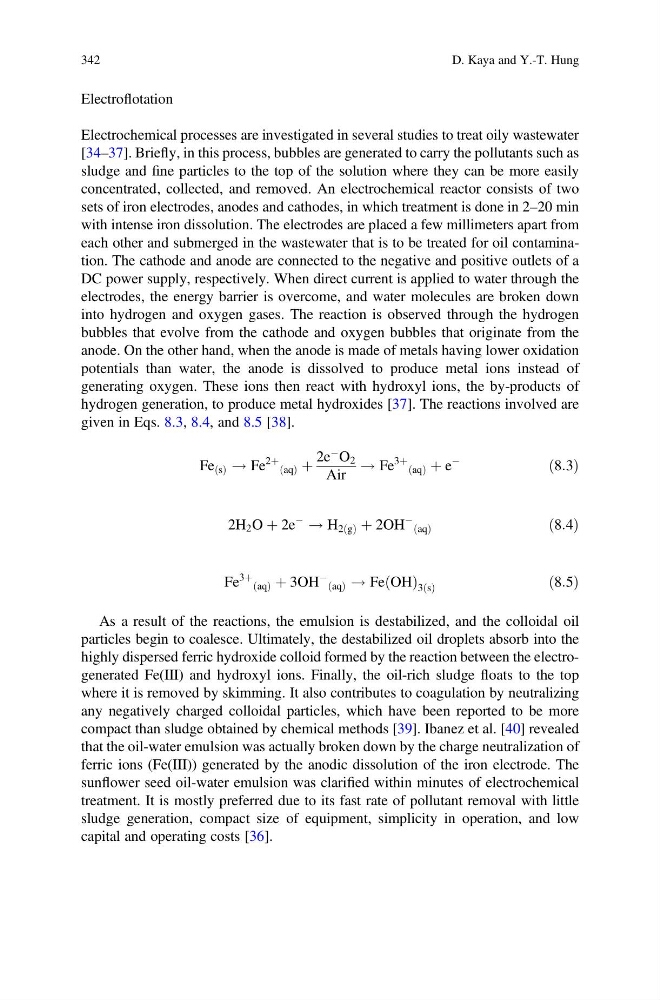
hydrogen generation, to produce metal hydroxides [37]. The reactions involved are
given in Eqs. 8.3, 8.4, and 8.5 [38].
Fe s
ð Þ ! Fe
2þ
aq
ð Þ þ
2e
À O 2
Air
! Fe
3þ
aq
ð Þ þ e
À
ð8:3Þ
2H 2 O þ 2e
À
! H 2 g
ð Þ þ 2OH
À
aq
ð Þ
ð8:4Þ
Fe
3þ
aq
ð Þ þ 3OH
À
aq
ð Þ ! Fe OH
ð Þ 3 s
ð Þ
ð8:5Þ
As a result of the reactions, the emulsion is destabilized, and the colloidal oil
particles begin to coalesce. Ultimately, the destabilized oil droplets absorb into the
highly dispersed ferric hydroxide colloid formed by the reaction between the electrogenerated Fe(III) and hydroxyl ions. Finally, the oil-rich sludge floats to the top
where it is removed by skimming. It also contributes to coagulation by neutralizing
any negatively charged colloidal particles, which have been reported to be more
compact than sludge obtained by chemical methods [39]. Ibanez et al. [40] revealed
that the oil-water emulsion was actually broken down by the charge neutralization of
ferric ions (Fe(III)) generated by the anodic dissolution of the iron electrode. The
sunflower seed oil-water emulsion was clarified within minutes of electrochemical
treatment. It is mostly preferred due to its fast rate of pollutant removal with little
sludge generation, compact size of equipment, simplicity in operation, and low
capital and operating costs [36].
342
D. Kaya and Y.-T. Hung
Electrochemical processes are investigated in several studies to treat oily wastewater
[34–37]. Briefly, in this process, bubbles are generated to carry the pollutants such as
sludge and fine particles to the top of the solution where they can be more easily
concentrated, collected, and removed. An electrochemical reactor consists of two
sets of iron electrodes, anodes and cathodes, in which treatment is done in 2–20 min
with intense iron dissolution. The electrodes are placed a few millimeters apart from
each other and submerged in the wastewater that is to be treated for oil contamination. The cathode and anode are connected to the negative and positive outlets of a
DC power supply, respectively. When direct current is applied to water through the
electrodes, the energy barrier is overcome, and water molecules are broken down
into hydrogen and oxygen gases. The reaction is observed through the hydrogen
bubbles that evolve from the cathode and oxygen bubbles that originate from the
anode. On the other hand, when the anode is made of metals having lower oxidation
potentials than water, the anode is dissolved to produce metal ions instead of
generating oxygen. These ions then react with hydroxyl ions, the by-products of
hydrogen generation, to produce metal hydroxides [37]. The reactions involved are
given in Eqs. 8.3, 8.4, and 8.5 [38].
Fe s
ð Þ ! Fe
2þ
aq
ð Þ þ
2e
À O 2
Air
! Fe
3þ
aq
ð Þ þ e
À
ð8:3Þ
2H 2 O þ 2e
À
! H 2 g
ð Þ þ 2OH
À
aq
ð Þ
ð8:4Þ
Fe
3þ
aq
ð Þ þ 3OH
À
aq
ð Þ ! Fe OH
ð Þ 3 s
ð Þ
ð8:5Þ
As a result of the reactions, the emulsion is destabilized, and the colloidal oil
particles begin to coalesce. Ultimately, the destabilized oil droplets absorb into the
highly dispersed ferric hydroxide colloid formed by the reaction between the electrogenerated Fe(III) and hydroxyl ions. Finally, the oil-rich sludge floats to the top
where it is removed by skimming. It also contributes to coagulation by neutralizing
any negatively charged colloidal particles, which have been reported to be more
compact than sludge obtained by chemical methods [39]. Ibanez et al. [40] revealed
that the oil-water emulsion was actually broken down by the charge neutralization of
ferric ions (Fe(III)) generated by the anodic dissolution of the iron electrode. The
sunflower seed oil-water emulsion was clarified within minutes of electrochemical
treatment. It is mostly preferred due to its fast rate of pollutant removal with little
sludge generation, compact size of equipment, simplicity in operation, and low
capital and operating costs [36].
342
D. Kaya and Y.-T. Hung