

1 Introduction
Vegetable oils and fats are essential to humans as a source of nutrients, but they are
also used in animal feed, for medicinal purposes, and for certain technical applications. There are numerous vegetable oils derived from various sources. Soybean,
sesame, sunflower, corn, canola, and cotton seeds are the most commonly used raw
materials for the production of edible oil [1]. Their yields, compositions, and
physical and chemical properties determine their usefulness in various applications
aside from edible uses.
Until the 19
th century, vegetable oils were extracted from oil seeds through
mechanical or hydraulic means. Today, vegetable oils are obtained by different
pressing methods, solvent extraction, or a combination of these [2]. The selection
of the extraction process depends primarily on the oil content of the source material,
the amount of residual oil in the meal allowed, the amount of protein denaturation
allowed, the amount of investment capital available, and local environmental laws
concerning emissions of volatile organic compounds (VOCs).
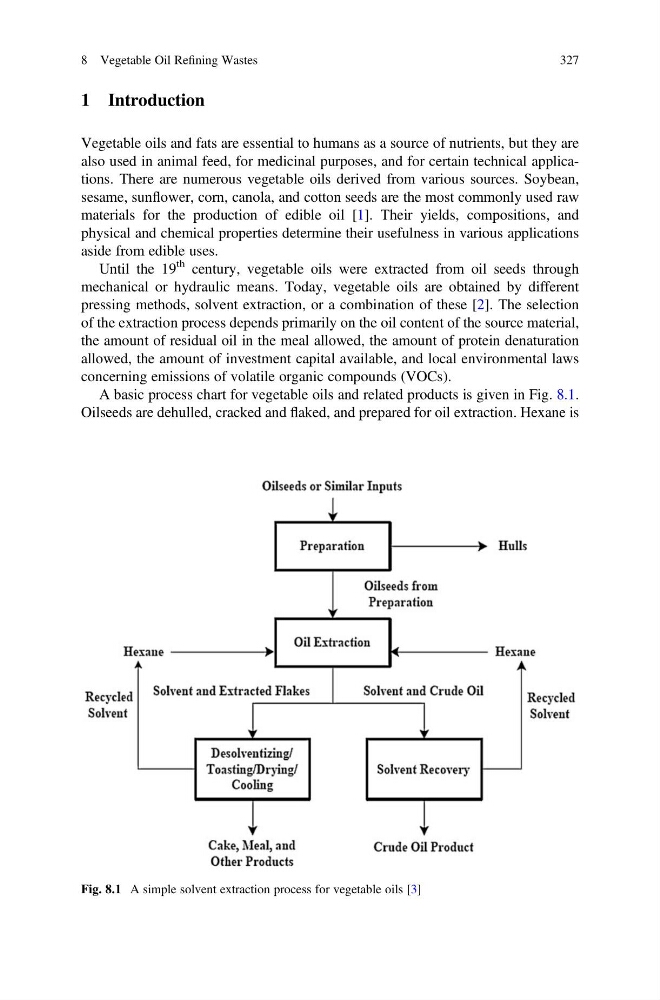
A basic process chart for vegetable oils and related products is given in Fig. 8.1.
Oilseeds are dehulled, cracked and flaked, and prepared for oil extraction. Hexane is
Fig. 8.1 A simple solvent extraction process for vegetable oils [3]
8 Vegetable Oil Refining Wastes
327
Vegetable oils and fats are essential to humans as a source of nutrients, but they are
also used in animal feed, for medicinal purposes, and for certain technical applications. There are numerous vegetable oils derived from various sources. Soybean,
sesame, sunflower, corn, canola, and cotton seeds are the most commonly used raw
materials for the production of edible oil [1]. Their yields, compositions, and
physical and chemical properties determine their usefulness in various applications
aside from edible uses.
Until the 19
th century, vegetable oils were extracted from oil seeds through
mechanical or hydraulic means. Today, vegetable oils are obtained by different
pressing methods, solvent extraction, or a combination of these [2]. The selection
of the extraction process depends primarily on the oil content of the source material,
the amount of residual oil in the meal allowed, the amount of protein denaturation
allowed, the amount of investment capital available, and local environmental laws
concerning emissions of volatile organic compounds (VOCs).
A basic process chart for vegetable oils and related products is given in Fig. 8.1.
Oilseeds are dehulled, cracked and flaked, and prepared for oil extraction. Hexane is
Fig. 8.1 A simple solvent extraction process for vegetable oils [3]
8 Vegetable Oil Refining Wastes
327