

by matching the collected XRD patterns with those derived from the standard
powder diffraction database of the International Centre for Diffraction Data (ICDD
PDF-2 Release 2008). With Rietveld refinement of the XRD patterns, the weight
fractions (in percentages) of the phases in the sample were obtained. The refinement
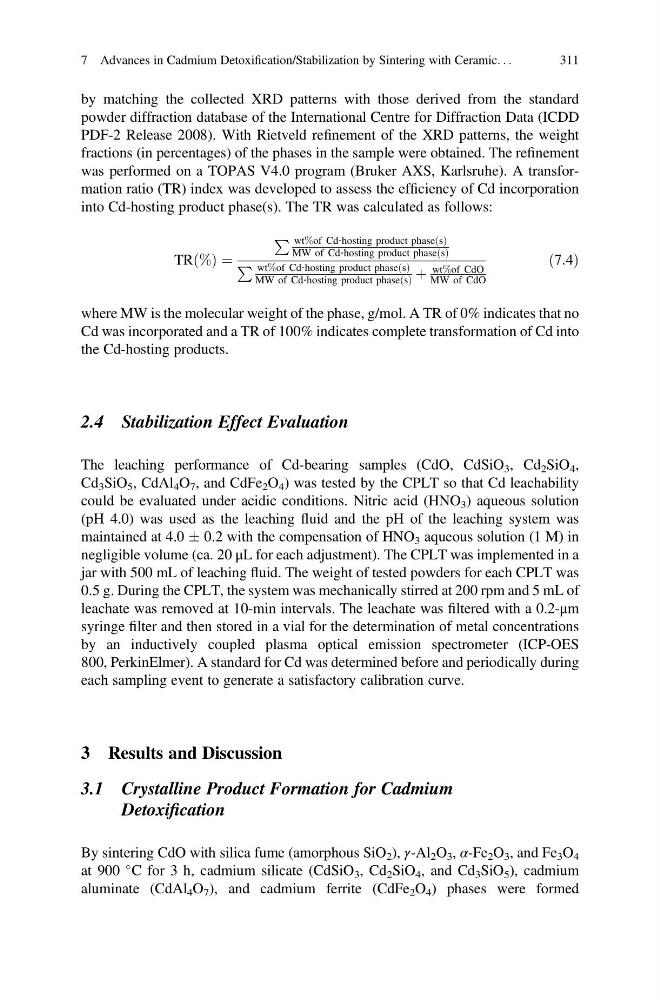
was performed on a TOPAS V4.0 program (Bruker AXS, Karlsruhe). A transformation ratio (TR) index was developed to assess the efficiency of Cd incorporation
into Cd-hosting product phase(s). The TR was calculated as follows:
TR %
ð Þ ¼
P wt%of Cd‐hosting product phase s
ð Þ
MW of Cd‐hosting product phase s
ð Þ
P wt%of Cd‐hosting product phase s
ð Þ
MW of Cd‐hosting product phase s
ð Þ þ
wt%of CdO
MW of CdO
ð7:4Þ
where MW is the molecular weight of the phase, g/mol. A TR of 0% indicates that no
Cd was incorporated and a TR of 100% indicates complete transformation of Cd into
the Cd-hosting products.
2.4 Stabilization Effect Evaluation
The leaching performance of Cd-bearing samples (CdO, CdSiO 3 , Cd 2 SiO 4 ,
Cd 3 SiO 5 , CdAl 4 O 7 , and CdFe 2 O 4 ) was tested by the CPLT so that Cd leachability
could be evaluated under acidic conditions. Nitric acid (HNO 3 ) aqueous solution
(pH 4.0) was used as the leaching fluid and the pH of the leaching system was
maintained at 4.0 Æ 0.2 with the compensation of HNO 3 aqueous solution (1 M) in
negligible volume (ca. 20 μL for each adjustment). The CPLT was implemented in a
jar with 500 mL of leaching fluid. The weight of tested powders for each CPLT was
0.5 g. During the CPLT, the system was mechanically stirred at 200 rpm and 5 mL of
leachate was removed at 10-min intervals. The leachate was filtered with a 0.2-μm
syringe filter and then stored in a vial for the determination of metal concentrations
by an inductively coupled plasma optical emission spectrometer (ICP-OES
800, PerkinElmer). A standard for Cd was determined before and periodically during
each sampling event to generate a satisfactory calibration curve.
3 Results and Discussion
3.1 Crystalline Product Formation for Cadmium
Detoxification
By sintering CdO with silica fume (amorphous SiO 2 ), γ-Al 2 O 3 , α-Fe 2 O 3 , and Fe 3 O 4
at 900
C for 3 h, cadmium silicate (CdSiO 3 , Cd 2 SiO 4 , and Cd 3 SiO 5 ), cadmium
aluminate (CdAl 4 O 7 ), and cadmium ferrite (CdFe 2 O 4 ) phases were formed
7 Advances in Cadmium Detoxification/Stabilization by Sintering with Ceramic. . .
311
powder diffraction database of the International Centre for Diffraction Data (ICDD
PDF-2 Release 2008). With Rietveld refinement of the XRD patterns, the weight
fractions (in percentages) of the phases in the sample were obtained. The refinement
was performed on a TOPAS V4.0 program (Bruker AXS, Karlsruhe). A transformation ratio (TR) index was developed to assess the efficiency of Cd incorporation
into Cd-hosting product phase(s). The TR was calculated as follows:
TR %
ð Þ ¼
P wt%of Cd‐hosting product phase s
ð Þ
MW of Cd‐hosting product phase s
ð Þ
P wt%of Cd‐hosting product phase s
ð Þ
MW of Cd‐hosting product phase s
ð Þ þ
wt%of CdO
MW of CdO
ð7:4Þ
where MW is the molecular weight of the phase, g/mol. A TR of 0% indicates that no
Cd was incorporated and a TR of 100% indicates complete transformation of Cd into
the Cd-hosting products.
2.4 Stabilization Effect Evaluation
The leaching performance of Cd-bearing samples (CdO, CdSiO 3 , Cd 2 SiO 4 ,
Cd 3 SiO 5 , CdAl 4 O 7 , and CdFe 2 O 4 ) was tested by the CPLT so that Cd leachability
could be evaluated under acidic conditions. Nitric acid (HNO 3 ) aqueous solution
(pH 4.0) was used as the leaching fluid and the pH of the leaching system was
maintained at 4.0 Æ 0.2 with the compensation of HNO 3 aqueous solution (1 M) in
negligible volume (ca. 20 μL for each adjustment). The CPLT was implemented in a
jar with 500 mL of leaching fluid. The weight of tested powders for each CPLT was
0.5 g. During the CPLT, the system was mechanically stirred at 200 rpm and 5 mL of
leachate was removed at 10-min intervals. The leachate was filtered with a 0.2-μm
syringe filter and then stored in a vial for the determination of metal concentrations
by an inductively coupled plasma optical emission spectrometer (ICP-OES
800, PerkinElmer). A standard for Cd was determined before and periodically during
each sampling event to generate a satisfactory calibration curve.
3 Results and Discussion
3.1 Crystalline Product Formation for Cadmium
Detoxification
By sintering CdO with silica fume (amorphous SiO 2 ), γ-Al 2 O 3 , α-Fe 2 O 3 , and Fe 3 O 4
at 900
C for 3 h, cadmium silicate (CdSiO 3 , Cd 2 SiO 4 , and Cd 3 SiO 5 ), cadmium
aluminate (CdAl 4 O 7 ), and cadmium ferrite (CdFe 2 O 4 ) phases were formed
7 Advances in Cadmium Detoxification/Stabilization by Sintering with Ceramic. . .
311