

Quantitative X-ray diffraction and constant-pH leaching test (CPLT) results reveal
the metal incorporation efficiencies and metal stabilization effects of this method.
1.1 Cadmium Pollution and Control Technologies
The rapid development of industrialization has generated a huge amount of solid
waste, including mining waste, electronic devices, industrial and domestic sludge,
and incineration residues like bottom and fly ash [2, 26–32]. Such solid waste often
contains large amounts of heavy metals and is a main source of environmental
pollution. The toxicity of heavy metals has been widely studied. Their effects on
human health have been well assessed by international organizations, such as the
World Health Organization (WHO). The heavy metals Cd, Pb, Hg, and Cr and most
of their compounds have been classified as highly toxic and are known to be
carcinogenic. Heavy metals tend to bioaccumulate in food chains and are eventually
assimilated in living tissues [33]. As they are non-biodegradable, they are very stable
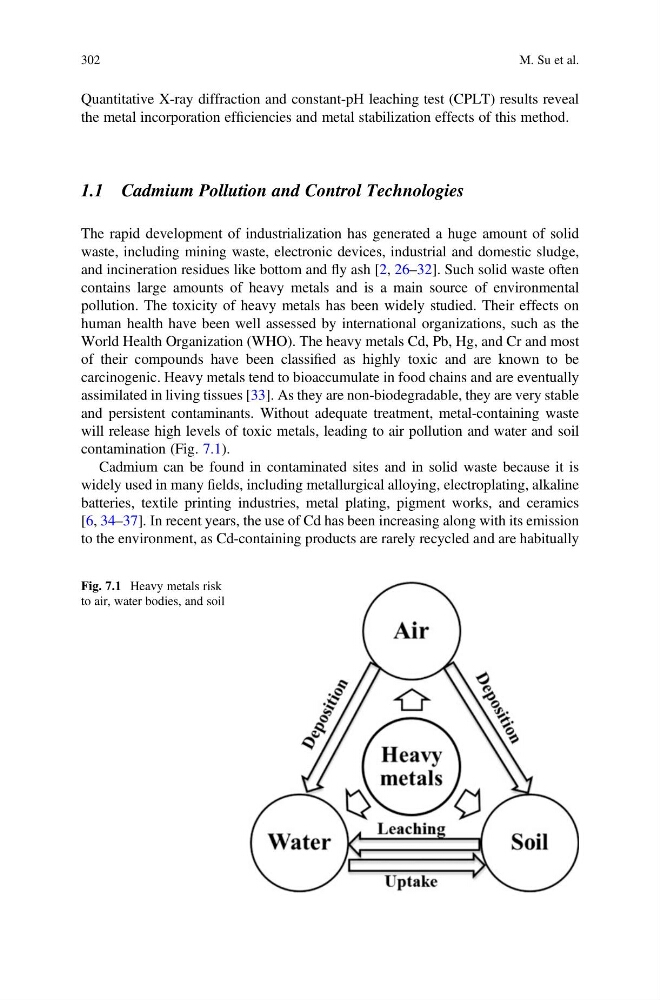
and persistent contaminants. Without adequate treatment, metal-containing waste
will release high levels of toxic metals, leading to air pollution and water and soil
contamination (Fig. 7.1).
Cadmium can be found in contaminated sites and in solid waste because it is
widely used in many fields, including metallurgical alloying, electroplating, alkaline
batteries, textile printing industries, metal plating, pigment works, and ceramics
[6, 34–37]. In recent years, the use of Cd has been increasing along with its emission
to the environment, as Cd-containing products are rarely recycled and are habitually
Fig. 7.1 Heavy metals risk
to air, water bodies, and soil
302
M. Su et al.
the metal incorporation efficiencies and metal stabilization effects of this method.
1.1 Cadmium Pollution and Control Technologies
The rapid development of industrialization has generated a huge amount of solid
waste, including mining waste, electronic devices, industrial and domestic sludge,
and incineration residues like bottom and fly ash [2, 26–32]. Such solid waste often
contains large amounts of heavy metals and is a main source of environmental
pollution. The toxicity of heavy metals has been widely studied. Their effects on
human health have been well assessed by international organizations, such as the
World Health Organization (WHO). The heavy metals Cd, Pb, Hg, and Cr and most
of their compounds have been classified as highly toxic and are known to be
carcinogenic. Heavy metals tend to bioaccumulate in food chains and are eventually
assimilated in living tissues [33]. As they are non-biodegradable, they are very stable
and persistent contaminants. Without adequate treatment, metal-containing waste
will release high levels of toxic metals, leading to air pollution and water and soil
contamination (Fig. 7.1).
Cadmium can be found in contaminated sites and in solid waste because it is
widely used in many fields, including metallurgical alloying, electroplating, alkaline
batteries, textile printing industries, metal plating, pigment works, and ceramics
[6, 34–37]. In recent years, the use of Cd has been increasing along with its emission
to the environment, as Cd-containing products are rarely recycled and are habitually
Fig. 7.1 Heavy metals risk
to air, water bodies, and soil
302
M. Su et al.