

cannot survive, their predators may in turn disappear, because they are not available
at the proper time for use by their predators. Thus, it may be seen that a change in
temperature at one location can impact the entire food chain throughout a stream or
ecosystem. Blue-green algae are more tolerant of higher temperatures. Some have
been shown to be present at up to 77
C in hot springs such as at Yellowstone. Most
of the colors in the hot springs are produced by different species of blue-green algae.
The blue-green algae, however, are less desirable as food for other organisms.
Therefore, they will consume the nutrients available and produce organic matter
that is not readily used by higher organisms in the food chain. This obviously distorts
the entire system.
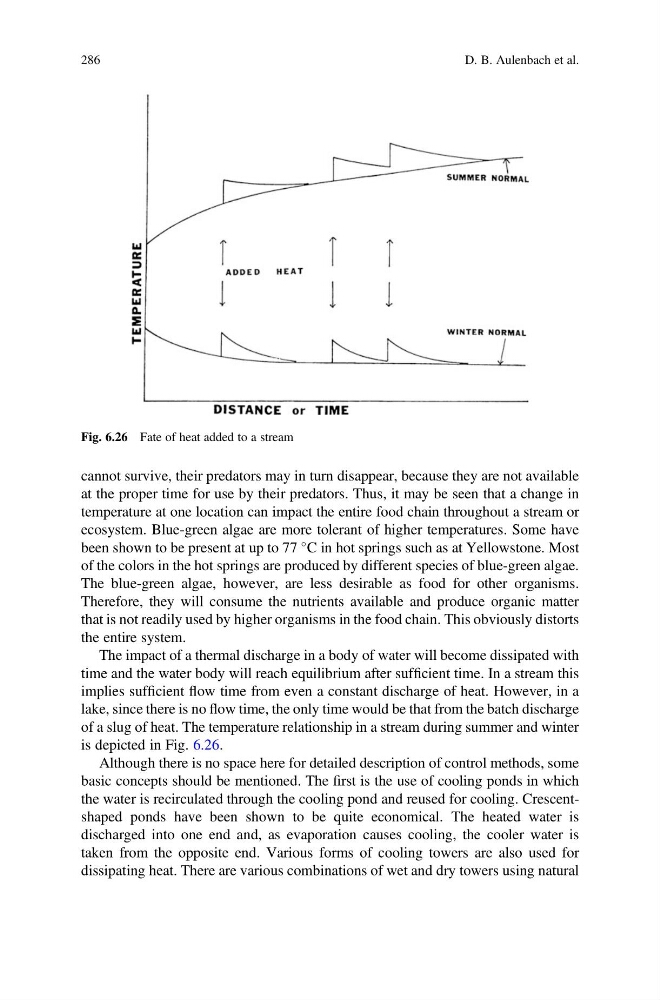
The impact of a thermal discharge in a body of water will become dissipated with
time and the water body will reach equilibrium after sufficient time. In a stream this
implies sufficient flow time from even a constant discharge of heat. However, in a
lake, since there is no flow time, the only time would be that from the batch discharge
of a slug of heat. The temperature relationship in a stream during summer and winter
is depicted in Fig. 6.26.
Although there is no space here for detailed description of control methods, some
basic concepts should be mentioned. The first is the use of cooling ponds in which
the water is recirculated through the cooling pond and reused for cooling. Crescentshaped ponds have been shown to be quite economical. The heated water is
discharged into one end and, as evaporation causes cooling, the cooler water is
taken from the opposite end. Various forms of cooling towers are also used for
dissipating heat. There are various combinations of wet and dry towers using natural
Fig. 6.26 Fate of heat added to a stream
286
D. B. Aulenbach et al.
at the proper time for use by their predators. Thus, it may be seen that a change in
temperature at one location can impact the entire food chain throughout a stream or
ecosystem. Blue-green algae are more tolerant of higher temperatures. Some have
been shown to be present at up to 77
C in hot springs such as at Yellowstone. Most
of the colors in the hot springs are produced by different species of blue-green algae.
The blue-green algae, however, are less desirable as food for other organisms.
Therefore, they will consume the nutrients available and produce organic matter
that is not readily used by higher organisms in the food chain. This obviously distorts
the entire system.
The impact of a thermal discharge in a body of water will become dissipated with
time and the water body will reach equilibrium after sufficient time. In a stream this
implies sufficient flow time from even a constant discharge of heat. However, in a
lake, since there is no flow time, the only time would be that from the batch discharge
of a slug of heat. The temperature relationship in a stream during summer and winter
is depicted in Fig. 6.26.
Although there is no space here for detailed description of control methods, some
basic concepts should be mentioned. The first is the use of cooling ponds in which
the water is recirculated through the cooling pond and reused for cooling. Crescentshaped ponds have been shown to be quite economical. The heated water is
discharged into one end and, as evaporation causes cooling, the cooler water is
taken from the opposite end. Various forms of cooling towers are also used for
dissipating heat. There are various combinations of wet and dry towers using natural
Fig. 6.26 Fate of heat added to a stream
286
D. B. Aulenbach et al.