

oxygen available for biological respiration at the higher temperature. Another
physical impact is the reduction of viscosity at a higher temperature. This is a benefit
in waste treatment plants in that it allows a more rapid settling of the particulate
matter. However, certain plankton require a specific viscosity of water in order to
remain in suspension. At a lower viscosity they will sink and may not be able to
remain in the euphotic zone. Obviously, greater evaporation occurs at a higher
temperature, thereby removing water from the liquid to the vapor phase. This does
result in an increased rate of cooling; however, the net effect is a greater loss of
water. Rapid heating of water or pressure reduction, such as in passing through a
power turbine, causes supersaturation of the nitrogen in the water, which has been
shown to kill fish by the formation of nitrogen bubbles in their blood systems.
In terms of chemical effects, most rates of reaction are increased at a higher
temperature. Unfortunately, this reduces the biological tolerance to change. This is
similar to the reaction with enzymes or catalysts that normally are more effective at
higher temperatures. Tastes and odors are also increased at higher temperatures. The
BOD rate, which is both chemical and biological, also increases, thus satisfying the
BOD in a shorter period of time. This can benefit an area farther downstream, but can
result in serious oxygen depletion in the area immediately below a discharge
containing a high BOD. Since there is less oxygen available at the higher temperature, it may be seen that the depletion is considerably more rapid and oxygen
deficiency occurs in a shorter period of time.
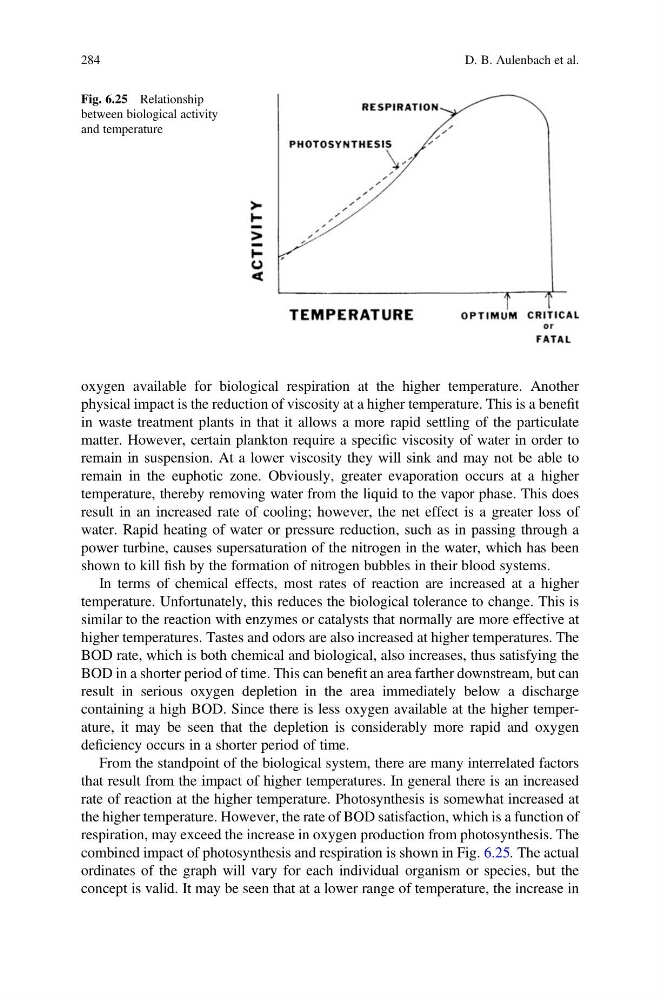
From the standpoint of the biological system, there are many interrelated factors
that result from the impact of higher temperatures. In general there is an increased
rate of reaction at the higher temperature. Photosynthesis is somewhat increased at
the higher temperature. However, the rate of BOD satisfaction, which is a function of
respiration, may exceed the increase in oxygen production from photosynthesis. The
combined impact of photosynthesis and respiration is shown in Fig. 6.25. The actual
ordinates of the graph will vary for each individual organism or species, but the
concept is valid. It may be seen that at a lower range of temperature, the increase in
Fig. 6.25 Relationship
between biological activity
and temperature
284
D. B. Aulenbach et al.
physical impact is the reduction of viscosity at a higher temperature. This is a benefit
in waste treatment plants in that it allows a more rapid settling of the particulate
matter. However, certain plankton require a specific viscosity of water in order to
remain in suspension. At a lower viscosity they will sink and may not be able to
remain in the euphotic zone. Obviously, greater evaporation occurs at a higher
temperature, thereby removing water from the liquid to the vapor phase. This does
result in an increased rate of cooling; however, the net effect is a greater loss of
water. Rapid heating of water or pressure reduction, such as in passing through a
power turbine, causes supersaturation of the nitrogen in the water, which has been
shown to kill fish by the formation of nitrogen bubbles in their blood systems.
In terms of chemical effects, most rates of reaction are increased at a higher
temperature. Unfortunately, this reduces the biological tolerance to change. This is
similar to the reaction with enzymes or catalysts that normally are more effective at
higher temperatures. Tastes and odors are also increased at higher temperatures. The
BOD rate, which is both chemical and biological, also increases, thus satisfying the
BOD in a shorter period of time. This can benefit an area farther downstream, but can
result in serious oxygen depletion in the area immediately below a discharge
containing a high BOD. Since there is less oxygen available at the higher temperature, it may be seen that the depletion is considerably more rapid and oxygen
deficiency occurs in a shorter period of time.
From the standpoint of the biological system, there are many interrelated factors
that result from the impact of higher temperatures. In general there is an increased
rate of reaction at the higher temperature. Photosynthesis is somewhat increased at
the higher temperature. However, the rate of BOD satisfaction, which is a function of
respiration, may exceed the increase in oxygen production from photosynthesis. The
combined impact of photosynthesis and respiration is shown in Fig. 6.25. The actual
ordinates of the graph will vary for each individual organism or species, but the
concept is valid. It may be seen that at a lower range of temperature, the increase in
Fig. 6.25 Relationship
between biological activity
and temperature
284
D. B. Aulenbach et al.