

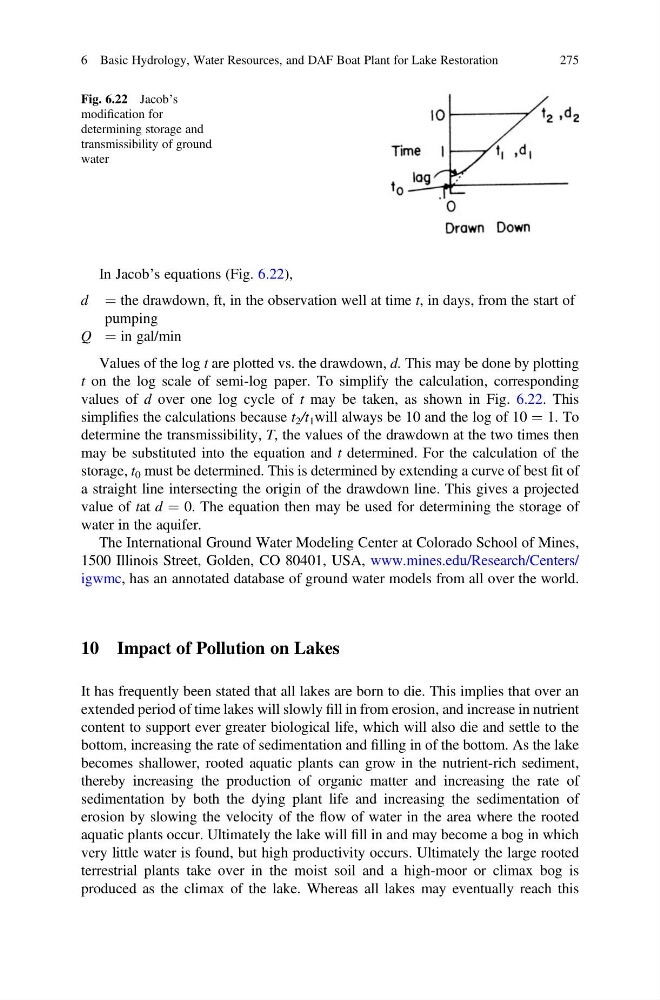
In Jacob’s equations (Fig. 6.22),
d ¼ the drawdown, ft, in the observation well at time t, in days, from the start of
pumping
Q ¼ in gal/min
Values of the log t are plotted vs. the drawdown, d. This may be done by plotting
t on the log scale of semi-log paper. To simplify the calculation, corresponding
values of d over one log cycle of t may be taken, as shown in Fig. 6.22. This
simplifies the calculations because t 2 /t 1 will always be 10 and the log of 10 ¼ 1. To
determine the transmissibility, T, the values of the drawdown at the two times then
may be substituted into the equation and t determined. For the calculation of the
storage, t 0 must be determined. This is determined by extending a curve of best fit of
a straight line intersecting the origin of the drawdown line. This gives a projected
value of tat d ¼ 0. The equation then may be used for determining the storage of
water in the aquifer.
The International Ground Water Modeling Center at Colorado School of Mines,
1500 Illinois Street, Golden, CO 80401, USA, www.mines.edu/Research/Centers/
igwmc, has an annotated database of ground water models from all over the world.
10 Impact of Pollution on Lakes
It has frequently been stated that all lakes are born to die. This implies that over an
extended period of time lakes will slowly fill in from erosion, and increase in nutrient
content to support ever greater biological life, which will also die and settle to the
bottom, increasing the rate of sedimentation and filling in of the bottom. As the lake
becomes shallower, rooted aquatic plants can grow in the nutrient-rich sediment,
thereby increasing the production of organic matter and increasing the rate of
sedimentation by both the dying plant life and increasing the sedimentation of
erosion by slowing the velocity of the flow of water in the area where the rooted
aquatic plants occur. Ultimately the lake will fill in and may become a bog in which
very little water is found, but high productivity occurs. Ultimately the large rooted
terrestrial plants take over in the moist soil and a high-moor or climax bog is
produced as the climax of the lake. Whereas all lakes may eventually reach this
Fig. 6.22 Jacob’s
modification for
determining storage and
transmissibility of ground
water
6 Basic Hydrology, Water Resources, and DAF Boat Plant for Lake Restoration
275
d ¼ the drawdown, ft, in the observation well at time t, in days, from the start of
pumping
Q ¼ in gal/min
Values of the log t are plotted vs. the drawdown, d. This may be done by plotting
t on the log scale of semi-log paper. To simplify the calculation, corresponding
values of d over one log cycle of t may be taken, as shown in Fig. 6.22. This
simplifies the calculations because t 2 /t 1 will always be 10 and the log of 10 ¼ 1. To
determine the transmissibility, T, the values of the drawdown at the two times then
may be substituted into the equation and t determined. For the calculation of the
storage, t 0 must be determined. This is determined by extending a curve of best fit of
a straight line intersecting the origin of the drawdown line. This gives a projected
value of tat d ¼ 0. The equation then may be used for determining the storage of
water in the aquifer.
The International Ground Water Modeling Center at Colorado School of Mines,
1500 Illinois Street, Golden, CO 80401, USA, www.mines.edu/Research/Centers/
igwmc, has an annotated database of ground water models from all over the world.
10 Impact of Pollution on Lakes
It has frequently been stated that all lakes are born to die. This implies that over an
extended period of time lakes will slowly fill in from erosion, and increase in nutrient
content to support ever greater biological life, which will also die and settle to the
bottom, increasing the rate of sedimentation and filling in of the bottom. As the lake
becomes shallower, rooted aquatic plants can grow in the nutrient-rich sediment,
thereby increasing the production of organic matter and increasing the rate of
sedimentation by both the dying plant life and increasing the sedimentation of
erosion by slowing the velocity of the flow of water in the area where the rooted
aquatic plants occur. Ultimately the lake will fill in and may become a bog in which
very little water is found, but high productivity occurs. Ultimately the large rooted
terrestrial plants take over in the moist soil and a high-moor or climax bog is
produced as the climax of the lake. Whereas all lakes may eventually reach this
Fig. 6.22 Jacob’s
modification for
determining storage and
transmissibility of ground
water
6 Basic Hydrology, Water Resources, and DAF Boat Plant for Lake Restoration
275