

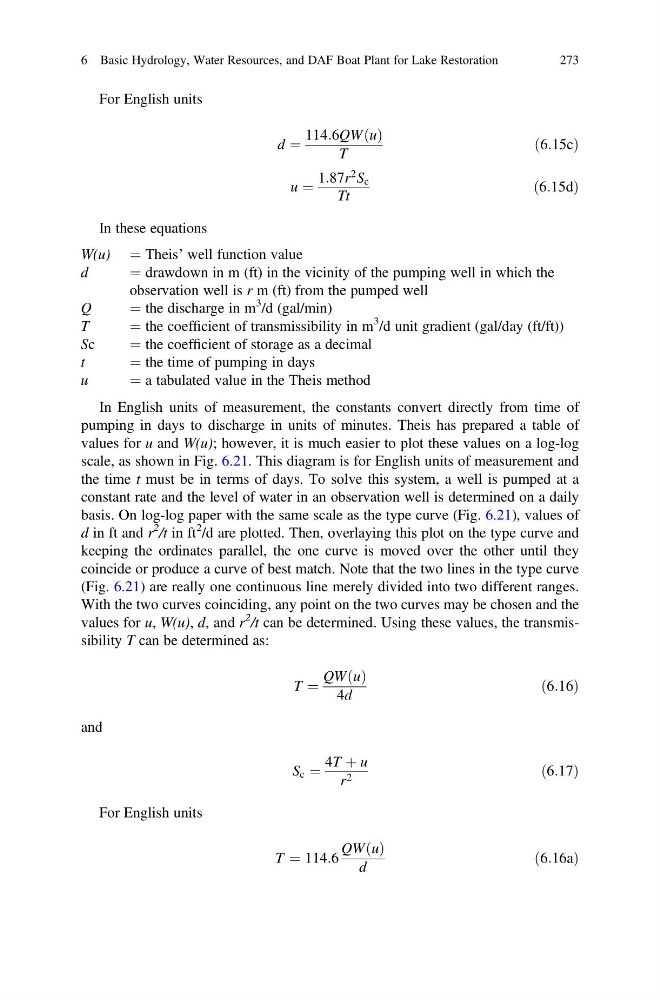
For English units
d ¼
114:6QW u
ð Þ
T
ð6:15cÞ
u ¼
1:87r
2 S c
Tt
ð6:15dÞ
In these equations
W(u) ¼ Theis’ well function value
d
¼ drawdown in m (ft) in the vicinity of the pumping well in which the
observation well is r m (ft) from the pumped well
Q
¼ the discharge in m
3 /d (gal/min)
T
¼ the coefficient of transmissibility in m
3 /d unit gradient (gal/day (ft/ft))
Sc
¼ the coefficient of storage as a decimal
t
¼ the time of pumping in days
u
¼ a tabulated value in the Theis method
In English units of measurement, the constants convert directly from time of
pumping in days to discharge in units of minutes. Theis has prepared a table of
values for u and W(u); however, it is much easier to plot these values on a log-log
scale, as shown in Fig. 6.21. This diagram is for English units of measurement and
the time t must be in terms of days. To solve this system, a well is pumped at a
constant rate and the level of water in an observation well is determined on a daily
basis. On log-log paper with the same scale as the type curve (Fig. 6.21), values of
d in ft and r
2 /t in ft
2 /d are plotted. Then, overlaying this plot on the type curve and
keeping the ordinates parallel, the one curve is moved over the other until they
coincide or produce a curve of best match. Note that the two lines in the type curve
(Fig. 6.21) are really one continuous line merely divided into two different ranges.
With the two curves coinciding, any point on the two curves may be chosen and the
values for u, W(u), d, and r
2 /t can be determined. Using these values, the transmissibility T can be determined as:
T ¼
QW u
ð Þ
4d
ð6:16Þ
and
S c ¼
4T þ u
r 2
ð6:17Þ
For English units
T ¼ 114:6
QW u
ð Þ
d
ð6:16aÞ
6 Basic Hydrology, Water Resources, and DAF Boat Plant for Lake Restoration
273
d ¼
114:6QW u
ð Þ
T
ð6:15cÞ
u ¼
1:87r
2 S c
Tt
ð6:15dÞ
In these equations
W(u) ¼ Theis’ well function value
d
¼ drawdown in m (ft) in the vicinity of the pumping well in which the
observation well is r m (ft) from the pumped well
Q
¼ the discharge in m
3 /d (gal/min)
T
¼ the coefficient of transmissibility in m
3 /d unit gradient (gal/day (ft/ft))
Sc
¼ the coefficient of storage as a decimal
t
¼ the time of pumping in days
u
¼ a tabulated value in the Theis method
In English units of measurement, the constants convert directly from time of
pumping in days to discharge in units of minutes. Theis has prepared a table of
values for u and W(u); however, it is much easier to plot these values on a log-log
scale, as shown in Fig. 6.21. This diagram is for English units of measurement and
the time t must be in terms of days. To solve this system, a well is pumped at a
constant rate and the level of water in an observation well is determined on a daily
basis. On log-log paper with the same scale as the type curve (Fig. 6.21), values of
d in ft and r
2 /t in ft
2 /d are plotted. Then, overlaying this plot on the type curve and
keeping the ordinates parallel, the one curve is moved over the other until they
coincide or produce a curve of best match. Note that the two lines in the type curve
(Fig. 6.21) are really one continuous line merely divided into two different ranges.
With the two curves coinciding, any point on the two curves may be chosen and the
values for u, W(u), d, and r
2 /t can be determined. Using these values, the transmissibility T can be determined as:
T ¼
QW u
ð Þ
4d
ð6:16Þ
and
S c ¼
4T þ u
r 2
ð6:17Þ
For English units
T ¼ 114:6
QW u
ð Þ
d
ð6:16aÞ
6 Basic Hydrology, Water Resources, and DAF Boat Plant for Lake Restoration
273