

some instances both the slope and direction of the flow may change in a relatively
small distance.
It is also useful to know the time of flow so that the velocity between any two
points may be established. This can be most readily accomplished by means of
various tracers, but the dye Rhodamine WT has been found to be very useful for
monitoring ground water flow (Aulenbach and Clesceri [16]). The dye or other tracer
is placed in the well with the highest water level elevation. Samples are then obtained
continuously or periodically (usually daily) until the dye appears in the next downstream well. Depending upon the means and location of the injection of the dye,
either the first appearance or the peak concentration of the dye in the observation
well is used. Knowing the time until the tracer is observed in the observation well
and the actual distance within the soil, the velocity may be determined as the distance
divided by time. It may be seen that the slope of the ground water table is especially
essential in this case since the flow in a nonhorizontal direction will increase the
distance from one point to another.
Since wells are utilized to obtain water from the ground, it is necessary to
determine how much water can be obtained from the soil without exceeding the
safe yield. Separate calculations must be made for wells in an unconfined aquifer and
those in a confined aquifer. Those in an unconfined aquifer are frequently referred to
as gravity or nonpressure wells, whereas those in a confined aquifer are referred to as
pressure wells. If water is removed from a well at a constant rate until the conditions
within the soil reach equilibrium, measurements can be made to determine the
DIRECTION
OF FLOW
LOWEST
HIGHEST
Line of Equal
Elevation
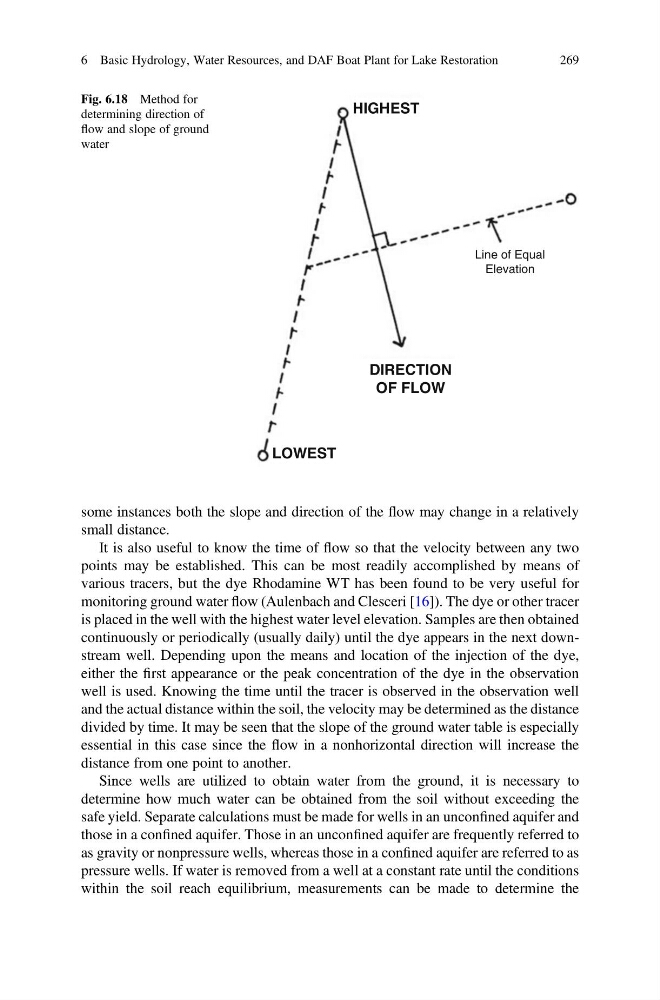
Fig. 6.18 Method for
determining direction of
flow and slope of ground
water
6 Basic Hydrology, Water Resources, and DAF Boat Plant for Lake Restoration
269
small distance.
It is also useful to know the time of flow so that the velocity between any two
points may be established. This can be most readily accomplished by means of
various tracers, but the dye Rhodamine WT has been found to be very useful for
monitoring ground water flow (Aulenbach and Clesceri [16]). The dye or other tracer
is placed in the well with the highest water level elevation. Samples are then obtained
continuously or periodically (usually daily) until the dye appears in the next downstream well. Depending upon the means and location of the injection of the dye,
either the first appearance or the peak concentration of the dye in the observation
well is used. Knowing the time until the tracer is observed in the observation well
and the actual distance within the soil, the velocity may be determined as the distance
divided by time. It may be seen that the slope of the ground water table is especially
essential in this case since the flow in a nonhorizontal direction will increase the
distance from one point to another.
Since wells are utilized to obtain water from the ground, it is necessary to
determine how much water can be obtained from the soil without exceeding the
safe yield. Separate calculations must be made for wells in an unconfined aquifer and
those in a confined aquifer. Those in an unconfined aquifer are frequently referred to
as gravity or nonpressure wells, whereas those in a confined aquifer are referred to as
pressure wells. If water is removed from a well at a constant rate until the conditions
within the soil reach equilibrium, measurements can be made to determine the
DIRECTION
OF FLOW
LOWEST
HIGHEST
Line of Equal
Elevation
Fig. 6.18 Method for
determining direction of
flow and slope of ground
water
6 Basic Hydrology, Water Resources, and DAF Boat Plant for Lake Restoration
269