

The volume of water in a saturated formation is a function of the pore space of the
soil. The porosity, p, is equal to the ratio of the pore void or interstitial space to the
total volume of the rock or soil as:
ρ ¼
Void volume
Total volume
ð6:11Þ
Concurrently, the voids ratio, e, is the ratio of the pore volume to the solid volume
and equals:
e ¼
ρ
1 À ρ
ð6:12Þ
The safe yield of an aquifer is the rate at which water can be withdrawn from it
without depleting the supply to such an extent that further withdrawal at this rate is
no longer economically feasible. The safe yield thus is a function of the velocity of
flow through the aquifer and the source of recharge of the aquifer. The velocity of
flow through an aquifer is a function of the permeability of the soil. According to
Darcy’s law V = ks, in which s is the slope of the hydraulic grade line in vertical units
divided by horizontal units (m/m, or ft/ft) and k is a constant as a function of the type
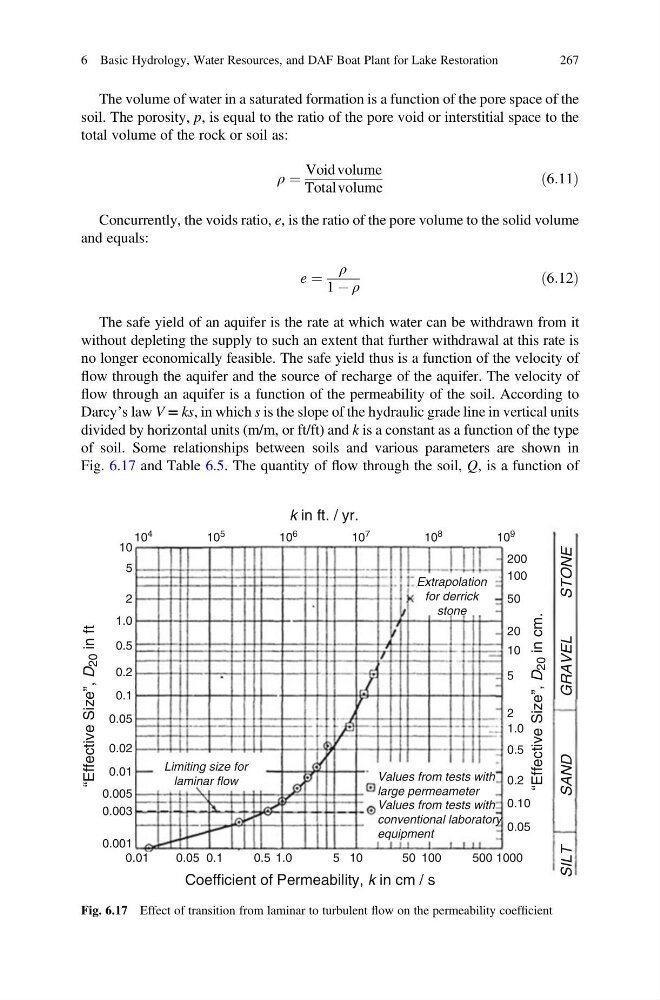
of soil. Some relationships between soils and various parameters are shown in
Fig. 6.17 and Table 6.5. The quantity of flow through the soil, Q, is a function of
10
5
2
1.0
1.0
5 10
50
0.5
0.2
0.1
0.05
0.02
0.01
0.005
0.003
0.001
0.01
0.05 0.1
10 4
10 5
10 6
10 7
10 8
10 9
0.5
Coefficient of Permeability, k in cm / s
k in ft. / yr.
STONE
GRAVEL
SAND
SILT
“Effective Size”, D
20 in ft
“Effective Size”, D
20 in cm.
100
500 1000
0.05
0.10
0.2
0.5
2
5
10
20
50
100
200
Extrapolation
for derrick
stone
Limiting size for
laminar flow
Values from tests with
large permeameter
Values from tests with
conventional laboratory
equipment
1.0
Fig. 6.17 Effect of transition from laminar to turbulent flow on the permeability coefficient
6 Basic Hydrology, Water Resources, and DAF Boat Plant for Lake Restoration
267
soil. The porosity, p, is equal to the ratio of the pore void or interstitial space to the
total volume of the rock or soil as:
ρ ¼
Void volume
Total volume
ð6:11Þ
Concurrently, the voids ratio, e, is the ratio of the pore volume to the solid volume
and equals:
e ¼
ρ
1 À ρ
ð6:12Þ
The safe yield of an aquifer is the rate at which water can be withdrawn from it
without depleting the supply to such an extent that further withdrawal at this rate is
no longer economically feasible. The safe yield thus is a function of the velocity of
flow through the aquifer and the source of recharge of the aquifer. The velocity of
flow through an aquifer is a function of the permeability of the soil. According to
Darcy’s law V = ks, in which s is the slope of the hydraulic grade line in vertical units
divided by horizontal units (m/m, or ft/ft) and k is a constant as a function of the type
of soil. Some relationships between soils and various parameters are shown in
Fig. 6.17 and Table 6.5. The quantity of flow through the soil, Q, is a function of
10
5
2
1.0
1.0
5 10
50
0.5
0.2
0.1
0.05
0.02
0.01
0.005
0.003
0.001
0.01
0.05 0.1
10 4
10 5
10 6
10 7
10 8
10 9
0.5
Coefficient of Permeability, k in cm / s
k in ft. / yr.
STONE
GRAVEL
SAND
SILT
“Effective Size”, D
20 in ft
“Effective Size”, D
20 in cm.
100
500 1000
0.05
0.10
0.2
0.5
2
5
10
20
50
100
200
Extrapolation
for derrick
stone
Limiting size for
laminar flow
Values from tests with
large permeameter
Values from tests with
conventional laboratory
equipment
1.0
Fig. 6.17 Effect of transition from laminar to turbulent flow on the permeability coefficient
6 Basic Hydrology, Water Resources, and DAF Boat Plant for Lake Restoration
267