

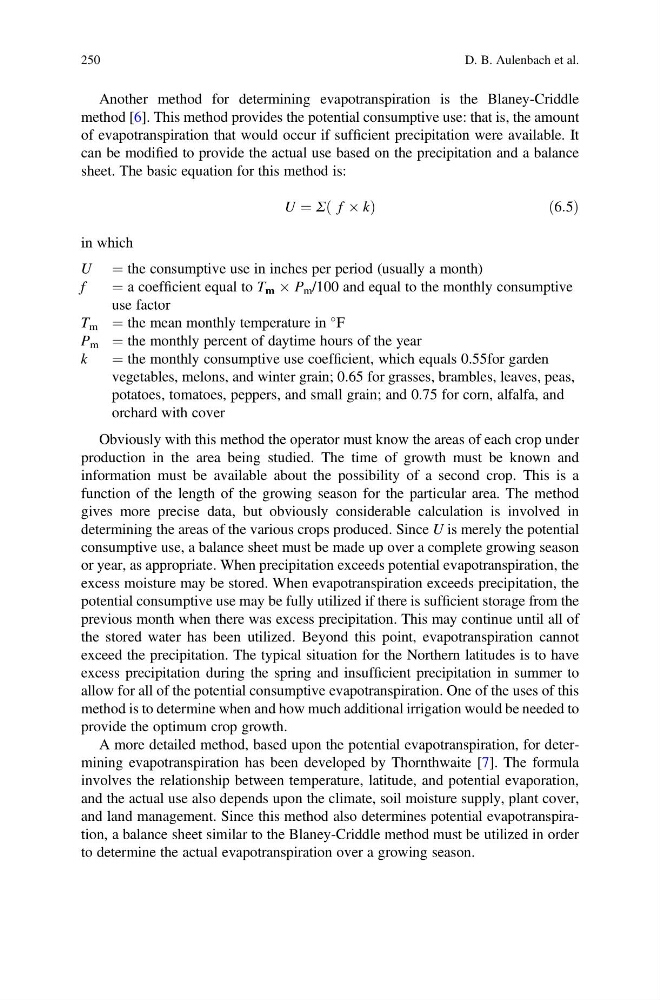
Another method for determining evapotranspiration is the Blaney-Criddle
method [6]. This method provides the potential consumptive use: that is, the amount
of evapotranspiration that would occur if sufficient precipitation were available. It
can be modified to provide the actual use based on the precipitation and a balance
sheet. The basic equation for this method is:
U ¼ Σ f  k
ð
Þ
ð6:5Þ
in which
U ¼ the consumptive use in inches per period (usually a month)
f
¼ a coefficient equal to T m  P m /100 and equal to the monthly consumptive
use factor
T m ¼ the mean monthly temperature in
F
P m ¼ the monthly percent of daytime hours of the year
k
¼ the monthly consumptive use coefficient, which equals 0.55for garden
vegetables, melons, and winter grain; 0.65 for grasses, brambles, leaves, peas,
potatoes, tomatoes, peppers, and small grain; and 0.75 for corn, alfalfa, and
orchard with cover
Obviously with this method the operator must know the areas of each crop under
production in the area being studied. The time of growth must be known and
information must be available about the possibility of a second crop. This is a
function of the length of the growing season for the particular area. The method
gives more precise data, but obviously considerable calculation is involved in
determining the areas of the various crops produced. Since U is merely the potential
consumptive use, a balance sheet must be made up over a complete growing season
or year, as appropriate. When precipitation exceeds potential evapotranspiration, the
excess moisture may be stored. When evapotranspiration exceeds precipitation, the
potential consumptive use may be fully utilized if there is sufficient storage from the
previous month when there was excess precipitation. This may continue until all of
the stored water has been utilized. Beyond this point, evapotranspiration cannot
exceed the precipitation. The typical situation for the Northern latitudes is to have
excess precipitation during the spring and insufficient precipitation in summer to
allow for all of the potential consumptive evapotranspiration. One of the uses of this
method is to determine when and how much additional irrigation would be needed to
provide the optimum crop growth.
A more detailed method, based upon the potential evapotranspiration, for determining evapotranspiration has been developed by Thornthwaite [7]. The formula
involves the relationship between temperature, latitude, and potential evaporation,
and the actual use also depends upon the climate, soil moisture supply, plant cover,
and land management. Since this method also determines potential evapotranspiration, a balance sheet similar to the Blaney-Criddle method must be utilized in order
to determine the actual evapotranspiration over a growing season.
250
D. B. Aulenbach et al.
method [6]. This method provides the potential consumptive use: that is, the amount
of evapotranspiration that would occur if sufficient precipitation were available. It
can be modified to provide the actual use based on the precipitation and a balance
sheet. The basic equation for this method is:
U ¼ Σ f  k
ð
Þ
ð6:5Þ
in which
U ¼ the consumptive use in inches per period (usually a month)
f
¼ a coefficient equal to T m  P m /100 and equal to the monthly consumptive
use factor
T m ¼ the mean monthly temperature in
F
P m ¼ the monthly percent of daytime hours of the year
k
¼ the monthly consumptive use coefficient, which equals 0.55for garden
vegetables, melons, and winter grain; 0.65 for grasses, brambles, leaves, peas,
potatoes, tomatoes, peppers, and small grain; and 0.75 for corn, alfalfa, and
orchard with cover
Obviously with this method the operator must know the areas of each crop under
production in the area being studied. The time of growth must be known and
information must be available about the possibility of a second crop. This is a
function of the length of the growing season for the particular area. The method
gives more precise data, but obviously considerable calculation is involved in
determining the areas of the various crops produced. Since U is merely the potential
consumptive use, a balance sheet must be made up over a complete growing season
or year, as appropriate. When precipitation exceeds potential evapotranspiration, the
excess moisture may be stored. When evapotranspiration exceeds precipitation, the
potential consumptive use may be fully utilized if there is sufficient storage from the
previous month when there was excess precipitation. This may continue until all of
the stored water has been utilized. Beyond this point, evapotranspiration cannot
exceed the precipitation. The typical situation for the Northern latitudes is to have
excess precipitation during the spring and insufficient precipitation in summer to
allow for all of the potential consumptive evapotranspiration. One of the uses of this
method is to determine when and how much additional irrigation would be needed to
provide the optimum crop growth.
A more detailed method, based upon the potential evapotranspiration, for determining evapotranspiration has been developed by Thornthwaite [7]. The formula
involves the relationship between temperature, latitude, and potential evaporation,
and the actual use also depends upon the climate, soil moisture supply, plant cover,
and land management. Since this method also determines potential evapotranspiration, a balance sheet similar to the Blaney-Criddle method must be utilized in order
to determine the actual evapotranspiration over a growing season.
250
D. B. Aulenbach et al.