

Precipitation occurs in many forms. Rain, in which droplets of liquid water fall to
the earth, is the most common. Drizzle is the descent of very fine droplets of liquid
water, usually with a diameter of less than 0.5 mm, which are small enough so that
wind currents easily carry them both horizontally and occasionally upward. Snow is
the precipitation of solid water, primarily in the form of hexagonal crystals. In North
America, sleet is rain that falls through subfreezing air masses that cause the rain to
freeze into ice pellets. In Britain, sleet is considered melting snow or a mixture of
snow and rain. Freezing rain is caused when liquid rain falls on a subfrozen object
coating it with ice. Whereas sleet occurs primarily in winter, hail is a form of frozen
rain droplets that are found primarily in summer thunderstorms. In the formation of
hail, the water droplets fall through a subfreezing air mass, forming small ice pellets.
Depending upon the rising force of the air masses, these ice pellets may be carried
upward into the warmer air mass where more condensation occurs, therefore,
increasing their size. They fall again through the cold air mass, where the newly
condensed water on the surface freezes forming a larger hailstone. Repeated rising,
growing, falling, and freezing has been known to create hail stones as large as 5 cm
(2 in). Dew forms directly from condensation on the ground, mainly during the night
when the ground surface has been cooled by outgoing radiation. In some circumstances, dew can be a significant portion of the total precipitation.
All of precipitation is the result of cooling that causes the condensation of the
water vapor. There are three main forms of cooling: dynamic, upward movement of
air, and external cooling. Dynamic cooling is caused by the expansion of the air as it
rises to a higher altitude. In general the temperature of the air above the earth’s
surface decreases with altitude. This change in temperature with altitude is called the
lapse rate. In the first 3–5 km above the earth’s surface, it is extremely variable. In
some cases it is even negative (an increase in temperature with altitude), which is
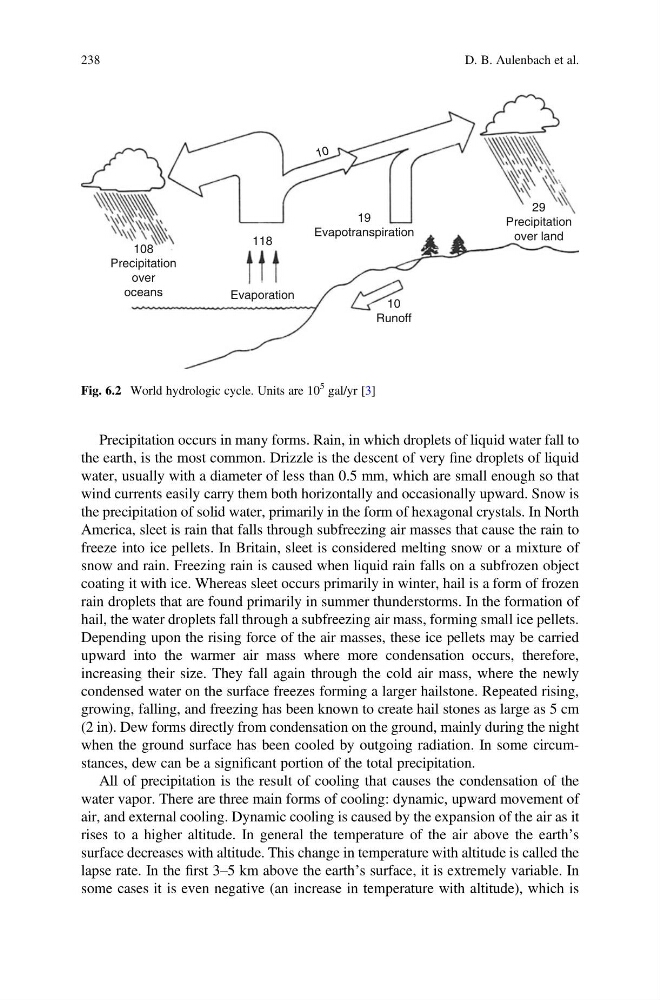
108
Precipitation
over
oceans
29
Precipitation
over land
118
Evaporation
10
Runoff
19
Evapotranspiration
1 0
Fig. 6.2 World hydrologic cycle. Units are 10
5 gal/yr [3]
238
D. B. Aulenbach et al.
the earth, is the most common. Drizzle is the descent of very fine droplets of liquid
water, usually with a diameter of less than 0.5 mm, which are small enough so that
wind currents easily carry them both horizontally and occasionally upward. Snow is
the precipitation of solid water, primarily in the form of hexagonal crystals. In North
America, sleet is rain that falls through subfreezing air masses that cause the rain to
freeze into ice pellets. In Britain, sleet is considered melting snow or a mixture of
snow and rain. Freezing rain is caused when liquid rain falls on a subfrozen object
coating it with ice. Whereas sleet occurs primarily in winter, hail is a form of frozen
rain droplets that are found primarily in summer thunderstorms. In the formation of
hail, the water droplets fall through a subfreezing air mass, forming small ice pellets.
Depending upon the rising force of the air masses, these ice pellets may be carried
upward into the warmer air mass where more condensation occurs, therefore,
increasing their size. They fall again through the cold air mass, where the newly
condensed water on the surface freezes forming a larger hailstone. Repeated rising,
growing, falling, and freezing has been known to create hail stones as large as 5 cm
(2 in). Dew forms directly from condensation on the ground, mainly during the night
when the ground surface has been cooled by outgoing radiation. In some circumstances, dew can be a significant portion of the total precipitation.
All of precipitation is the result of cooling that causes the condensation of the
water vapor. There are three main forms of cooling: dynamic, upward movement of
air, and external cooling. Dynamic cooling is caused by the expansion of the air as it
rises to a higher altitude. In general the temperature of the air above the earth’s
surface decreases with altitude. This change in temperature with altitude is called the
lapse rate. In the first 3–5 km above the earth’s surface, it is extremely variable. In
some cases it is even negative (an increase in temperature with altitude), which is
108
Precipitation
over
oceans
29
Precipitation
over land
118
Evaporation
10
Runoff
19
Evapotranspiration
1 0
Fig. 6.2 World hydrologic cycle. Units are 10
5 gal/yr [3]
238
D. B. Aulenbach et al.