

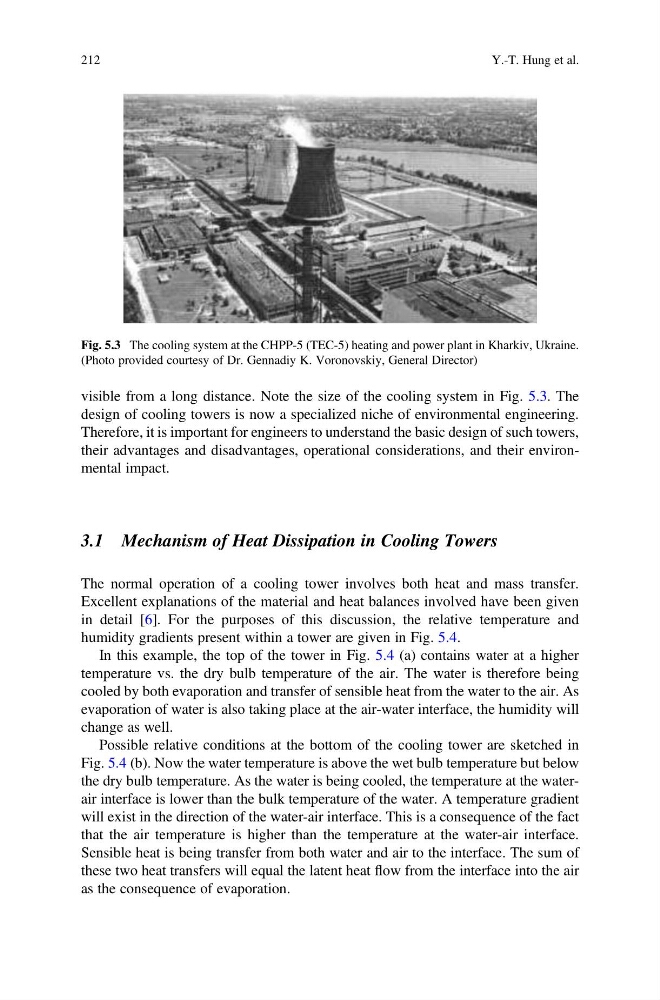
visible from a long distance. Note the size of the cooling system in Fig. 5.3. The
design of cooling towers is now a specialized niche of environmental engineering.
Therefore, it is important for engineers to understand the basic design of such towers,
their advantages and disadvantages, operational considerations, and their environmental impact.
3.1 Mechanism of Heat Dissipation in Cooling Towers
The normal operation of a cooling tower involves both heat and mass transfer.
Excellent explanations of the material and heat balances involved have been given
in detail [6]. For the purposes of this discussion, the relative temperature and
humidity gradients present within a tower are given in Fig. 5.4.
In this example, the top of the tower in Fig. 5.4 (a) contains water at a higher
temperature vs. the dry bulb temperature of the air. The water is therefore being
cooled by both evaporation and transfer of sensible heat from the water to the air. As
evaporation of water is also taking place at the air-water interface, the humidity will
change as well.
Possible relative conditions at the bottom of the cooling tower are sketched in
Fig. 5.4 (b). Now the water temperature is above the wet bulb temperature but below
the dry bulb temperature. As the water is being cooled, the temperature at the waterair interface is lower than the bulk temperature of the water. A temperature gradient
will exist in the direction of the water-air interface. This is a consequence of the fact
that the air temperature is higher than the temperature at the water-air interface.
Sensible heat is being transfer from both water and air to the interface. The sum of
these two heat transfers will equal the latent heat flow from the interface into the air
as the consequence of evaporation.
Fig. 5.3 The cooling system at the CHPP-5 (TEC-5) heating and power plant in Kharkiv, Ukraine.
(Photo provided courtesy of Dr. Gennadiy K. Voronovskiy, General Director)
212
Y.-T. Hung et al.
design of cooling towers is now a specialized niche of environmental engineering.
Therefore, it is important for engineers to understand the basic design of such towers,
their advantages and disadvantages, operational considerations, and their environmental impact.
3.1 Mechanism of Heat Dissipation in Cooling Towers
The normal operation of a cooling tower involves both heat and mass transfer.
Excellent explanations of the material and heat balances involved have been given
in detail [6]. For the purposes of this discussion, the relative temperature and
humidity gradients present within a tower are given in Fig. 5.4.
In this example, the top of the tower in Fig. 5.4 (a) contains water at a higher
temperature vs. the dry bulb temperature of the air. The water is therefore being
cooled by both evaporation and transfer of sensible heat from the water to the air. As
evaporation of water is also taking place at the air-water interface, the humidity will
change as well.
Possible relative conditions at the bottom of the cooling tower are sketched in
Fig. 5.4 (b). Now the water temperature is above the wet bulb temperature but below
the dry bulb temperature. As the water is being cooled, the temperature at the waterair interface is lower than the bulk temperature of the water. A temperature gradient
will exist in the direction of the water-air interface. This is a consequence of the fact
that the air temperature is higher than the temperature at the water-air interface.
Sensible heat is being transfer from both water and air to the interface. The sum of
these two heat transfers will equal the latent heat flow from the interface into the air
as the consequence of evaporation.
Fig. 5.3 The cooling system at the CHPP-5 (TEC-5) heating and power plant in Kharkiv, Ukraine.
(Photo provided courtesy of Dr. Gennadiy K. Voronovskiy, General Director)
212
Y.-T. Hung et al.