

warnings to automatically alert the customers to the occurrence of operational
problems.
6 Water Treatment Techniques for Specific EDC Removal
The EDCs addressed in this chapter that are included in the NPDWRs as drinking
water contaminants are methoxychlor, DDT and DDE, endosulfan, PCBs, DEP, and
DEHP [41–49]. The EDCs in this section are grouped by chemical class. Removal
techniques for the EDCs not listed in the NPDWRs will be based on removal of
similar contaminants that are listed.
The treatment processes are described with considerations of advantages, limitations, and special considerations. The actual choice of a process to include in a
treatment train will ultimately depend on:
1. The source water quality
2. The nature of the contaminant to be removed
3. The required quality of the finished water
4. The size of the drinking water system
6.1 Methoxychlor
The BAT for removal of methoxychlor from drinking water is GAC. Steiner and
Singley [50] have tested a wide range of water treatment processes and found GAC
to be the most efficient for removal of methoxychlor. They found that over a broad
range of concentrations (ranging from 1 mg/mL to 25 mg/mL), the GAC process
could remove sufficient quantities of methoxychlor so that the finished water met
MCL requirements which is 0.1 mg/mL.
6.2 Endosulfan
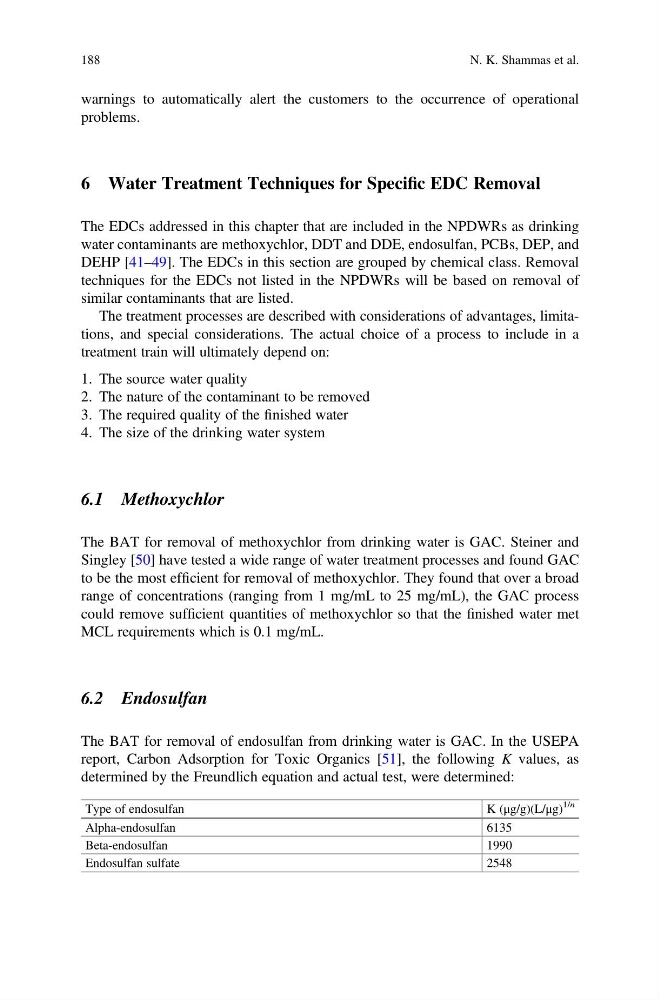
The BAT for removal of endosulfan from drinking water is GAC. In the USEPA
report, Carbon Adsorption for Toxic Organics [51], the following K values, as
determined by the Freundlich equation and actual test, were determined:
Type of endosulfan
K (μg/g)(L/μg)
1/n
Alpha-endosulfan
6135
Beta-endosulfan
1990
Endosulfan sulfate
2548
188
N. K. Shammas et al.
problems.
6 Water Treatment Techniques for Specific EDC Removal
The EDCs addressed in this chapter that are included in the NPDWRs as drinking
water contaminants are methoxychlor, DDT and DDE, endosulfan, PCBs, DEP, and
DEHP [41–49]. The EDCs in this section are grouped by chemical class. Removal
techniques for the EDCs not listed in the NPDWRs will be based on removal of
similar contaminants that are listed.
The treatment processes are described with considerations of advantages, limitations, and special considerations. The actual choice of a process to include in a
treatment train will ultimately depend on:
1. The source water quality
2. The nature of the contaminant to be removed
3. The required quality of the finished water
4. The size of the drinking water system
6.1 Methoxychlor
The BAT for removal of methoxychlor from drinking water is GAC. Steiner and
Singley [50] have tested a wide range of water treatment processes and found GAC
to be the most efficient for removal of methoxychlor. They found that over a broad
range of concentrations (ranging from 1 mg/mL to 25 mg/mL), the GAC process
could remove sufficient quantities of methoxychlor so that the finished water met
MCL requirements which is 0.1 mg/mL.
6.2 Endosulfan
The BAT for removal of endosulfan from drinking water is GAC. In the USEPA
report, Carbon Adsorption for Toxic Organics [51], the following K values, as
determined by the Freundlich equation and actual test, were determined:
Type of endosulfan
K (μg/g)(L/μg)
1/n
Alpha-endosulfan
6135
Beta-endosulfan
1990
Endosulfan sulfate
2548
188
N. K. Shammas et al.