

surface area per unit mass material [38]. The activation process is considered a
two-step procedure in which amorphous material is burned off and pore size is
increased. Typically, GACs have surface areas ranging from 500 to 1400 m
2 /g.
GAC treatment removes contaminants via the physical and chemical process of
sorption. The contaminants accumulate within the pores, and the greatest efficiency
is attained when the pore size is only slightly larger than the material being adsorbed.
Removal efficiencies for many organic contaminants are good to excellent. Water
quality parameters such as dissolved organic matter, pH, and temperature can
significantly affect the removal efficiency of GAC. However, for GAC treatment
of drinking water, it is necessary to reduce the total organic carbon (TOC) of the
treated water through the preliminary steps of coagulation/filtration [39] before
treatment with GAC. Its removal efficiencies change drastically once the bed nears
exhaustion, as contaminant breakthrough occurs. GAC beds can be reactivated by
removing the granular carbon from the water treatment chambers, drying the material then placing it in large furnaces that heat the material to 1200–1400
F. This
heating process removes any residual of contaminants from the pores and again
enlarges the pore size. This feature and the high temperatures needed to attain
reactivation should be kept in mind when considering claims of some manufacturers
that flushing point-of-use (POU) GAC filters with hot water will reactivate units or
increase operating efficiency. The increased temperatures that are reached with hot
water do not in any manner achieve reactivation.
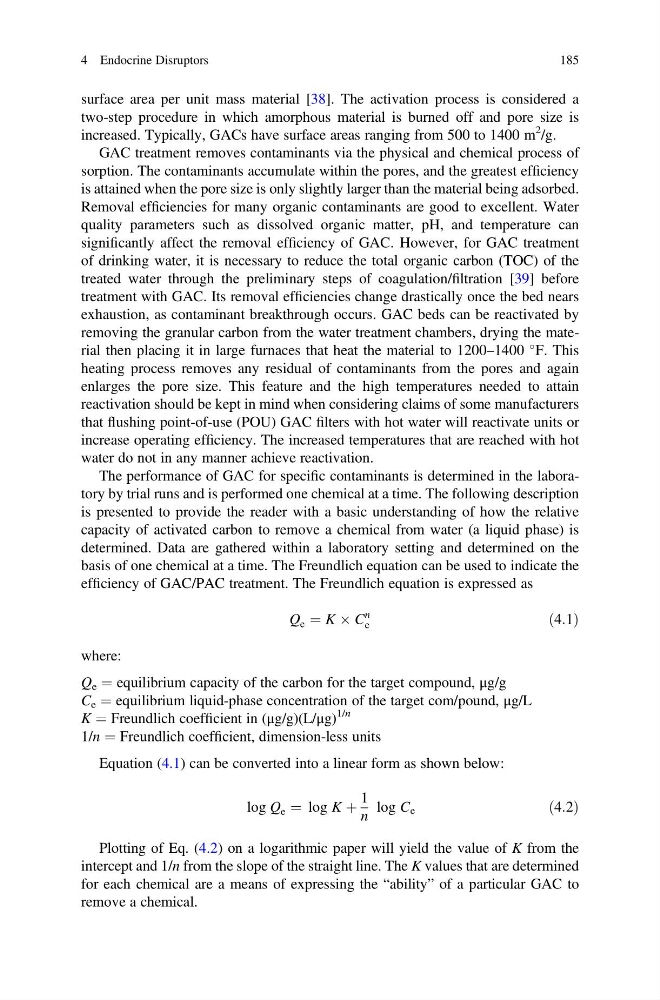
The performance of GAC for specific contaminants is determined in the laboratory by trial runs and is performed one chemical at a time. The following description
is presented to provide the reader with a basic understanding of how the relative
capacity of activated carbon to remove a chemical from water (a liquid phase) is
determined. Data are gathered within a laboratory setting and determined on the
basis of one chemical at a time. The Freundlich equation can be used to indicate the
efficiency of GAC/PAC treatment. The Freundlich equation is expressed as
Q e ¼ K Â C
n
e
ð4:1Þ
where:
Q e ¼ equilibrium capacity of the carbon for the target compound, μg/g
C e ¼ equilibrium liquid-phase concentration of the target com/pound, μg/L
K ¼ Freundlich coefficient in (μg/g)(L/μg)
1/n
1/n ¼ Freundlich coefficient, dimension-less units
Equation (4.1) can be converted into a linear form as shown below:
log Q e ¼ log K þ
1
n
log C e
ð4:2Þ
Plotting of Eq. (4.2) on a logarithmic paper will yield the value of K from the
intercept and 1/n from the slope of the straight line. The K values that are determined
for each chemical are a means of expressing the “ability” of a particular GAC to
remove a chemical.
4 Endocrine Disruptors
185
two-step procedure in which amorphous material is burned off and pore size is
increased. Typically, GACs have surface areas ranging from 500 to 1400 m
2 /g.
GAC treatment removes contaminants via the physical and chemical process of
sorption. The contaminants accumulate within the pores, and the greatest efficiency
is attained when the pore size is only slightly larger than the material being adsorbed.
Removal efficiencies for many organic contaminants are good to excellent. Water
quality parameters such as dissolved organic matter, pH, and temperature can
significantly affect the removal efficiency of GAC. However, for GAC treatment
of drinking water, it is necessary to reduce the total organic carbon (TOC) of the
treated water through the preliminary steps of coagulation/filtration [39] before
treatment with GAC. Its removal efficiencies change drastically once the bed nears
exhaustion, as contaminant breakthrough occurs. GAC beds can be reactivated by
removing the granular carbon from the water treatment chambers, drying the material then placing it in large furnaces that heat the material to 1200–1400
F. This
heating process removes any residual of contaminants from the pores and again
enlarges the pore size. This feature and the high temperatures needed to attain
reactivation should be kept in mind when considering claims of some manufacturers
that flushing point-of-use (POU) GAC filters with hot water will reactivate units or
increase operating efficiency. The increased temperatures that are reached with hot
water do not in any manner achieve reactivation.
The performance of GAC for specific contaminants is determined in the laboratory by trial runs and is performed one chemical at a time. The following description
is presented to provide the reader with a basic understanding of how the relative
capacity of activated carbon to remove a chemical from water (a liquid phase) is
determined. Data are gathered within a laboratory setting and determined on the
basis of one chemical at a time. The Freundlich equation can be used to indicate the
efficiency of GAC/PAC treatment. The Freundlich equation is expressed as
Q e ¼ K Â C
n
e
ð4:1Þ
where:
Q e ¼ equilibrium capacity of the carbon for the target compound, μg/g
C e ¼ equilibrium liquid-phase concentration of the target com/pound, μg/L
K ¼ Freundlich coefficient in (μg/g)(L/μg)
1/n
1/n ¼ Freundlich coefficient, dimension-less units
Equation (4.1) can be converted into a linear form as shown below:
log Q e ¼ log K þ
1
n
log C e
ð4:2Þ
Plotting of Eq. (4.2) on a logarithmic paper will yield the value of K from the
intercept and 1/n from the slope of the straight line. The K values that are determined
for each chemical are a means of expressing the “ability” of a particular GAC to
remove a chemical.
4 Endocrine Disruptors
185