

7.9 US Environmental Protection Agency Model
A general EPA model has been presented in a US EPA report [129] for designing all
attached-growth systems primarily to assess the removal phenomenon as a function
of hydraulic loading rate per unit volume.
L e
L o
¼ exp À K p
V
695Q
0:5
ð3:62Þ
where:
V ¼ attached-growth media volume, ft
3
Q ¼ wastewater design flow excluding recycle flow, MGD
L e ¼ reactor effluent BOD 5 , mg/L
L o ¼ reactor influent BOD 5 , mg/L
K p ¼ performance measurement parameter ¼ 0:265 þ ln
q w
20
ð3:63Þ
q w ¼ wastewater surface application rate (wetting rate), gpm/ft
2
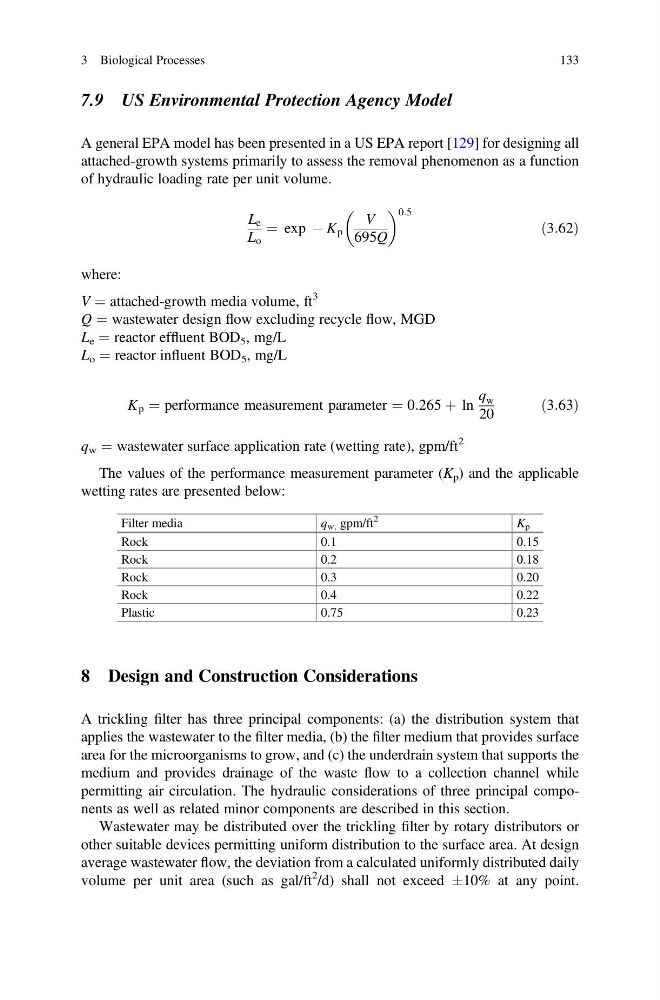
The values of the performance measurement parameter (K p ) and the applicable
wetting rates are presented below:
Filter media
q w, gpm/ft
2
K p
Rock
0.1
0.15
Rock
0.2
0.18
Rock
0.3
0.20
Rock
0.4
0.22
Plastic
0.75
0.23
8 Design and Construction Considerations
A trickling filter has three principal components: (a) the distribution system that
applies the wastewater to the filter media, (b) the filter medium that provides surface
area for the microorganisms to grow, and (c) the underdrain system that supports the
medium and provides drainage of the waste flow to a collection channel while
permitting air circulation. The hydraulic considerations of three principal components as well as related minor components are described in this section.
Wastewater may be distributed over the trickling filter by rotary distributors or
other suitable devices permitting uniform distribution to the surface area. At design
average wastewater flow, the deviation from a calculated uniformly distributed daily
volume per unit area (such as gal/ft
2 /d) shall not exceed Æ10% at any point.
3 Biological Processes
133
A general EPA model has been presented in a US EPA report [129] for designing all
attached-growth systems primarily to assess the removal phenomenon as a function
of hydraulic loading rate per unit volume.
L e
L o
¼ exp À K p
V
695Q
0:5
ð3:62Þ
where:
V ¼ attached-growth media volume, ft
3
Q ¼ wastewater design flow excluding recycle flow, MGD
L e ¼ reactor effluent BOD 5 , mg/L
L o ¼ reactor influent BOD 5 , mg/L
K p ¼ performance measurement parameter ¼ 0:265 þ ln
q w
20
ð3:63Þ
q w ¼ wastewater surface application rate (wetting rate), gpm/ft
2
The values of the performance measurement parameter (K p ) and the applicable
wetting rates are presented below:
Filter media
q w, gpm/ft
2
K p
Rock
0.1
0.15
Rock
0.2
0.18
Rock
0.3
0.20
Rock
0.4
0.22
Plastic
0.75
0.23
8 Design and Construction Considerations
A trickling filter has three principal components: (a) the distribution system that
applies the wastewater to the filter media, (b) the filter medium that provides surface
area for the microorganisms to grow, and (c) the underdrain system that supports the
medium and provides drainage of the waste flow to a collection channel while
permitting air circulation. The hydraulic considerations of three principal components as well as related minor components are described in this section.
Wastewater may be distributed over the trickling filter by rotary distributors or
other suitable devices permitting uniform distribution to the surface area. At design
average wastewater flow, the deviation from a calculated uniformly distributed daily
volume per unit area (such as gal/ft
2 /d) shall not exceed Æ10% at any point.
3 Biological Processes
133