

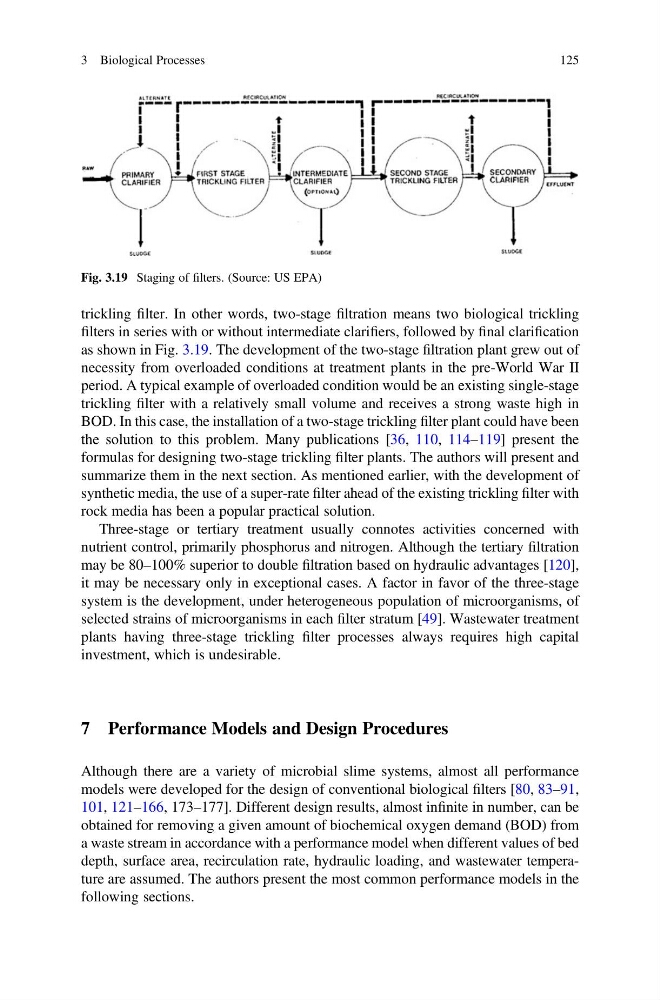
trickling filter. In other words, two-stage filtration means two biological trickling
filters in series with or without intermediate clarifiers, followed by final clarification
as shown in Fig. 3.19. The development of the two-stage filtration plant grew out of
necessity from overloaded conditions at treatment plants in the pre-World War II
period. A typical example of overloaded condition would be an existing single-stage
trickling filter with a relatively small volume and receives a strong waste high in
BOD. In this case, the installation of a two-stage trickling filter plant could have been
the solution to this problem. Many publications [36, 110, 114–119] present the
formulas for designing two-stage trickling filter plants. The authors will present and
summarize them in the next section. As mentioned earlier, with the development of
synthetic media, the use of a super-rate filter ahead of the existing trickling filter with
rock media has been a popular practical solution.
Three-stage or tertiary treatment usually connotes activities concerned with
nutrient control, primarily phosphorus and nitrogen. Although the tertiary filtration
may be 80–100% superior to double filtration based on hydraulic advantages [120],
it may be necessary only in exceptional cases. A factor in favor of the three-stage
system is the development, under heterogeneous population of microorganisms, of
selected strains of microorganisms in each filter stratum [49]. Wastewater treatment
plants having three-stage trickling filter processes always requires high capital
investment, which is undesirable.
7 Performance Models and Design Procedures
Although there are a variety of microbial slime systems, almost all performance
models were developed for the design of conventional biological filters [80, 83–91,
101, 121–166, 173–177]. Different design results, almost infinite in number, can be
obtained for removing a given amount of biochemical oxygen demand (BOD) from
a waste stream in accordance with a performance model when different values of bed
depth, surface area, recirculation rate, hydraulic loading, and wastewater temperature are assumed. The authors present the most common performance models in the
following sections.
Fig. 3.19 Staging of filters. (Source: US EPA)
3 Biological Processes
125
filters in series with or without intermediate clarifiers, followed by final clarification
as shown in Fig. 3.19. The development of the two-stage filtration plant grew out of
necessity from overloaded conditions at treatment plants in the pre-World War II
period. A typical example of overloaded condition would be an existing single-stage
trickling filter with a relatively small volume and receives a strong waste high in
BOD. In this case, the installation of a two-stage trickling filter plant could have been
the solution to this problem. Many publications [36, 110, 114–119] present the
formulas for designing two-stage trickling filter plants. The authors will present and
summarize them in the next section. As mentioned earlier, with the development of
synthetic media, the use of a super-rate filter ahead of the existing trickling filter with
rock media has been a popular practical solution.
Three-stage or tertiary treatment usually connotes activities concerned with
nutrient control, primarily phosphorus and nitrogen. Although the tertiary filtration
may be 80–100% superior to double filtration based on hydraulic advantages [120],
it may be necessary only in exceptional cases. A factor in favor of the three-stage
system is the development, under heterogeneous population of microorganisms, of
selected strains of microorganisms in each filter stratum [49]. Wastewater treatment
plants having three-stage trickling filter processes always requires high capital
investment, which is undesirable.
7 Performance Models and Design Procedures
Although there are a variety of microbial slime systems, almost all performance
models were developed for the design of conventional biological filters [80, 83–91,
101, 121–166, 173–177]. Different design results, almost infinite in number, can be
obtained for removing a given amount of biochemical oxygen demand (BOD) from
a waste stream in accordance with a performance model when different values of bed
depth, surface area, recirculation rate, hydraulic loading, and wastewater temperature are assumed. The authors present the most common performance models in the
following sections.
Fig. 3.19 Staging of filters. (Source: US EPA)
3 Biological Processes
125