

3.2 Step Aeration Process
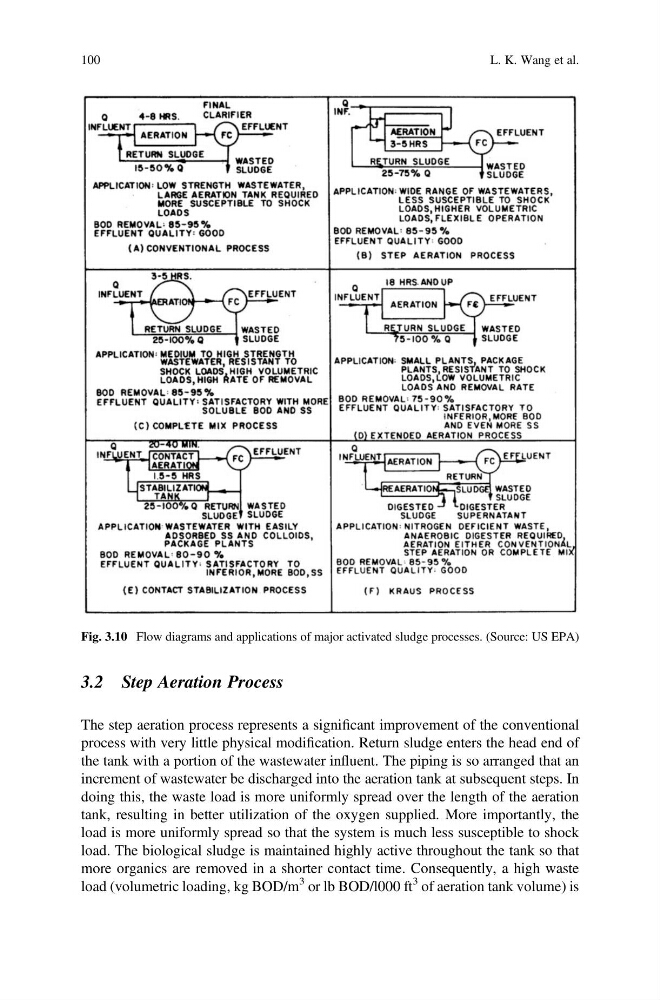
The step aeration process represents a significant improvement of the conventional
process with very little physical modification. Return sludge enters the head end of
the tank with a portion of the wastewater influent. The piping is so arranged that an
increment of wastewater be discharged into the aeration tank at subsequent steps. In
doing this, the waste load is more uniformly spread over the length of the aeration
tank, resulting in better utilization of the oxygen supplied. More importantly, the
load is more uniformly spread so that the system is much less susceptible to shock
load. The biological sludge is maintained highly active throughout the tank so that
more organics are removed in a shorter contact time. Consequently, a high waste
load (volumetric loading, kg BOD/m
3 or lb BOD/l000 ft
3 of aeration tank volume) is
Fig. 3.10 Flow diagrams and applications of major activated sludge processes. (Source: US EPA)
100
L. K. Wang et al.
The step aeration process represents a significant improvement of the conventional
process with very little physical modification. Return sludge enters the head end of
the tank with a portion of the wastewater influent. The piping is so arranged that an
increment of wastewater be discharged into the aeration tank at subsequent steps. In
doing this, the waste load is more uniformly spread over the length of the aeration
tank, resulting in better utilization of the oxygen supplied. More importantly, the
load is more uniformly spread so that the system is much less susceptible to shock
load. The biological sludge is maintained highly active throughout the tank so that
more organics are removed in a shorter contact time. Consequently, a high waste
load (volumetric loading, kg BOD/m
3 or lb BOD/l000 ft
3 of aeration tank volume) is
Fig. 3.10 Flow diagrams and applications of major activated sludge processes. (Source: US EPA)
100
L. K. Wang et al.