

2.1.2 Complete Mix and Sludge Recycle Model
With biological sludge recycled from the final clarifier, the mean cell residence time
or sludge retention lime is longer than the hydraulic retention time. The sludge
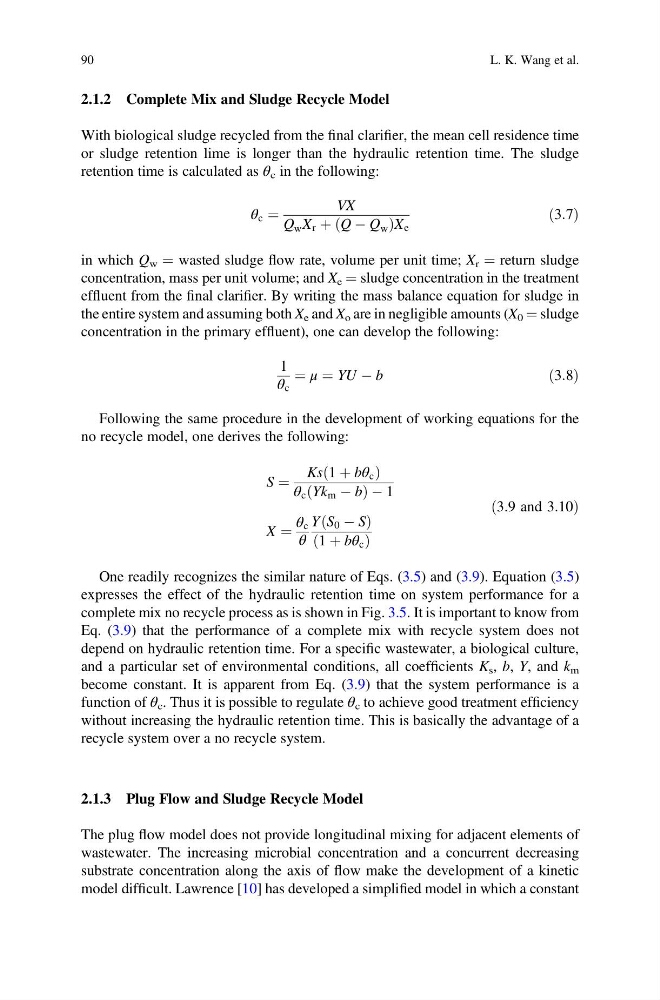
retention time is calculated as θ c in the following:
θ c ¼
VX
Q w X r þ Q À Q w
ð
Þ X e
ð3:7Þ
in which Q w ¼ wasted sludge flow rate, volume per unit time; X r ¼ return sludge
concentration, mass per unit volume; and X e ¼ sludge concentration in the treatment
effluent from the final clarifier. By writing the mass balance equation for sludge in
the entire system and assuming both X e and X o are in negligible amounts (X 0 ¼ sludge
concentration in the primary effluent), one can develop the following:
1
θ c
¼ μ ¼ YU À b
ð3:8Þ
Following the same procedure in the development of working equations for the
no recycle model, one derives the following:
S ¼
Ks 1 þ bθ c
ð
Þ
θ c Yk m À b
ð
ÞÀ1
X ¼
θ c
θ
Y S 0 À S
ð
Þ
1 þ bθ c
ð
Þ
ð3.9 and 3.10Þ
One readily recognizes the similar nature of Eqs. (3.5) and (3.9). Equation (3.5)
expresses the effect of the hydraulic retention time on system performance for a
complete mix no recycle process as is shown in Fig. 3.5. It is important to know from
Eq. (3.9) that the performance of a complete mix with recycle system does not
depend on hydraulic retention time. For a specific wastewater, a biological culture,
and a particular set of environmental conditions, all coefficients K s , b, Y, and k m
become constant. It is apparent from Eq. (3.9) that the system performance is a
function of θ c . Thus it is possible to regulate θ c to achieve good treatment efficiency
without increasing the hydraulic retention time. This is basically the advantage of a
recycle system over a no recycle system.
2.1.3 Plug Flow and Sludge Recycle Model
The plug flow model does not provide longitudinal mixing for adjacent elements of
wastewater. The increasing microbial concentration and a concurrent decreasing
substrate concentration along the axis of flow make the development of a kinetic
model difficult. Lawrence [10] has developed a simplified model in which a constant
90
L. K. Wang et al.
With biological sludge recycled from the final clarifier, the mean cell residence time
or sludge retention lime is longer than the hydraulic retention time. The sludge
retention time is calculated as θ c in the following:
θ c ¼
VX
Q w X r þ Q À Q w
ð
Þ X e
ð3:7Þ
in which Q w ¼ wasted sludge flow rate, volume per unit time; X r ¼ return sludge
concentration, mass per unit volume; and X e ¼ sludge concentration in the treatment
effluent from the final clarifier. By writing the mass balance equation for sludge in
the entire system and assuming both X e and X o are in negligible amounts (X 0 ¼ sludge
concentration in the primary effluent), one can develop the following:
1
θ c
¼ μ ¼ YU À b
ð3:8Þ
Following the same procedure in the development of working equations for the
no recycle model, one derives the following:
S ¼
Ks 1 þ bθ c
ð
Þ
θ c Yk m À b
ð
ÞÀ1
X ¼
θ c
θ
Y S 0 À S
ð
Þ
1 þ bθ c
ð
Þ
ð3.9 and 3.10Þ
One readily recognizes the similar nature of Eqs. (3.5) and (3.9). Equation (3.5)
expresses the effect of the hydraulic retention time on system performance for a
complete mix no recycle process as is shown in Fig. 3.5. It is important to know from
Eq. (3.9) that the performance of a complete mix with recycle system does not
depend on hydraulic retention time. For a specific wastewater, a biological culture,
and a particular set of environmental conditions, all coefficients K s , b, Y, and k m
become constant. It is apparent from Eq. (3.9) that the system performance is a
function of θ c . Thus it is possible to regulate θ c to achieve good treatment efficiency
without increasing the hydraulic retention time. This is basically the advantage of a
recycle system over a no recycle system.
2.1.3 Plug Flow and Sludge Recycle Model
The plug flow model does not provide longitudinal mixing for adjacent elements of
wastewater. The increasing microbial concentration and a concurrent decreasing
substrate concentration along the axis of flow make the development of a kinetic
model difficult. Lawrence [10] has developed a simplified model in which a constant
90
L. K. Wang et al.