

2 Interparticle Interactions: Theory and Mesoscopic Modeling
53
competition between the anisotropy energy and the exchange energy. The average
assembly concentration is uniform but density fluctuations may result in different
local concentrations. As a result, we may have small agglomerates of particles more
strongly connected, in sites that have bigger number of neighbors and anisotropy
axis toward the same direction. So smaller clusters, compared to the ones of the nonuniform morphology, are formed but they are more strongly connected with other
clusters or particles. We have to note that here the definition of a cluster is different
from that in the non-uniform model. As a cluster in the non-uniform model, a set
of connected particles of the same area is defined, each one with the coordination
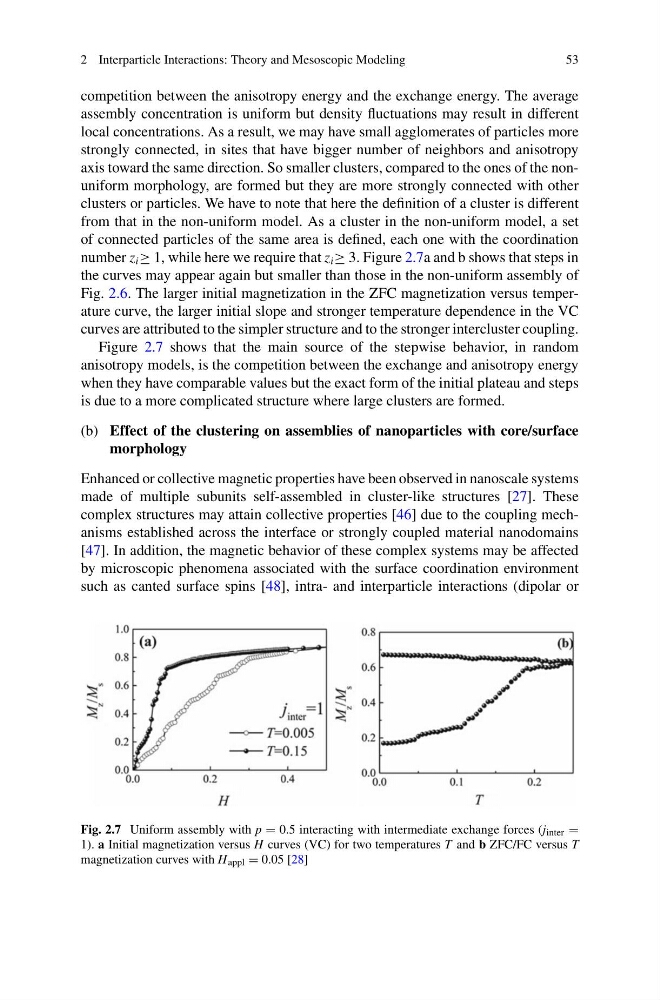
number z i ≥ 1, while here we require that z i ≥ 3. Figure 2.7a and b shows that steps in
the curves may appear again but smaller than those in the non-uniform assembly of
Fig. 2.6. The larger initial magnetization in the ZFC magnetization versus temperature curve, the larger initial slope and stronger temperature dependence in the VC
curves are attributed to the simpler structure and to the stronger intercluster coupling.
Figure 2.7 shows that the main source of the stepwise behavior, in random
anisotropy models, is the competition between the exchange and anisotropy energy
when they have comparable values but the exact form of the initial plateau and steps
is due to a more complicated structure where large clusters are formed.
(b) Effect of the clustering on assemblies of nanoparticles with core/surface
morphology
Enhanced or collective magnetic properties have been observed in nanoscale systems
made of multiple subunits self-assembled in cluster-like structures [27]. These
complex structures may attain collective properties [46] due to the coupling mechanisms established across the interface or strongly coupled material nanodomains
[47]. In addition, the magnetic behavior of these complex systems may be affected
by microscopic phenomena associated with the surface coordination environment
such as canted surface spins [48], intra- and interparticle interactions (dipolar or
Fig. 2.7 Uniform assembly with p = 0.5 interacting with intermediate exchange forces (j inter =
1). a Initial magnetization versus H curves (VC) for two temperatures T and b ZFC/FC versus T
magnetization curves with H appl = 0.05 [28]
53
competition between the anisotropy energy and the exchange energy. The average
assembly concentration is uniform but density fluctuations may result in different
local concentrations. As a result, we may have small agglomerates of particles more
strongly connected, in sites that have bigger number of neighbors and anisotropy
axis toward the same direction. So smaller clusters, compared to the ones of the nonuniform morphology, are formed but they are more strongly connected with other
clusters or particles. We have to note that here the definition of a cluster is different
from that in the non-uniform model. As a cluster in the non-uniform model, a set
of connected particles of the same area is defined, each one with the coordination
number z i ≥ 1, while here we require that z i ≥ 3. Figure 2.7a and b shows that steps in
the curves may appear again but smaller than those in the non-uniform assembly of
Fig. 2.6. The larger initial magnetization in the ZFC magnetization versus temperature curve, the larger initial slope and stronger temperature dependence in the VC
curves are attributed to the simpler structure and to the stronger intercluster coupling.
Figure 2.7 shows that the main source of the stepwise behavior, in random
anisotropy models, is the competition between the exchange and anisotropy energy
when they have comparable values but the exact form of the initial plateau and steps
is due to a more complicated structure where large clusters are formed.
(b) Effect of the clustering on assemblies of nanoparticles with core/surface
morphology
Enhanced or collective magnetic properties have been observed in nanoscale systems
made of multiple subunits self-assembled in cluster-like structures [27]. These
complex structures may attain collective properties [46] due to the coupling mechanisms established across the interface or strongly coupled material nanodomains
[47]. In addition, the magnetic behavior of these complex systems may be affected
by microscopic phenomena associated with the surface coordination environment
such as canted surface spins [48], intra- and interparticle interactions (dipolar or
Fig. 2.7 Uniform assembly with p = 0.5 interacting with intermediate exchange forces (j inter =
1). a Initial magnetization versus H curves (VC) for two temperatures T and b ZFC/FC versus T
magnetization curves with H appl = 0.05 [28]