

46
M. Vasilakaki et al.
The main parameters used in MC simulations are: p = 0.47 the particle concentration introduced in the model, g = 0.884 the dipolar energy strength, m = 1.17
the mean particle magnetic moment. Accordingly, the values of the intra-particle
exchange energy among the core spin and the surface spins were taken as j c1 = −
7.77, j c2 = −1.35, j srf = −0.091 and the anisotropy energy of the core as k C = 0.1,
while that of the surface as k srf = 3.5, since it is expected to be more than one order
of magnitude larger than that of the core. These parameters are dimensionless as
they are normalized by 10 K C V. The particles in the assembly interact only through
dipolar interactions since they are coated with the PAA surfactant (j inter = 0) no
interparticle exchange interactions are considered in our model.
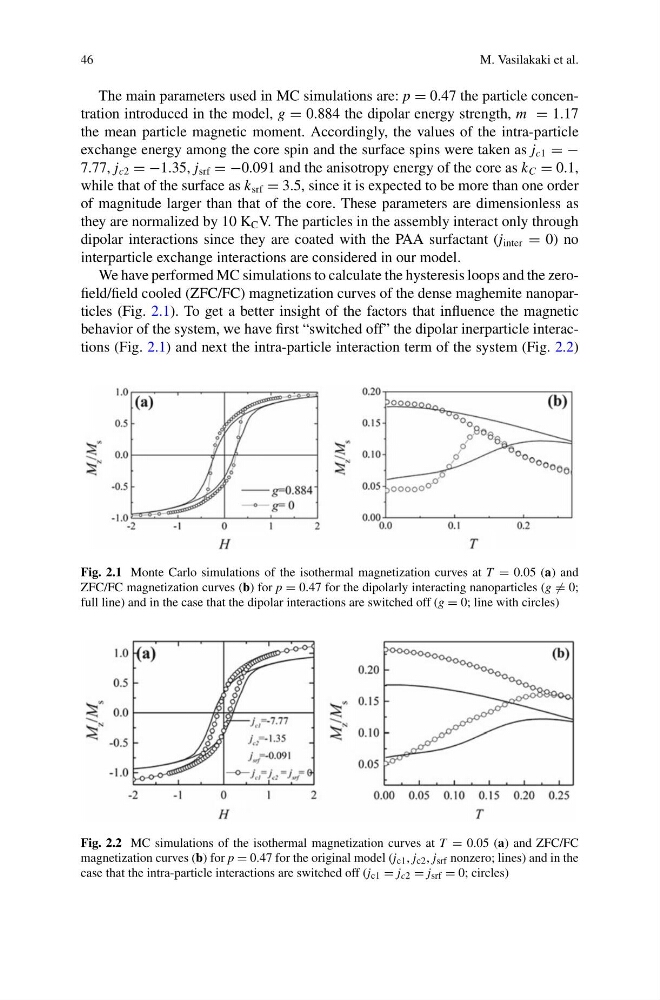
We have performed MC simulations to calculate the hysteresis loops and the zerofield/field cooled (ZFC/FC) magnetization curves of the dense maghemite nanoparticles (Fig. 2.1). To get a better insight of the factors that influence the magnetic
behavior of the system, we have first “switched off” the dipolar inerparticle interactions (Fig. 2.1) and next the intra-particle interaction term of the system (Fig. 2.2)
Fig. 2.1 Monte Carlo simulations of the isothermal magnetization curves at T = 0.05 (a) and
ZFC/FC magnetization curves (b) for p = 0.47 for the dipolarly interacting nanoparticles (g = 0;
full line) and in the case that the dipolar interactions are switched off (g = 0; line with circles)
Fig. 2.2 MC simulations of the isothermal magnetization curves at T = 0.05 (a) and ZFC/FC
magnetization curves (b) for p = 0.47 for the original model (j c1 , j c2 , j srf nonzero; lines) and in the
case that the intra-particle interactions are switched off (j c1 = j c2 = j srf = 0; circles)
M. Vasilakaki et al.
The main parameters used in MC simulations are: p = 0.47 the particle concentration introduced in the model, g = 0.884 the dipolar energy strength, m = 1.17
the mean particle magnetic moment. Accordingly, the values of the intra-particle
exchange energy among the core spin and the surface spins were taken as j c1 = −
7.77, j c2 = −1.35, j srf = −0.091 and the anisotropy energy of the core as k C = 0.1,
while that of the surface as k srf = 3.5, since it is expected to be more than one order
of magnitude larger than that of the core. These parameters are dimensionless as
they are normalized by 10 K C V. The particles in the assembly interact only through
dipolar interactions since they are coated with the PAA surfactant (j inter = 0) no
interparticle exchange interactions are considered in our model.
We have performed MC simulations to calculate the hysteresis loops and the zerofield/field cooled (ZFC/FC) magnetization curves of the dense maghemite nanoparticles (Fig. 2.1). To get a better insight of the factors that influence the magnetic
behavior of the system, we have first “switched off” the dipolar inerparticle interactions (Fig. 2.1) and next the intra-particle interaction term of the system (Fig. 2.2)
Fig. 2.1 Monte Carlo simulations of the isothermal magnetization curves at T = 0.05 (a) and
ZFC/FC magnetization curves (b) for p = 0.47 for the dipolarly interacting nanoparticles (g = 0;
full line) and in the case that the dipolar interactions are switched off (g = 0; line with circles)
Fig. 2.2 MC simulations of the isothermal magnetization curves at T = 0.05 (a) and ZFC/FC
magnetization curves (b) for p = 0.47 for the original model (j c1 , j c2 , j srf nonzero; lines) and in the
case that the intra-particle interactions are switched off (j c1 = j c2 = j srf = 0; circles)