

44
M. Vasilakaki et al.
Each spin has a uniaxial easy anisotropy axis with a certain orientation. Depending
on the model, the three spins can have either one or two (different for the core spin)
common randomly oriented anisotropy axes or each of the three spins can have each
own randomly orientated anisotropy axis.
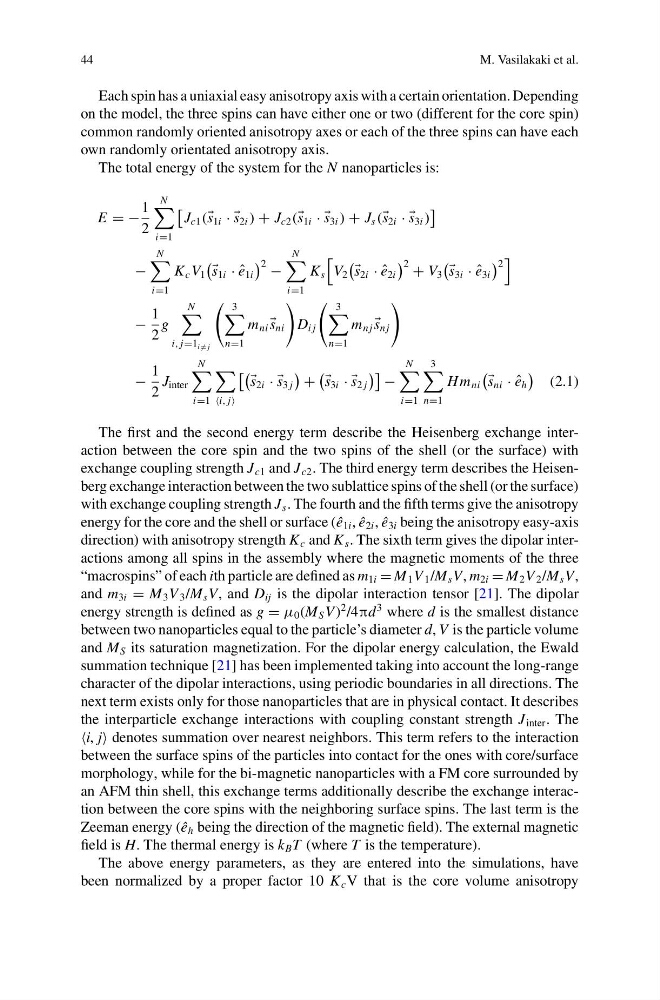
The total energy of the system for the N nanoparticles is:
E = −
1
2
N
i=1
J c1 ( s 1i · ·
s 2i ) + J c2 ( s 1i · ·
s 3i ) + J s ( s 2i · ·
s 3i )
−
N
i=1
K c V 1
s 1i · ˆ
e 1i
2 −
N
i=1
K s
V 2
s 2i · ˆ
e 2i
2 + V 3
s 3i · ˆ
e 3i
2
−
1
2
g
N
i, j=1 i = j
3
n=1
m ni
s ni
D i j
3
n=1
m nj
s nj
−
1
2
J inter
N
i=1
i, j
s 2i · ·
s 3 j
+
s 3i · ·
s 2 j
−
N
i=1
3
n=1
Hm ni
s ni · ˆ
e h
(2.1)
The first and the second energy term describe the Heisenberg exchange interaction between the core spin and the two spins of the shell (or the surface) with
exchange coupling strength J c1 and J c2 . The third energy term describes the Heisenberg exchange interaction between the two sublattice spins of the shell (or the surface)
with exchange coupling strength J s . The fourth and the fifth terms give the anisotropy
energy for the core and the shell or surface (ê 1i , ê 2i , ê 3i being the anisotropy easy-axis
direction) with anisotropy strength K c and K s . The sixth term gives the dipolar interactions among all spins in the assembly where the magnetic moments of the three
“macrospins” of each ith particle are defined as m 1i = M 1 V 1 /M s V, m 2i = M 2 V 2 /M s V,
and m 3i = M 3 V 3 /M s V, and D ij is the dipolar interaction tensor [21]. The dipolar
energy strength is defined as g = μ 0 (M S V )
2 /4πd
3 where d is the smallest distance
between two nanoparticles equal to the particle’s diameter d, V is the particle volume
and M S its saturation magnetization. For the dipolar energy calculation, the Ewald
summation technique [21] has been implemented taking into account the long-range
character of the dipolar interactions, using periodic boundaries in all directions. The
next term exists only for those nanoparticles that are in physical contact. It describes
the interparticle exchange interactions with coupling constant strength J inter . The
i, j denotes summation over nearest neighbors. This term refers to the interaction
between the surface spins of the particles into contact for the ones with core/surface
morphology, while for the bi-magnetic nanoparticles with a FM core surrounded by
an AFM thin shell, this exchange terms additionally describe the exchange interaction between the core spins with the neighboring surface spins. The last term is the
Zeeman energy (ê h being the direction of the magnetic field). The external magnetic
field is H. The thermal energy is k B T (where T is the temperature).
The above energy parameters, as they are entered into the simulations, have
been normalized by a proper factor 10 K c V that is the core volume anisotropy
M. Vasilakaki et al.
Each spin has a uniaxial easy anisotropy axis with a certain orientation. Depending
on the model, the three spins can have either one or two (different for the core spin)
common randomly oriented anisotropy axes or each of the three spins can have each
own randomly orientated anisotropy axis.
The total energy of the system for the N nanoparticles is:
E = −
1
2
N
i=1
J c1 ( s 1i · ·
s 2i ) + J c2 ( s 1i · ·
s 3i ) + J s ( s 2i · ·
s 3i )
−
N
i=1
K c V 1
s 1i · ˆ
e 1i
2 −
N
i=1
K s
V 2
s 2i · ˆ
e 2i
2 + V 3
s 3i · ˆ
e 3i
2
−
1
2
g
N
i, j=1 i = j
3
n=1
m ni
s ni
D i j
3
n=1
m nj
s nj
−
1
2
J inter
N
i=1
i, j
s 2i · ·
s 3 j
+
s 3i · ·
s 2 j
−
N
i=1
3
n=1
Hm ni
s ni · ˆ
e h
(2.1)
The first and the second energy term describe the Heisenberg exchange interaction between the core spin and the two spins of the shell (or the surface) with
exchange coupling strength J c1 and J c2 . The third energy term describes the Heisenberg exchange interaction between the two sublattice spins of the shell (or the surface)
with exchange coupling strength J s . The fourth and the fifth terms give the anisotropy
energy for the core and the shell or surface (ê 1i , ê 2i , ê 3i being the anisotropy easy-axis
direction) with anisotropy strength K c and K s . The sixth term gives the dipolar interactions among all spins in the assembly where the magnetic moments of the three
“macrospins” of each ith particle are defined as m 1i = M 1 V 1 /M s V, m 2i = M 2 V 2 /M s V,
and m 3i = M 3 V 3 /M s V, and D ij is the dipolar interaction tensor [21]. The dipolar
energy strength is defined as g = μ 0 (M S V )
2 /4πd
3 where d is the smallest distance
between two nanoparticles equal to the particle’s diameter d, V is the particle volume
and M S its saturation magnetization. For the dipolar energy calculation, the Ewald
summation technique [21] has been implemented taking into account the long-range
character of the dipolar interactions, using periodic boundaries in all directions. The
next term exists only for those nanoparticles that are in physical contact. It describes
the interparticle exchange interactions with coupling constant strength J inter . The
i, j denotes summation over nearest neighbors. This term refers to the interaction
between the surface spins of the particles into contact for the ones with core/surface
morphology, while for the bi-magnetic nanoparticles with a FM core surrounded by
an AFM thin shell, this exchange terms additionally describe the exchange interaction between the core spins with the neighboring surface spins. The last term is the
Zeeman energy (ê h being the direction of the magnetic field). The external magnetic
field is H. The thermal energy is k B T (where T is the temperature).
The above energy parameters, as they are entered into the simulations, have
been normalized by a proper factor 10 K c V that is the core volume anisotropy