

428
I. de Moraes and N. M. Dempsey
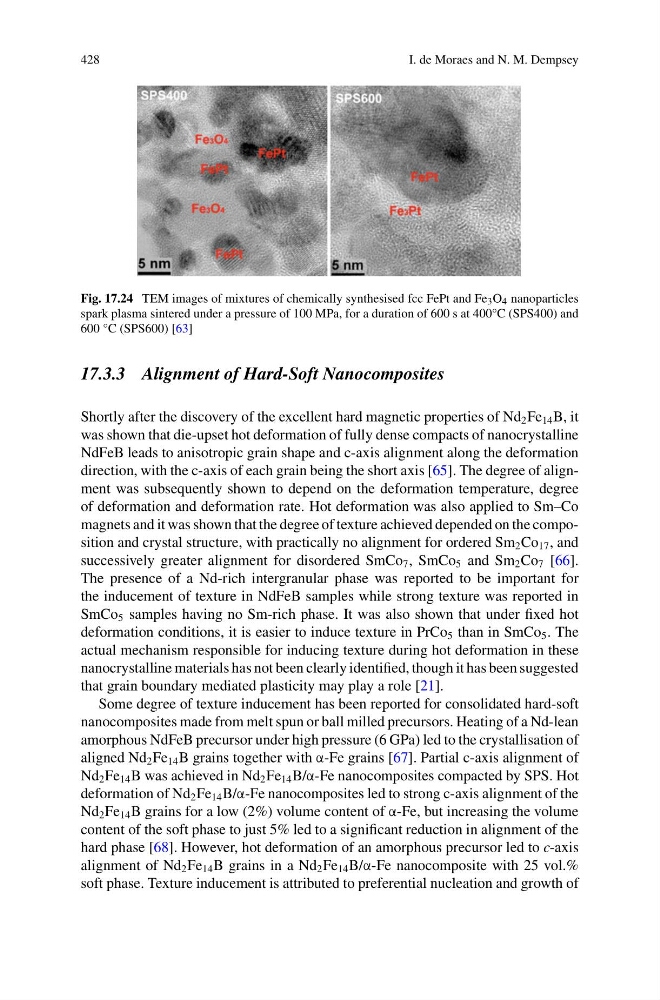
Fig. 17.24 TEM images of mixtures of chemically synthesised fcc FePt and Fe 3 O 4 nanoparticles
spark plasma sintered under a pressure of 100 MPa, for a duration of 600 s at 400°C (SPS400) and
600 °C (SPS600) [63]
17.3.3 Alignment of Hard-Soft Nanocomposites
Shortly after the discovery of the excellent hard magnetic properties of Nd 2 Fe 14 B, it
was shown that die-upset hot deformation of fully dense compacts of nanocrystalline
NdFeB leads to anisotropic grain shape and c-axis alignment along the deformation
direction, with the c-axis of each grain being the short axis [65]. The degree of alignment was subsequently shown to depend on the deformation temperature, degree
of deformation and deformation rate. Hot deformation was also applied to Sm–Co
magnets and it was shown that the degree of texture achieved depended on the composition and crystal structure, with practically no alignment for ordered Sm 2 Co 17 , and
successively greater alignment for disordered SmCo 7 , SmCo 5 and Sm 2 Co 7 [66].
The presence of a Nd-rich intergranular phase was reported to be important for
the inducement of texture in NdFeB samples while strong texture was reported in
SmCo 5 samples having no Sm-rich phase. It was also shown that under fixed hot
deformation conditions, it is easier to induce texture in PrCo 5 than in SmCo 5 . The
actual mechanism responsible for inducing texture during hot deformation in these
nanocrystalline materials has not been clearly identified, though it has been suggested
that grain boundary mediated plasticity may play a role [21].
Some degree of texture inducement has been reported for consolidated hard-soft
nanocomposites made from melt spun or ball milled precursors. Heating of a Nd-lean
amorphous NdFeB precursor under high pressure (6 GPa) led to the crystallisation of
aligned Nd 2 Fe 14 B grains together with α-Fe grains [67]. Partial c-axis alignment of
Nd 2 Fe 14 B was achieved in Nd 2 Fe 14 B/α-Fe nanocomposites compacted by SPS. Hot
deformation of Nd 2 Fe 14 B/α-Fe nanocomposites led to strong c-axis alignment of the
Nd 2 Fe 14 B grains for a low (2%) volume content of α-Fe, but increasing the volume
content of the soft phase to just 5% led to a significant reduction in alignment of the
hard phase [68]. However, hot deformation of an amorphous precursor led to c-axis
alignment of Nd 2 Fe 14 B grains in a Nd 2 Fe 14 B/α-Fe nanocomposite with 25 vol.%
soft phase. Texture inducement is attributed to preferential nucleation and growth of
I. de Moraes and N. M. Dempsey
Fig. 17.24 TEM images of mixtures of chemically synthesised fcc FePt and Fe 3 O 4 nanoparticles
spark plasma sintered under a pressure of 100 MPa, for a duration of 600 s at 400°C (SPS400) and
600 °C (SPS600) [63]
17.3.3 Alignment of Hard-Soft Nanocomposites
Shortly after the discovery of the excellent hard magnetic properties of Nd 2 Fe 14 B, it
was shown that die-upset hot deformation of fully dense compacts of nanocrystalline
NdFeB leads to anisotropic grain shape and c-axis alignment along the deformation
direction, with the c-axis of each grain being the short axis [65]. The degree of alignment was subsequently shown to depend on the deformation temperature, degree
of deformation and deformation rate. Hot deformation was also applied to Sm–Co
magnets and it was shown that the degree of texture achieved depended on the composition and crystal structure, with practically no alignment for ordered Sm 2 Co 17 , and
successively greater alignment for disordered SmCo 7 , SmCo 5 and Sm 2 Co 7 [66].
The presence of a Nd-rich intergranular phase was reported to be important for
the inducement of texture in NdFeB samples while strong texture was reported in
SmCo 5 samples having no Sm-rich phase. It was also shown that under fixed hot
deformation conditions, it is easier to induce texture in PrCo 5 than in SmCo 5 . The
actual mechanism responsible for inducing texture during hot deformation in these
nanocrystalline materials has not been clearly identified, though it has been suggested
that grain boundary mediated plasticity may play a role [21].
Some degree of texture inducement has been reported for consolidated hard-soft
nanocomposites made from melt spun or ball milled precursors. Heating of a Nd-lean
amorphous NdFeB precursor under high pressure (6 GPa) led to the crystallisation of
aligned Nd 2 Fe 14 B grains together with α-Fe grains [67]. Partial c-axis alignment of
Nd 2 Fe 14 B was achieved in Nd 2 Fe 14 B/α-Fe nanocomposites compacted by SPS. Hot
deformation of Nd 2 Fe 14 B/α-Fe nanocomposites led to strong c-axis alignment of the
Nd 2 Fe 14 B grains for a low (2%) volume content of α-Fe, but increasing the volume
content of the soft phase to just 5% led to a significant reduction in alignment of the
hard phase [68]. However, hot deformation of an amorphous precursor led to c-axis
alignment of Nd 2 Fe 14 B grains in a Nd 2 Fe 14 B/α-Fe nanocomposite with 25 vol.%
soft phase. Texture inducement is attributed to preferential nucleation and growth of