

426
I. de Moraes and N. M. Dempsey
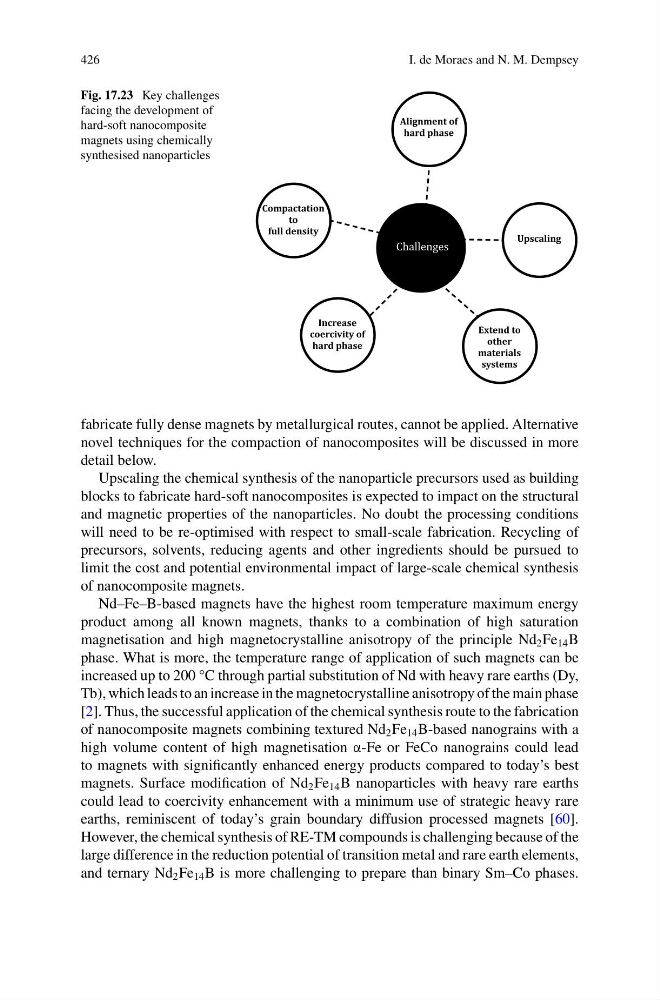
Fig. 17.23 Key challenges
facing the development of
hard-soft nanocomposite
magnets using chemically
synthesised nanoparticles
fabricate fully dense magnets by metallurgical routes, cannot be applied. Alternative
novel techniques for the compaction of nanocomposites will be discussed in more
detail below.
Upscaling the chemical synthesis of the nanoparticle precursors used as building
blocks to fabricate hard-soft nanocomposites is expected to impact on the structural
and magnetic properties of the nanoparticles. No doubt the processing conditions
will need to be re-optimised with respect to small-scale fabrication. Recycling of
precursors, solvents, reducing agents and other ingredients should be pursued to
limit the cost and potential environmental impact of large-scale chemical synthesis
of nanocomposite magnets.
Nd–Fe–B-based magnets have the highest room temperature maximum energy
product among all known magnets, thanks to a combination of high saturation
magnetisation and high magnetocrystalline anisotropy of the principle Nd 2 Fe 14 B
phase. What is more, the temperature range of application of such magnets can be
increased up to 200 °C through partial substitution of Nd with heavy rare earths (Dy,
Tb), which leads to an increase in the magnetocrystalline anisotropy of the main phase
[2]. Thus, the successful application of the chemical synthesis route to the fabrication
of nanocomposite magnets combining textured Nd 2 Fe 14 B-based nanograins with a
high volume content of high magnetisation α-Fe or FeCo nanograins could lead
to magnets with significantly enhanced energy products compared to today’s best
magnets. Surface modification of Nd 2 Fe 14 B nanoparticles with heavy rare earths
could lead to coercivity enhancement with a minimum use of strategic heavy rare
earths, reminiscent of today’s grain boundary diffusion processed magnets [60].
However, the chemical synthesis of RE-TM compounds is challenging because of the
large difference in the reduction potential of transition metal and rare earth elements,
and ternary Nd 2 Fe 14 B is more challenging to prepare than binary Sm–Co phases.
I. de Moraes and N. M. Dempsey
Fig. 17.23 Key challenges
facing the development of
hard-soft nanocomposite
magnets using chemically
synthesised nanoparticles
fabricate fully dense magnets by metallurgical routes, cannot be applied. Alternative
novel techniques for the compaction of nanocomposites will be discussed in more
detail below.
Upscaling the chemical synthesis of the nanoparticle precursors used as building
blocks to fabricate hard-soft nanocomposites is expected to impact on the structural
and magnetic properties of the nanoparticles. No doubt the processing conditions
will need to be re-optimised with respect to small-scale fabrication. Recycling of
precursors, solvents, reducing agents and other ingredients should be pursued to
limit the cost and potential environmental impact of large-scale chemical synthesis
of nanocomposite magnets.
Nd–Fe–B-based magnets have the highest room temperature maximum energy
product among all known magnets, thanks to a combination of high saturation
magnetisation and high magnetocrystalline anisotropy of the principle Nd 2 Fe 14 B
phase. What is more, the temperature range of application of such magnets can be
increased up to 200 °C through partial substitution of Nd with heavy rare earths (Dy,
Tb), which leads to an increase in the magnetocrystalline anisotropy of the main phase
[2]. Thus, the successful application of the chemical synthesis route to the fabrication
of nanocomposite magnets combining textured Nd 2 Fe 14 B-based nanograins with a
high volume content of high magnetisation α-Fe or FeCo nanograins could lead
to magnets with significantly enhanced energy products compared to today’s best
magnets. Surface modification of Nd 2 Fe 14 B nanoparticles with heavy rare earths
could lead to coercivity enhancement with a minimum use of strategic heavy rare
earths, reminiscent of today’s grain boundary diffusion processed magnets [60].
However, the chemical synthesis of RE-TM compounds is challenging because of the
large difference in the reduction potential of transition metal and rare earth elements,
and ternary Nd 2 Fe 14 B is more challenging to prepare than binary Sm–Co phases.