

398
S. Nakamae
can expect a 30% efficiency increase. Within the existing theoretical framework, the
increase in Se
ini is ascribed to the large Eastman entropy of transfer and possibly
a large effective surface charge of magnetic nanoparticles. As the thermodiffusion
term is lost from the thermoelectric potential once the steady state is reached, it is
desirable to operate the thermocell in its (close to) initial state; a condition that can
easily be achieved in a flow-cell.
A promising technological path for the future exploration of ferrofluids as a thermoelectric material can be found in combining magnetic nanoparticles with ionic
liquids introduced at the beginning of this chapter. The use of ionic liquids will
expand both the operation temperature and the voltage (and thus power) range of
liquid thermoelectric devices due to their higher boiling temperature and the electrochemical stability. There are only a few examples of IL-based ferrofluids in existence
today, either charge-stabilized or with surfactants (see for example [43–46]) but the
Seebeck coefficient (thermogalvanic or thermodiffusion) has not been examined for
any of them. The preliminary results obtained in an ionic liquid ferrofluid (based on
EAN (ethylammonium acetate) containing maghemite nanoparticles with a redox
couple of I 2 /I
− shows a maximum initial Seebeck coefficient at the particle (volume)
concentration as small as 0.005 (of about 60% increase) whose origin is yet to be
confirmed [39].
Another interesting thermoelectric application route for ferrofluids is that of thermally chargeable (super)capacitors [47–49]. In the absence of a redox couple, the
electrons cannot be extracted from the liquids. In that case, a thermocell will function as a capacitor, where electric charges are stored at the electrode/liquid interface
through an electronic double layer (EDL) effect. The asymmetry in the EDL at two
electrodes is induced due to the temperature difference applied across the thermocell. The temperature (gradient)-dependent adsorption of magnetic nanoparticles as
discussed in this chapter is a very promising candidate for amplifying the EDL in
thermocells.
In addition to these, there are alternative and unique ways to improve the efficiency
of liquid thermoelectric materials. In fact, in a liquid and non-Ohmic conductor, the
electrical conductivity to be included in the ZT calculation is that of the redox couple
(at a low frequency), rather than the ionic conductivity of the liquid itself. The more
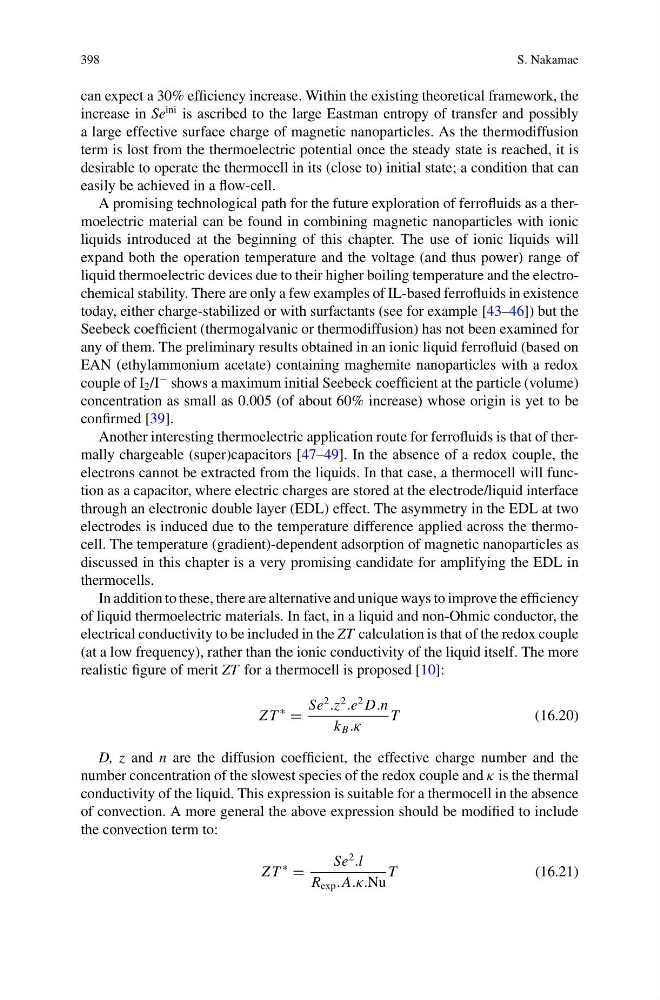
realistic figure of merit ZT for a thermocell is proposed [10]:
Z T
∗
=
Se
2
.z
2
.e
2 D.n
k B .κ
T
(16.20)
D, z and n are the diffusion coefficient, the effective charge number and the
number concentration of the slowest species of the redox couple and κ is the thermal
conductivity of the liquid. This expression is suitable for a thermocell in the absence
of convection. A more general the above expression should be modified to include
the convection term to:
Z T
∗
=
Se
2
.l
R exp .A.κ.Nu
T
(16.21)
S. Nakamae
can expect a 30% efficiency increase. Within the existing theoretical framework, the
increase in Se
ini is ascribed to the large Eastman entropy of transfer and possibly
a large effective surface charge of magnetic nanoparticles. As the thermodiffusion
term is lost from the thermoelectric potential once the steady state is reached, it is
desirable to operate the thermocell in its (close to) initial state; a condition that can
easily be achieved in a flow-cell.
A promising technological path for the future exploration of ferrofluids as a thermoelectric material can be found in combining magnetic nanoparticles with ionic
liquids introduced at the beginning of this chapter. The use of ionic liquids will
expand both the operation temperature and the voltage (and thus power) range of
liquid thermoelectric devices due to their higher boiling temperature and the electrochemical stability. There are only a few examples of IL-based ferrofluids in existence
today, either charge-stabilized or with surfactants (see for example [43–46]) but the
Seebeck coefficient (thermogalvanic or thermodiffusion) has not been examined for
any of them. The preliminary results obtained in an ionic liquid ferrofluid (based on
EAN (ethylammonium acetate) containing maghemite nanoparticles with a redox
couple of I 2 /I
− shows a maximum initial Seebeck coefficient at the particle (volume)
concentration as small as 0.005 (of about 60% increase) whose origin is yet to be
confirmed [39].
Another interesting thermoelectric application route for ferrofluids is that of thermally chargeable (super)capacitors [47–49]. In the absence of a redox couple, the
electrons cannot be extracted from the liquids. In that case, a thermocell will function as a capacitor, where electric charges are stored at the electrode/liquid interface
through an electronic double layer (EDL) effect. The asymmetry in the EDL at two
electrodes is induced due to the temperature difference applied across the thermocell. The temperature (gradient)-dependent adsorption of magnetic nanoparticles as
discussed in this chapter is a very promising candidate for amplifying the EDL in
thermocells.
In addition to these, there are alternative and unique ways to improve the efficiency
of liquid thermoelectric materials. In fact, in a liquid and non-Ohmic conductor, the
electrical conductivity to be included in the ZT calculation is that of the redox couple
(at a low frequency), rather than the ionic conductivity of the liquid itself. The more
realistic figure of merit ZT for a thermocell is proposed [10]:
Z T
∗
=
Se
2
.z
2
.e
2 D.n
k B .κ
T
(16.20)
D, z and n are the diffusion coefficient, the effective charge number and the
number concentration of the slowest species of the redox couple and κ is the thermal
conductivity of the liquid. This expression is suitable for a thermocell in the absence
of convection. A more general the above expression should be modified to include
the convection term to:
Z T
∗
=
Se
2
.l
R exp .A.κ.Nu
T
(16.21)