

382
S. Nakamae
recovery at all levels of human activities, from industrial waste stream, internal
combustion car engines, electronic appliances to body heat. Solid semiconductorbased TE modules entered the commercial application many decades ago and they
still are dominant in the TE market today. Despite their technical advantages including
simple usage with no moving parts and high reliability, however, the TE technology
is still limited to low-power applications due to their poor efficiency. The latter is
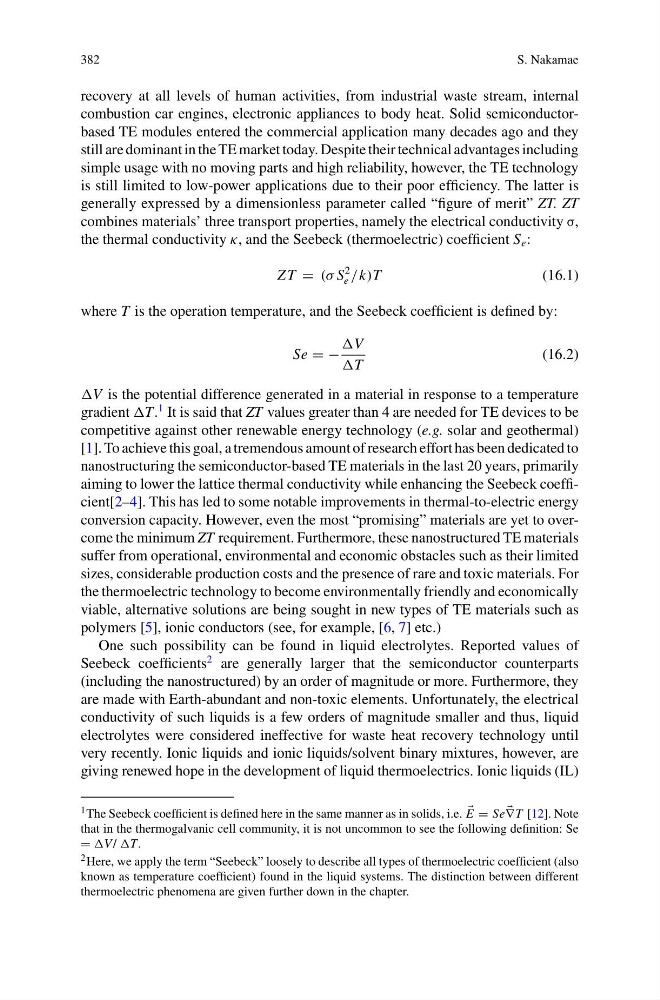
generally expressed by a dimensionless parameter called “figure of merit” ZT. ZT
combines materials’ three transport properties, namely the electrical conductivity σ,
the thermal conductivity κ, and the Seebeck (thermoelectric) coefficient S e :
Z T = (σ S
2
e /k)T
(16.1)
where T is the operation temperature, and the Seebeck coefficient is defined by:
Se = −
V
T
(16.2)
V is the potential difference generated in a material in response to a temperature
gradient T.
1 It is said that ZT values greater than 4 are needed for TE devices to be
competitive against other renewable energy technology (e.g. solar and geothermal)
[1]. To achieve this goal, a tremendous amount of research effort has been dedicated to
nanostructuring the semiconductor-based TE materials in the last 20 years, primarily
aiming to lower the lattice thermal conductivity while enhancing the Seebeck coefficient[2–4]. This has led to some notable improvements in thermal-to-electric energy
conversion capacity. However, even the most “promising” materials are yet to overcome the minimum ZT requirement. Furthermore, these nanostructured TE materials
suffer from operational, environmental and economic obstacles such as their limited
sizes, considerable production costs and the presence of rare and toxic materials. For
the thermoelectric technology to become environmentally friendly and economically
viable, alternative solutions are being sought in new types of TE materials such as
polymers [5], ionic conductors (see, for example, [6, 7] etc.)
One such possibility can be found in liquid electrolytes. Reported values of
Seebeck coefficients
2 are generally larger that the semiconductor counterparts
(including the nanostructured) by an order of magnitude or more. Furthermore, they
are made with Earth-abundant and non-toxic elements. Unfortunately, the electrical
conductivity of such liquids is a few orders of magnitude smaller and thus, liquid
electrolytes were considered ineffective for waste heat recovery technology until
very recently. Ionic liquids and ionic liquids/solvent binary mixtures, however, are
giving renewed hope in the development of liquid thermoelectrics. Ionic liquids (IL)
1 The Seebeck coefficient is defined here in the same manner as in solids, i.e.
E = Se
∇T [12]. Note
that in the thermogalvanic cell community, it is not uncommon to see the following definition: Se
= V / T.
2 Here, we apply the term “Seebeck” loosely to describe all types of thermoelectric coefficient (also
known as temperature coefficient) found in the liquid systems. The distinction between different
thermoelectric phenomena are given further down in the chapter.
S. Nakamae
recovery at all levels of human activities, from industrial waste stream, internal
combustion car engines, electronic appliances to body heat. Solid semiconductorbased TE modules entered the commercial application many decades ago and they
still are dominant in the TE market today. Despite their technical advantages including
simple usage with no moving parts and high reliability, however, the TE technology
is still limited to low-power applications due to their poor efficiency. The latter is
generally expressed by a dimensionless parameter called “figure of merit” ZT. ZT
combines materials’ three transport properties, namely the electrical conductivity σ,
the thermal conductivity κ, and the Seebeck (thermoelectric) coefficient S e :
Z T = (σ S
2
e /k)T
(16.1)
where T is the operation temperature, and the Seebeck coefficient is defined by:
Se = −
V
T
(16.2)
V is the potential difference generated in a material in response to a temperature
gradient T.
1 It is said that ZT values greater than 4 are needed for TE devices to be
competitive against other renewable energy technology (e.g. solar and geothermal)
[1]. To achieve this goal, a tremendous amount of research effort has been dedicated to
nanostructuring the semiconductor-based TE materials in the last 20 years, primarily
aiming to lower the lattice thermal conductivity while enhancing the Seebeck coefficient[2–4]. This has led to some notable improvements in thermal-to-electric energy
conversion capacity. However, even the most “promising” materials are yet to overcome the minimum ZT requirement. Furthermore, these nanostructured TE materials
suffer from operational, environmental and economic obstacles such as their limited
sizes, considerable production costs and the presence of rare and toxic materials. For
the thermoelectric technology to become environmentally friendly and economically
viable, alternative solutions are being sought in new types of TE materials such as
polymers [5], ionic conductors (see, for example, [6, 7] etc.)
One such possibility can be found in liquid electrolytes. Reported values of
Seebeck coefficients
2 are generally larger that the semiconductor counterparts
(including the nanostructured) by an order of magnitude or more. Furthermore, they
are made with Earth-abundant and non-toxic elements. Unfortunately, the electrical
conductivity of such liquids is a few orders of magnitude smaller and thus, liquid
electrolytes were considered ineffective for waste heat recovery technology until
very recently. Ionic liquids and ionic liquids/solvent binary mixtures, however, are
giving renewed hope in the development of liquid thermoelectrics. Ionic liquids (IL)
1 The Seebeck coefficient is defined here in the same manner as in solids, i.e.
E = Se
∇T [12]. Note
that in the thermogalvanic cell community, it is not uncommon to see the following definition: Se
= V / T.
2 Here, we apply the term “Seebeck” loosely to describe all types of thermoelectric coefficient (also
known as temperature coefficient) found in the liquid systems. The distinction between different
thermoelectric phenomena are given further down in the chapter.