

15 Smart Platforms for Biomedical Applications
369
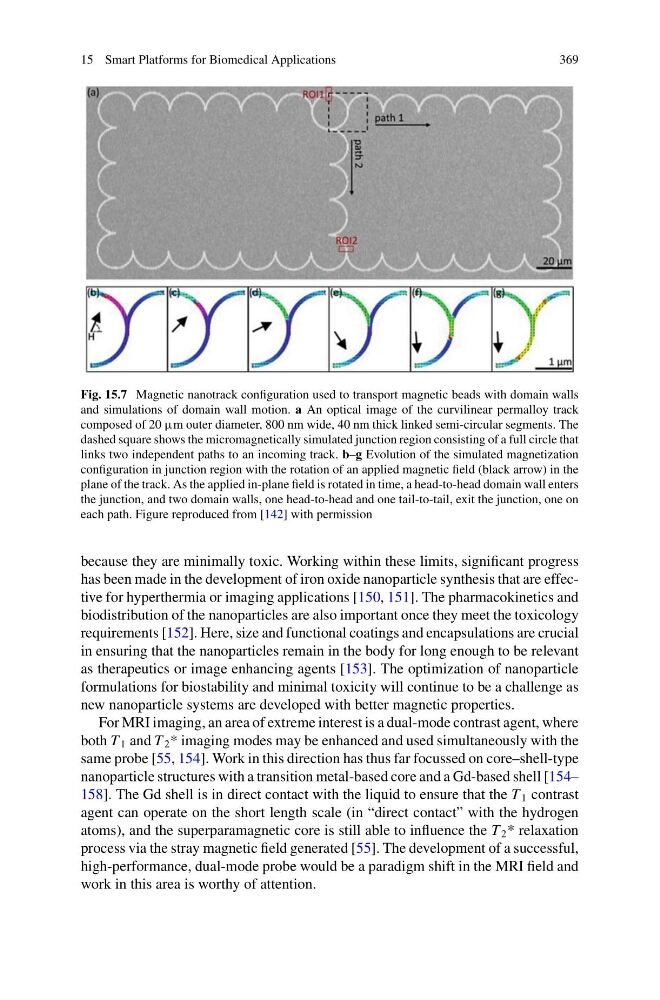
Fig. 15.7 Magnetic nanotrack configuration used to transport magnetic beads with domain walls
and simulations of domain wall motion. a An optical image of the curvilinear permalloy track
composed of 20 μm outer diameter, 800 nm wide, 40 nm thick linked semi-circular segments. The
dashed square shows the micromagnetically simulated junction region consisting of a full circle that
links two independent paths to an incoming track. b–g Evolution of the simulated magnetization
configuration in junction region with the rotation of an applied magnetic field (black arrow) in the
plane of the track. As the applied in-plane field is rotated in time, a head-to-head domain wall enters
the junction, and two domain walls, one head-to-head and one tail-to-tail, exit the junction, one on
each path. Figure reproduced from [142] with permission
because they are minimally toxic. Working within these limits, significant progress
has been made in the development of iron oxide nanoparticle synthesis that are effective for hyperthermia or imaging applications [150, 151]. The pharmacokinetics and
biodistribution of the nanoparticles are also important once they meet the toxicology
requirements [152]. Here, size and functional coatings and encapsulations are crucial
in ensuring that the nanoparticles remain in the body for long enough to be relevant
as therapeutics or image enhancing agents [153]. The optimization of nanoparticle
formulations for biostability and minimal toxicity will continue to be a challenge as
new nanoparticle systems are developed with better magnetic properties.
For MRI imaging, an area of extreme interest is a dual-mode contrast agent, where
both T 1 and T 2 * imaging modes may be enhanced and used simultaneously with the
same probe [55, 154]. Work in this direction has thus far focussed on core–shell-type
nanoparticle structures with a transition metal-based core and a Gd-based shell [154–
158]. The Gd shell is in direct contact with the liquid to ensure that the T 1 contrast
agent can operate on the short length scale (in “direct contact” with the hydrogen
atoms), and the superparamagnetic core is still able to influence the T 2 * relaxation
process via the stray magnetic field generated [55]. The development of a successful,
high-performance, dual-mode probe would be a paradigm shift in the MRI field and
work in this area is worthy of attention.
369
Fig. 15.7 Magnetic nanotrack configuration used to transport magnetic beads with domain walls
and simulations of domain wall motion. a An optical image of the curvilinear permalloy track
composed of 20 μm outer diameter, 800 nm wide, 40 nm thick linked semi-circular segments. The
dashed square shows the micromagnetically simulated junction region consisting of a full circle that
links two independent paths to an incoming track. b–g Evolution of the simulated magnetization
configuration in junction region with the rotation of an applied magnetic field (black arrow) in the
plane of the track. As the applied in-plane field is rotated in time, a head-to-head domain wall enters
the junction, and two domain walls, one head-to-head and one tail-to-tail, exit the junction, one on
each path. Figure reproduced from [142] with permission
because they are minimally toxic. Working within these limits, significant progress
has been made in the development of iron oxide nanoparticle synthesis that are effective for hyperthermia or imaging applications [150, 151]. The pharmacokinetics and
biodistribution of the nanoparticles are also important once they meet the toxicology
requirements [152]. Here, size and functional coatings and encapsulations are crucial
in ensuring that the nanoparticles remain in the body for long enough to be relevant
as therapeutics or image enhancing agents [153]. The optimization of nanoparticle
formulations for biostability and minimal toxicity will continue to be a challenge as
new nanoparticle systems are developed with better magnetic properties.
For MRI imaging, an area of extreme interest is a dual-mode contrast agent, where
both T 1 and T 2 * imaging modes may be enhanced and used simultaneously with the
same probe [55, 154]. Work in this direction has thus far focussed on core–shell-type
nanoparticle structures with a transition metal-based core and a Gd-based shell [154–
158]. The Gd shell is in direct contact with the liquid to ensure that the T 1 contrast
agent can operate on the short length scale (in “direct contact” with the hydrogen
atoms), and the superparamagnetic core is still able to influence the T 2 * relaxation
process via the stray magnetic field generated [55]. The development of a successful,
high-performance, dual-mode probe would be a paradigm shift in the MRI field and
work in this area is worthy of attention.