

366
T. Vemulkar and R. P. Cowburn
Both discs were used to mechanically disrupt glioblastoma cells in vitro, under
an applied rotating field of 1 T at 20 Hz for 60 s. This was carried out by incubating the cells with the microdiscs for 24 h which led to the internalization of the
microdiscs by the cells. They were then exposed to the magnetic field treatment, and
it was found that the perpendicular microdiscs demonstrated approximately 60% cell
killing, whereas the vortex microdiscs displayed just 12% cell killing. To understand
the large difference in cell killing efficiency, the difference in the magnitude of the
magnetic torque and the symmetry of the anisotropy between the two particles was
considered.
The study simulated the torque as a function of field angle using a StonerWohlfarth-like model, and compared this to experimental measurements of the
magnetization angle as a function of field angle. Both the simulation and experimental results estimated the peak torque of approximately 75 pNm for the vortex
microdiscs, and approximately 20 pNm for the perpendicular microdiscs. The difference in peak torque is due to the difference in magnetic moment and anisotropy
fields between the two microdiscs. Thus, the magnitude of the torque did not provide
an explanation for the difference in performance between the two types of particles
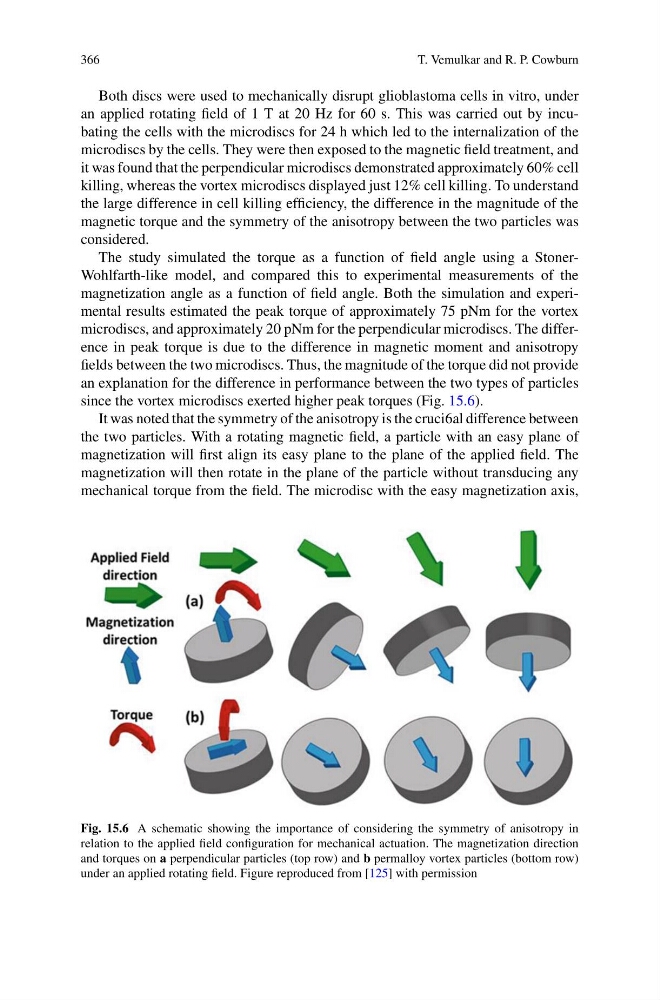
since the vortex microdiscs exerted higher peak torques (Fig. 15.6).
It was noted that the symmetry of the anisotropy is the cruci6al difference between
the two particles. With a rotating magnetic field, a particle with an easy plane of
magnetization will first align its easy plane to the plane of the applied field. The
magnetization will then rotate in the plane of the particle without transducing any
mechanical torque from the field. The microdisc with the easy magnetization axis,
Fig. 15.6 A schematic showing the importance of considering the symmetry of anisotropy in
relation to the applied field configuration for mechanical actuation. The magnetization direction
and torques on a perpendicular particles (top row) and b permalloy vortex particles (bottom row)
under an applied rotating field. Figure reproduced from [125] with permission
T. Vemulkar and R. P. Cowburn
Both discs were used to mechanically disrupt glioblastoma cells in vitro, under
an applied rotating field of 1 T at 20 Hz for 60 s. This was carried out by incubating the cells with the microdiscs for 24 h which led to the internalization of the
microdiscs by the cells. They were then exposed to the magnetic field treatment, and
it was found that the perpendicular microdiscs demonstrated approximately 60% cell
killing, whereas the vortex microdiscs displayed just 12% cell killing. To understand
the large difference in cell killing efficiency, the difference in the magnitude of the
magnetic torque and the symmetry of the anisotropy between the two particles was
considered.
The study simulated the torque as a function of field angle using a StonerWohlfarth-like model, and compared this to experimental measurements of the
magnetization angle as a function of field angle. Both the simulation and experimental results estimated the peak torque of approximately 75 pNm for the vortex
microdiscs, and approximately 20 pNm for the perpendicular microdiscs. The difference in peak torque is due to the difference in magnetic moment and anisotropy
fields between the two microdiscs. Thus, the magnitude of the torque did not provide
an explanation for the difference in performance between the two types of particles
since the vortex microdiscs exerted higher peak torques (Fig. 15.6).
It was noted that the symmetry of the anisotropy is the cruci6al difference between
the two particles. With a rotating magnetic field, a particle with an easy plane of
magnetization will first align its easy plane to the plane of the applied field. The
magnetization will then rotate in the plane of the particle without transducing any
mechanical torque from the field. The microdisc with the easy magnetization axis,
Fig. 15.6 A schematic showing the importance of considering the symmetry of anisotropy in
relation to the applied field configuration for mechanical actuation. The magnetization direction
and torques on a perpendicular particles (top row) and b permalloy vortex particles (bottom row)
under an applied rotating field. Figure reproduced from [125] with permission