

15 Smart Platforms for Biomedical Applications
357
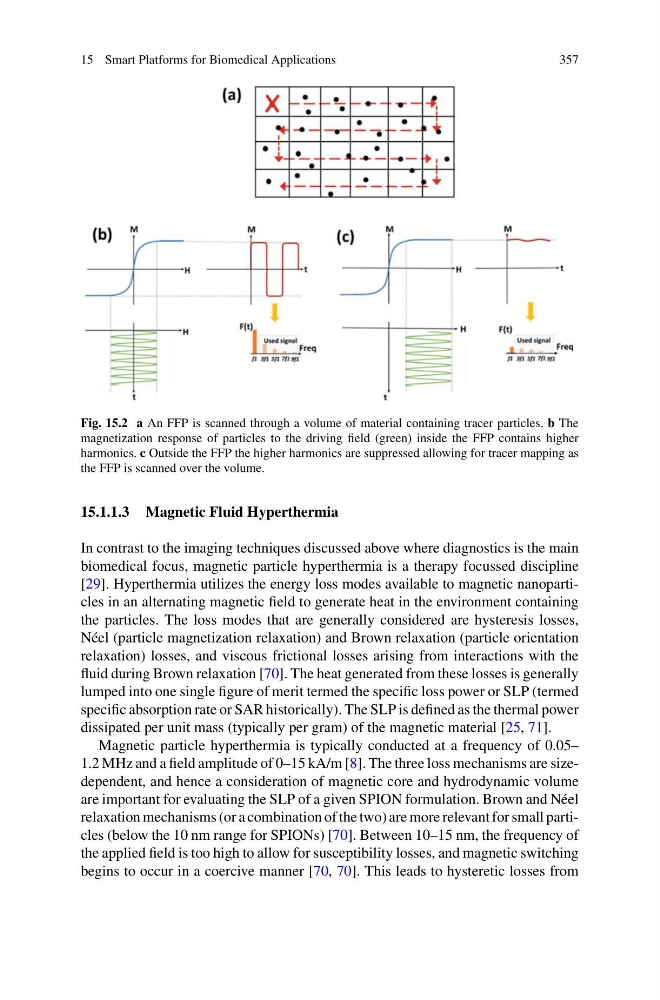
Fig. 15.2 a An FFP is scanned through a volume of material containing tracer particles. b The
magnetization response of particles to the driving field (green) inside the FFP contains higher
harmonics. c Outside the FFP the higher harmonics are suppressed allowing for tracer mapping as
the FFP is scanned over the volume.
15.1.1.3 Magnetic Fluid Hyperthermia
In contrast to the imaging techniques discussed above where diagnostics is the main
biomedical focus, magnetic particle hyperthermia is a therapy focussed discipline
[29]. Hyperthermia utilizes the energy loss modes available to magnetic nanoparticles in an alternating magnetic field to generate heat in the environment containing
the particles. The loss modes that are generally considered are hysteresis losses,
Néel (particle magnetization relaxation) and Brown relaxation (particle orientation
relaxation) losses, and viscous frictional losses arising from interactions with the
fluid during Brown relaxation [70]. The heat generated from these losses is generally
lumped into one single figure of merit termed the specific loss power or SLP (termed
specific absorption rate or SAR historically). The SLP is defined as the thermal power
dissipated per unit mass (typically per gram) of the magnetic material [25, 71].
Magnetic particle hyperthermia is typically conducted at a frequency of 0.05–
1.2 MHz and a field amplitude of 0–15 kA/m [8]. The three loss mechanisms are sizedependent, and hence a consideration of magnetic core and hydrodynamic volume
are important for evaluating the SLP of a given SPION formulation. Brown and Néel
relaxation mechanisms (or a combination of the two) are more relevant for small particles (below the 10 nm range for SPIONs) [70]. Between 10–15 nm, the frequency of
the applied field is too high to allow for susceptibility losses, and magnetic switching
begins to occur in a coercive manner [70, 70]. This leads to hysteretic losses from
357
Fig. 15.2 a An FFP is scanned through a volume of material containing tracer particles. b The
magnetization response of particles to the driving field (green) inside the FFP contains higher
harmonics. c Outside the FFP the higher harmonics are suppressed allowing for tracer mapping as
the FFP is scanned over the volume.
15.1.1.3 Magnetic Fluid Hyperthermia
In contrast to the imaging techniques discussed above where diagnostics is the main
biomedical focus, magnetic particle hyperthermia is a therapy focussed discipline
[29]. Hyperthermia utilizes the energy loss modes available to magnetic nanoparticles in an alternating magnetic field to generate heat in the environment containing
the particles. The loss modes that are generally considered are hysteresis losses,
Néel (particle magnetization relaxation) and Brown relaxation (particle orientation
relaxation) losses, and viscous frictional losses arising from interactions with the
fluid during Brown relaxation [70]. The heat generated from these losses is generally
lumped into one single figure of merit termed the specific loss power or SLP (termed
specific absorption rate or SAR historically). The SLP is defined as the thermal power
dissipated per unit mass (typically per gram) of the magnetic material [25, 71].
Magnetic particle hyperthermia is typically conducted at a frequency of 0.05–
1.2 MHz and a field amplitude of 0–15 kA/m [8]. The three loss mechanisms are sizedependent, and hence a consideration of magnetic core and hydrodynamic volume
are important for evaluating the SLP of a given SPION formulation. Brown and Néel
relaxation mechanisms (or a combination of the two) are more relevant for small particles (below the 10 nm range for SPIONs) [70]. Between 10–15 nm, the frequency of
the applied field is too high to allow for susceptibility losses, and magnetic switching
begins to occur in a coercive manner [70, 70]. This leads to hysteretic losses from