

15 Smart Platforms for Biomedical Applications
355
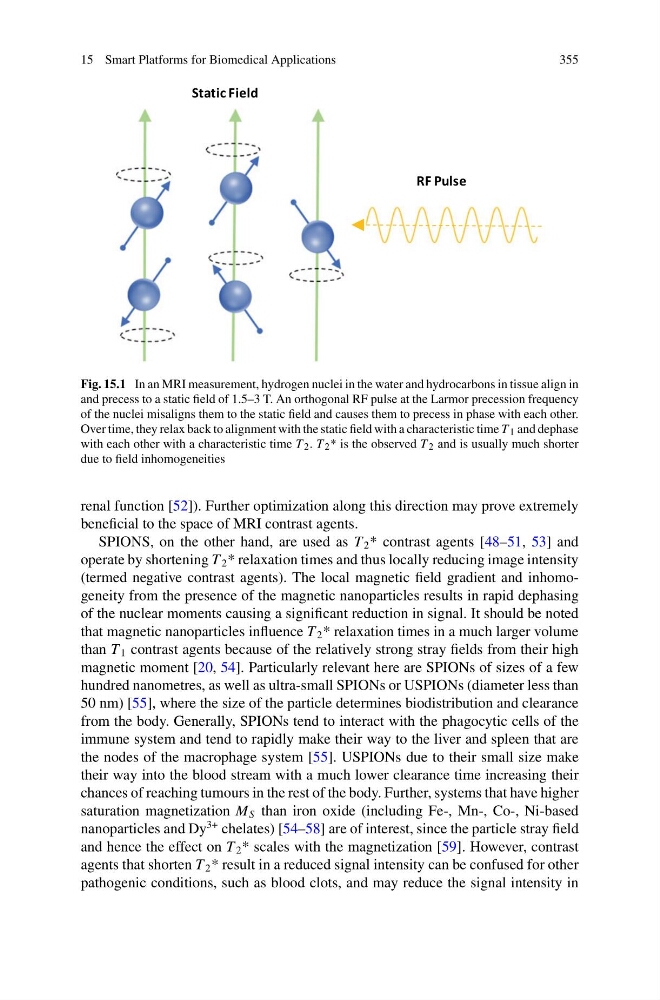
RF Pulse
Static Field
Fig. 15.1 In an MRI measurement, hydrogen nuclei in the water and hydrocarbons in tissue align in
and precess to a static field of 1.5–3 T. An orthogonal RF pulse at the Larmor precession frequency
of the nuclei misaligns them to the static field and causes them to precess in phase with each other.
Over time, they relax back to alignment with the static field with a characteristic time T 1 and dephase
with each other with a characteristic time T 2 . T 2 * is the observed T 2 and is usually much shorter
due to field inhomogeneities
renal function [52]). Further optimization along this direction may prove extremely
beneficial to the space of MRI contrast agents.
SPIONS, on the other hand, are used as T 2 * contrast agents [48–51, 53] and
operate by shortening T 2 * relaxation times and thus locally reducing image intensity
(termed negative contrast agents). The local magnetic field gradient and inhomogeneity from the presence of the magnetic nanoparticles results in rapid dephasing
of the nuclear moments causing a significant reduction in signal. It should be noted
that magnetic nanoparticles influence T 2 * relaxation times in a much larger volume
than T 1 contrast agents because of the relatively strong stray fields from their high
magnetic moment [20, 54]. Particularly relevant here are SPIONs of sizes of a few
hundred nanometres, as well as ultra-small SPIONs or USPIONs (diameter less than
50 nm) [55], where the size of the particle determines biodistribution and clearance
from the body. Generally, SPIONs tend to interact with the phagocytic cells of the
immune system and tend to rapidly make their way to the liver and spleen that are
the nodes of the macrophage system [55]. USPIONs due to their small size make
their way into the blood stream with a much lower clearance time increasing their
chances of reaching tumours in the rest of the body. Further, systems that have higher
saturation magnetization M S than iron oxide (including Fe-, Mn-, Co-, Ni-based
nanoparticles and Dy
3+ chelates) [54–58] are of interest, since the particle stray field
and hence the effect on T 2 * scales with the magnetization [59]. However, contrast
agents that shorten T 2 * result in a reduced signal intensity can be confused for other
pathogenic conditions, such as blood clots, and may reduce the signal intensity in
355
RF Pulse
Static Field
Fig. 15.1 In an MRI measurement, hydrogen nuclei in the water and hydrocarbons in tissue align in
and precess to a static field of 1.5–3 T. An orthogonal RF pulse at the Larmor precession frequency
of the nuclei misaligns them to the static field and causes them to precess in phase with each other.
Over time, they relax back to alignment with the static field with a characteristic time T 1 and dephase
with each other with a characteristic time T 2 . T 2 * is the observed T 2 and is usually much shorter
due to field inhomogeneities
renal function [52]). Further optimization along this direction may prove extremely
beneficial to the space of MRI contrast agents.
SPIONS, on the other hand, are used as T 2 * contrast agents [48–51, 53] and
operate by shortening T 2 * relaxation times and thus locally reducing image intensity
(termed negative contrast agents). The local magnetic field gradient and inhomogeneity from the presence of the magnetic nanoparticles results in rapid dephasing
of the nuclear moments causing a significant reduction in signal. It should be noted
that magnetic nanoparticles influence T 2 * relaxation times in a much larger volume
than T 1 contrast agents because of the relatively strong stray fields from their high
magnetic moment [20, 54]. Particularly relevant here are SPIONs of sizes of a few
hundred nanometres, as well as ultra-small SPIONs or USPIONs (diameter less than
50 nm) [55], where the size of the particle determines biodistribution and clearance
from the body. Generally, SPIONs tend to interact with the phagocytic cells of the
immune system and tend to rapidly make their way to the liver and spleen that are
the nodes of the macrophage system [55]. USPIONs due to their small size make
their way into the blood stream with a much lower clearance time increasing their
chances of reaching tumours in the rest of the body. Further, systems that have higher
saturation magnetization M S than iron oxide (including Fe-, Mn-, Co-, Ni-based
nanoparticles and Dy
3+ chelates) [54–58] are of interest, since the particle stray field
and hence the effect on T 2 * scales with the magnetization [59]. However, contrast
agents that shorten T 2 * result in a reduced signal intensity can be confused for other
pathogenic conditions, such as blood clots, and may reduce the signal intensity in