

13 Magnetic Nanoparticles for Life Sciences Applications
313
the tissue samples was less than that found when applying the nanoparticles by injection, raises the need to optimize the suspension of nanoparticles, testing for example
other biocompatible liquid carriers, functionalized nanoparticles for a higher affinity
with the leave tissues etc.
13.2.3 Nanoparticle Application by the Roots
The study on the nanoparticle absorption and translocation was extended to the case
in which the nanoparticles penetrate through the roots into the plant. In this case no
magnets were used, to study the free movement of the nanoparticles inside the plant. A
comparative analysis was carried out in four living crop plants belonging to different
families, to unveil whether there were differences regarding the transport routes, the
organs and tissues where nanoparticles tend to accumulate. This research was carried
out on sunflower (Helianthus annuus) from the family Compositae; tomato (Lycopersicum sculentum) from the Solanaceae; pea (Pisum sativum), from the Fabaceae;
and wheat (Triticum aestivum), from the Triticeae [55]. In this case, the plants were
grown in vitro using a Petri dish system (rhizotron) allowing the visualization of
the roots [71]. A biocompatible magnetic fluid was prepared suspending the Fe@C
nanoparticles in manitol solution (1%). Once the plants developed the second pair of
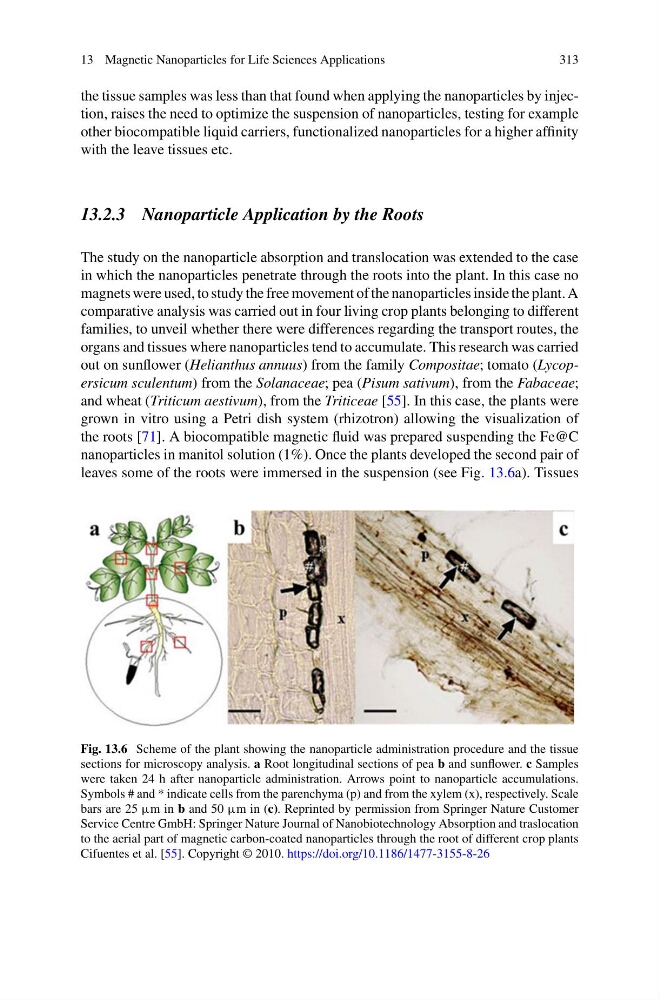
leaves some of the roots were immersed in the suspension (see Fig. 13.6a). Tissues
Fig. 13.6 Scheme of the plant showing the nanoparticle administration procedure and the tissue
sections for microscopy analysis. a Root longitudinal sections of pea b and sunflower. c Samples
were taken 24 h after nanoparticle administration. Arrows point to nanoparticle accumulations.
Symbols # and * indicate cells from the parenchyma (p) and from the xylem (x), respectively. Scale
bars are 25 μm in b and 50 μm in (c). Reprinted by permission from Springer Nature Customer
Service Centre GmbH: Springer Nature Journal of Nanobiotechnology Absorption and traslocation
to the aerial part of magnetic carbon-coated nanoparticles through the root of different crop plants
Cifuentes et al. [55]. Copyright © 2010. https://doi.org/10.1186/1477-3155-8-26
313
the tissue samples was less than that found when applying the nanoparticles by injection, raises the need to optimize the suspension of nanoparticles, testing for example
other biocompatible liquid carriers, functionalized nanoparticles for a higher affinity
with the leave tissues etc.
13.2.3 Nanoparticle Application by the Roots
The study on the nanoparticle absorption and translocation was extended to the case
in which the nanoparticles penetrate through the roots into the plant. In this case no
magnets were used, to study the free movement of the nanoparticles inside the plant. A
comparative analysis was carried out in four living crop plants belonging to different
families, to unveil whether there were differences regarding the transport routes, the
organs and tissues where nanoparticles tend to accumulate. This research was carried
out on sunflower (Helianthus annuus) from the family Compositae; tomato (Lycopersicum sculentum) from the Solanaceae; pea (Pisum sativum), from the Fabaceae;
and wheat (Triticum aestivum), from the Triticeae [55]. In this case, the plants were
grown in vitro using a Petri dish system (rhizotron) allowing the visualization of
the roots [71]. A biocompatible magnetic fluid was prepared suspending the Fe@C
nanoparticles in manitol solution (1%). Once the plants developed the second pair of
leaves some of the roots were immersed in the suspension (see Fig. 13.6a). Tissues
Fig. 13.6 Scheme of the plant showing the nanoparticle administration procedure and the tissue
sections for microscopy analysis. a Root longitudinal sections of pea b and sunflower. c Samples
were taken 24 h after nanoparticle administration. Arrows point to nanoparticle accumulations.
Symbols # and * indicate cells from the parenchyma (p) and from the xylem (x), respectively. Scale
bars are 25 μm in b and 50 μm in (c). Reprinted by permission from Springer Nature Customer
Service Centre GmbH: Springer Nature Journal of Nanobiotechnology Absorption and traslocation
to the aerial part of magnetic carbon-coated nanoparticles through the root of different crop plants
Cifuentes et al. [55]. Copyright © 2010. https://doi.org/10.1186/1477-3155-8-26