

294
D. Passeri et al.
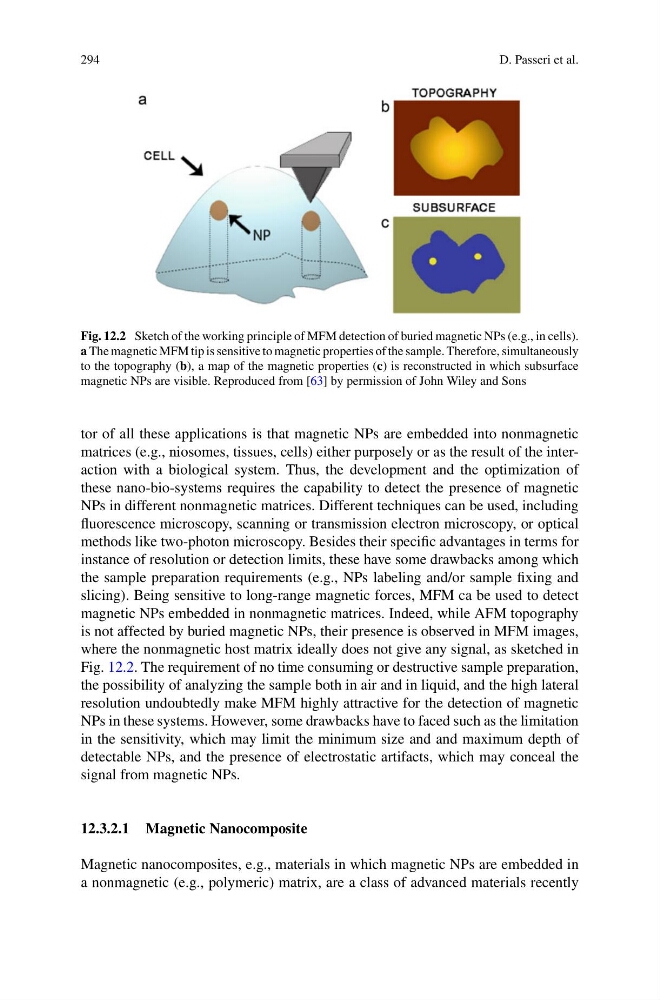
Fig. 12.2 Sketch of the working principle of MFM detection of buried magnetic NPs (e.g., in cells).
a The magnetic MFM tip is sensitive to magnetic properties of the sample. Therefore, simultaneously
to the topography (b), a map of the magnetic properties (c) is reconstructed in which subsurface
magnetic NPs are visible. Reproduced from [63] by permission of John Wiley and Sons
tor of all these applications is that magnetic NPs are embedded into nonmagnetic
matrices (e.g., niosomes, tissues, cells) either purposely or as the result of the interaction with a biological system. Thus, the development and the optimization of
these nano-bio-systems requires the capability to detect the presence of magnetic
NPs in different nonmagnetic matrices. Different techniques can be used, including
fluorescence microscopy, scanning or transmission electron microscopy, or optical
methods like two-photon microscopy. Besides their specific advantages in terms for
instance of resolution or detection limits, these have some drawbacks among which
the sample preparation requirements (e.g., NPs labeling and/or sample fixing and
slicing). Being sensitive to long-range magnetic forces, MFM ca be used to detect
magnetic NPs embedded in nonmagnetic matrices. Indeed, while AFM topography
is not affected by buried magnetic NPs, their presence is observed in MFM images,
where the nonmagnetic host matrix ideally does not give any signal, as sketched in
Fig. 12.2. The requirement of no time consuming or destructive sample preparation,
the possibility of analyzing the sample both in air and in liquid, and the high lateral
resolution undoubtedly make MFM highly attractive for the detection of magnetic
NPs in these systems. However, some drawbacks have to faced such as the limitation
in the sensitivity, which may limit the minimum size and and maximum depth of
detectable NPs, and the presence of electrostatic artifacts, which may conceal the
signal from magnetic NPs.
12.3.2.1 Magnetic Nanocomposite
Magnetic nanocomposites, e.g., materials in which magnetic NPs are embedded in
a nonmagnetic (e.g., polymeric) matrix, are a class of advanced materials recently
D. Passeri et al.
Fig. 12.2 Sketch of the working principle of MFM detection of buried magnetic NPs (e.g., in cells).
a The magnetic MFM tip is sensitive to magnetic properties of the sample. Therefore, simultaneously
to the topography (b), a map of the magnetic properties (c) is reconstructed in which subsurface
magnetic NPs are visible. Reproduced from [63] by permission of John Wiley and Sons
tor of all these applications is that magnetic NPs are embedded into nonmagnetic
matrices (e.g., niosomes, tissues, cells) either purposely or as the result of the interaction with a biological system. Thus, the development and the optimization of
these nano-bio-systems requires the capability to detect the presence of magnetic
NPs in different nonmagnetic matrices. Different techniques can be used, including
fluorescence microscopy, scanning or transmission electron microscopy, or optical
methods like two-photon microscopy. Besides their specific advantages in terms for
instance of resolution or detection limits, these have some drawbacks among which
the sample preparation requirements (e.g., NPs labeling and/or sample fixing and
slicing). Being sensitive to long-range magnetic forces, MFM ca be used to detect
magnetic NPs embedded in nonmagnetic matrices. Indeed, while AFM topography
is not affected by buried magnetic NPs, their presence is observed in MFM images,
where the nonmagnetic host matrix ideally does not give any signal, as sketched in
Fig. 12.2. The requirement of no time consuming or destructive sample preparation,
the possibility of analyzing the sample both in air and in liquid, and the high lateral
resolution undoubtedly make MFM highly attractive for the detection of magnetic
NPs in these systems. However, some drawbacks have to faced such as the limitation
in the sensitivity, which may limit the minimum size and and maximum depth of
detectable NPs, and the presence of electrostatic artifacts, which may conceal the
signal from magnetic NPs.
12.3.2.1 Magnetic Nanocomposite
Magnetic nanocomposites, e.g., materials in which magnetic NPs are embedded in
a nonmagnetic (e.g., polymeric) matrix, are a class of advanced materials recently