

11 Electron Tomography
263
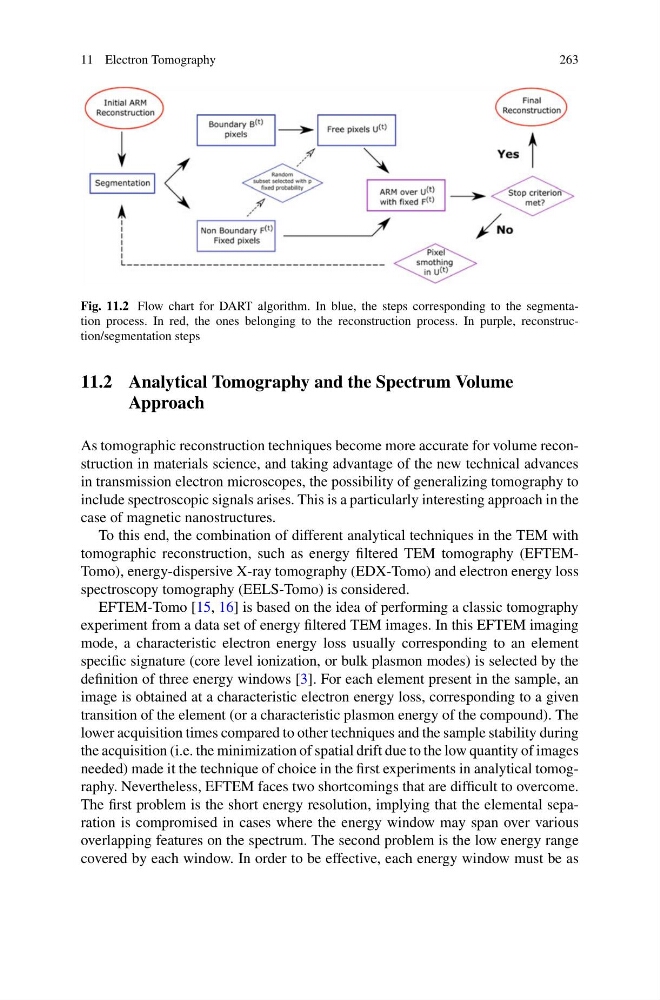
Fig. 11.2 Flow chart for DART algorithm. In blue, the steps corresponding to the segmentation process. In red, the ones belonging to the reconstruction process. In purple, reconstruction/segmentation steps
11.2 Analytical Tomography and the Spectrum Volume
Approach
As tomographic reconstruction techniques become more accurate for volume reconstruction in materials science, and taking advantage of the new technical advances
in transmission electron microscopes, the possibility of generalizing tomography to
include spectroscopic signals arises. This is a particularly interesting approach in the
case of magnetic nanostructures.
To this end, the combination of different analytical techniques in the TEM with
tomographic reconstruction, such as energy filtered TEM tomography (EFTEMTomo), energy-dispersive X-ray tomography (EDX-Tomo) and electron energy loss
spectroscopy tomography (EELS-Tomo) is considered.
EFTEM-Tomo [15, 16] is based on the idea of performing a classic tomography
experiment from a data set of energy filtered TEM images. In this EFTEM imaging
mode, a characteristic electron energy loss usually corresponding to an element
specific signature (core level ionization, or bulk plasmon modes) is selected by the
definition of three energy windows [3]. For each element present in the sample, an
image is obtained at a characteristic electron energy loss, corresponding to a given
transition of the element (or a characteristic plasmon energy of the compound). The
lower acquisition times compared to other techniques and the sample stability during
the acquisition (i.e. the minimization of spatial drift due to the low quantity of images
needed) made it the technique of choice in the first experiments in analytical tomography. Nevertheless, EFTEM faces two shortcomings that are difficult to overcome.
The first problem is the short energy resolution, implying that the elemental separation is compromised in cases where the energy window may span over various
overlapping features on the spectrum. The second problem is the low energy range
covered by each window. In order to be effective, each energy window must be as
263
Fig. 11.2 Flow chart for DART algorithm. In blue, the steps corresponding to the segmentation process. In red, the ones belonging to the reconstruction process. In purple, reconstruction/segmentation steps
11.2 Analytical Tomography and the Spectrum Volume
Approach
As tomographic reconstruction techniques become more accurate for volume reconstruction in materials science, and taking advantage of the new technical advances
in transmission electron microscopes, the possibility of generalizing tomography to
include spectroscopic signals arises. This is a particularly interesting approach in the
case of magnetic nanostructures.
To this end, the combination of different analytical techniques in the TEM with
tomographic reconstruction, such as energy filtered TEM tomography (EFTEMTomo), energy-dispersive X-ray tomography (EDX-Tomo) and electron energy loss
spectroscopy tomography (EELS-Tomo) is considered.
EFTEM-Tomo [15, 16] is based on the idea of performing a classic tomography
experiment from a data set of energy filtered TEM images. In this EFTEM imaging
mode, a characteristic electron energy loss usually corresponding to an element
specific signature (core level ionization, or bulk plasmon modes) is selected by the
definition of three energy windows [3]. For each element present in the sample, an
image is obtained at a characteristic electron energy loss, corresponding to a given
transition of the element (or a characteristic plasmon energy of the compound). The
lower acquisition times compared to other techniques and the sample stability during
the acquisition (i.e. the minimization of spatial drift due to the low quantity of images
needed) made it the technique of choice in the first experiments in analytical tomography. Nevertheless, EFTEM faces two shortcomings that are difficult to overcome.
The first problem is the short energy resolution, implying that the elemental separation is compromised in cases where the energy window may span over various
overlapping features on the spectrum. The second problem is the low energy range
covered by each window. In order to be effective, each energy window must be as